
A Marxist Approach to Dog Day Afternoon (1975)
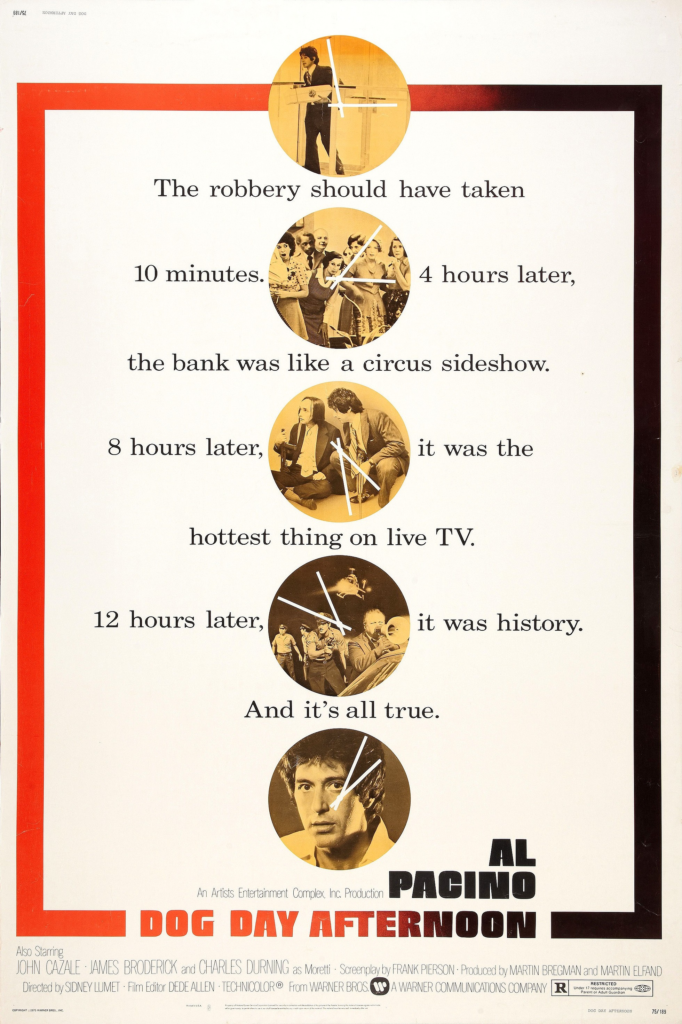
Dog Day Afternoon (1975) – Marxist
The only Sidney Lumet films I had seen before this week were Serpico (1973) and The Wiz (1978), and I only really paid attention to the second one, so you can imagine my shock when I watched Dog Day Afternoon (1975) for the first time. (We have established here before that I am just not a huge fan of 70s cinema except for The Conversation (1974), One Flew Over the Cuckoo’s Nest (1975), Grease (1978) obviously, and of course Mel Brooks’s Young Frankenstein (1974), oh and Jaws (1975) is great and The Godfather Part II (1974) is alright and The Sting (1973) is PERFECT. Okay, so I’m coming around on 70s cinema, I GUESS.)
I didn’t know anything about Dog Day Afternoon before I watched it, so I didn’t know what to expect, especially when the Review Roulette wheel landed on Marxist for the approach. A Marxist lens prompts us to think about how money and power are portrayed in a film, what are the social dimensions of the world presented within the film and what do they say about our world outside of it. You can answer those questions about any film; how are people depicted in relation to a monied or power hierarchy is always something you can think about in any film, especially one about a robbery. But, to have something really interesting to say, it helps if the movie gives you more to work with beyond the obvious, so I’m always a little nervous when we land on Marxist. And just like with Weekend at Bernie’s (1989), I was pleasantly surprised by how artistically the filmmaker chose to represent the imbalances of humanity and resources in late 20th century New York.
So, for those unaware, Dog Day Afternoon is a 2-hour film based on a real 14-hour bank heist gone terribly wrong. The film stars Al Pacino as Sonny, our chaotic, deeply emotional lead, and John Cazale as his partner-in-crime Sal. The two hold up a bank in Brooklyn, but learn that the cash had been picked up from the vault earlier that day by an armed transport leaving the thieves with only $1,100 (around $7,000 today). I don’t want to spoil this film for those who don’t know, so I’ll say there are some unexpected reveals, but on the whole, this film is a paradigm of police standoffs in film.
What I want to focus on will only spoil that in his negotiations with the police and FBI, Sonny secures a limo and plane waiting for him, Sal, and the hostages at JFK. Think about that. Really sit with that.
Sonny and Sal are robbing a bank in Brooklyn that only has $1,100 in it. In response, there are battalions of police officers. They’re coming from the woodwork. Plain clothes officers, officers in uniform, undercover officers, multiple precincts, the FBI, cars, trucks, vans, buses, helicopters, barricades, communications equipment, all descend in moments on this bank in Brooklyn over $1,100. The police take over a barber shop across the street, removing chairs and drilling comms wires into the walls. There’s massive disruption to the neighborhood, hundreds of officers present, and easily hundreds of thousands of dollars worth of overtime and equipment. Over $1,100.
If you watch the opening credits of the film attentively, you can see this coming, but it’s still shocking. The opening credits start with a shot of a ferry, and as the camera pans back we begin to see a cruise ship towering over it in a simple but effective juxtaposition of the wealth and resources in New York City. The credits continue to alternate between images of working class people in blue collar jobs sweating for a day’s pay and wealthy people living lives of luxury and leisure sweating for a day’s lay on the beach. We see images including a dog pawing at trash on the street as men wait for potential work, homeless individuals and businessmen, manicured lawns and garbage overwhelming the streets.
It’s an opening credit sequence that you can easily read as simply situating us in the multitudinous world of New York City. There are people across the socioeconomic spectrum, commuters from Jersey and businessmen arriving by plane, people who have to work in the heat of a dog day afternoon and those who can take the day off to relax. But below that is the idea of resources and city management. There’s water allocated for watering lawns and washing down the street, there’re sanitation workers but not enough to keep up with the overflowing garbage littering the streets, there’re construction workers and toll booth operators, all keeping the city going so the other half can relax.
Sonny, we learn, is a former bank teller. Not as blue collar as a construction worker out in the heat of summer, but a worker who, like those hostages we meet in the Brooklyn bank, didn’t make enough to feed his wife and kids on the pitiful salary allotted for those who conduct transactions for more monied clientele. The bank manager even says, “Look, on my salary, I’m not gonna be a hero,” and agrees to just give Sonny the money almost immediately. And then the entire NYPD and FBI shows up outside to protect the bank’s $1,100.
The imbalance is absurd to witness, by design. The initial cop with whom Sonny is negotiating invites him to come outside, to see how surrounded he is. Sonny is just as appalled at the police presence, and begins chanting “Attica!” at the police in reference to the massacre of 43 inmates and guards at Attica Correctional Facility by the State’s law enforcement response to a prison riot. The scene outside the bank is filled in by locals who begin cheering for Sonny, forming a contingent of civilian supporters against state sanctioned violence.
Lumet doesn’t shy away from critiquing the social dimensions of society in the slightest, but he does choose exceptional visuals and moments to underscore the disparities. At one point, the negotiator orders pizza for the hostages at Sonny’s request. When he goes out to get the food, he asks the delivery man how much, and the negotiator says it’s already paid for. Sonny refuses to accept anything from the State and instead uses the traceable marked bills from the till, that he would not be able to steal, to pay for the food, give the worker a generous tip, and distribute the rest of the marked bills to the growing crowd to yet more cheers. A literal redistribution of seemingly unstealable wealth while paying gig workers is a symbol, one that hit in 2026 as I myself continue to beg for gig work (adjuncting).
It’s a fascinating film, and one that is all too relatable today for many reasons. There’s a significant reveal in the film that adds a deep layer of love, care, and tender, bitter sadness about the imbalance of humanity and resources in a way that reminds me of the Denzel Washington film John Q. (2002), in which a father takes a hospital hostage because he cannot afford the $250,000 heart transplant that would save his son’s life. Unfortunately, Dog Day Afternoon and the real life heist it was based on are both deeply understandable.
Pacino’s performance has his iconic chaotic energy, but he manages to ground it in a profound sadness for Sonny’s circumstances and the circumstances of all gig economy workers and low-wage earners. Early in the hostage situation, Sonny says “I’m a Catholic, I don’t want to hurt anyone,” and he proves it throughout the film, helping the hostages get food and medical care when needed. It doesn’t excuse the crime or the terror he is inflicting on the hostages. It does display the extreme disparity between how we are supposed to think of a bank robbing criminal and who Sonny actually is. It shows the direness of need juxtaposed to the overabundance displayed by the police presence. And it prompts us to think about what “violence,” “terror,” and “hostage” mean and look like in a system that will spend hundreds of thousands of dollars to bring down two desperate, sad men who could really use a redistribution of the wealth overflowing from the repressive state. Dog day indeed.
Leave a Reply