
A Disciplinary Approach to Young Frankenstein (1974)
Young Frankenstein (1974) – Disciplinary
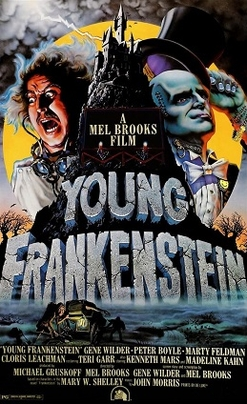
Happy Mel Brooks-a-thon round 3! Leading up to the man’s 100th birthday next month, I’ve been reviewing one of his films a month arbitrarily since March, including The Producers (1967) and Robin Hood: Men in Tights (1993). This week, we’re adding one of my favorites to the mix, Young Frankenstein (1974).
The Review Roulette wheel landed on Disciplinary as our approach this week, and I feel kind of bad doing that one I’ve written so much on Frankenstein in general over the last year, but I think we can pull out some threads with this one. Firstly, as a reminder, Disciplinary is my own invention, my own little stitched together creature of an approach that prompts the reviewer to use their training as an approach. Here, while I am a film historian and analyst, I use my previous training, the one that underpins all of my work, as a Classicist to read films when Disciplinary pops up. So, we’re going to think about Classical Reception frameworks with regard to Mel Brooks’s Young Frankenstein.
What I mean by “Classical Reception frameworks” can also be broadened to be “Cultural Reception frameworks” and is the idea that cultural ideas and icons have had lives prior to the one you are viewing in front of you. Depictions of Zeus carry with them millennia of baggage and stories and interpretations of who that God of Gods is. Spider Man has had so many iterations and lives that prompt in you, the viewer, a set of expectations for who the character is, how he came about, and rough parameters of the storylines and structures he might be invoked in. Of course, new stories can always adjust/manipulate/reinvent/reinterpret/whatever the character, idea, or iconography, but the point is that you, as the viewer, bring to it a set of thoughts and expectations.
Secondly, I want to highlight some of the other places I’ve written about these things. The first and best, in my opinion, is this piece I wrote for Contingent Magazine on the many filmic versions of Frankenstein, culminating with Guillermo del Toro’s masterpiece last fall. Genuinely, it is one of my favorite things I’ve ever written and GdT himself shared it on social media, so if you’re only reading one thing today, I’d happily recommend switching to that one, evocatively titled “To Invent Immortality”. I absolutely went off on that one.
I also wrote a couple of reviews of Frankenstein films last October as I was researching for that Contingent piece. They were part of my Monster Mash series (the first of which, The Hunchback of Notre Dame (1996) is also one of my favorite of my written works about the scariest villains who wrap themselves in flags and bible quotes). I reviewed Frankenstein (1931), which Brooks draws on heavily for his own film, and Gods and Monsters (1998) which is truly a stunning film about the director of that 1931 adaptation, James Whale (Ian McKellen), and a young man he tries to make into a real life monster played by Brendan Fraser.
Both the Contingent piece and my Frankenstein (1931) reviews are also Disciplinary approaches. The 1931 review, though, fair warning, is a bit of a monster in itself as I tried to map out the cave of insanity that is my mind and how I think about culture. But, both use these foundations of thinking about cultural icons as an amalgamation of layers and influences and offshoots that create their own creatures each time. And neither goes into Young Frankenstein in any depth.
So, how do we apply these ideas to Brooks’s film? Let’s start with the fact that Brooks’s film, like Robin Hood: Men in Tights draws on a specific film centrally for its parody, but also brings in other parts of the cultural life/mythology of Frankenstein for additional jokes and touches. In particular, I’m thinking about Gene Hackman’s role as the blind man, a reference to a sequence in the book that is not in Whale’s 1931 classic film.
In many other ways, though, Young Frankenstein follows in the footsteps of Whale’s film, even getting Kenneth Strickfaden, the original film’s electrician and set designer, to bring in the original lab equipment from that ‘31 set. The film is shot in black and white and invokes the Universal Monsters aesthetic in all the [Family Member/Ghost] of Frankenstein films from the 1930s and 40s. Brooks and Gene Wilder, who co-wrote the film, decided on adding a generation: the grandson of Frankenstein who wanted nothing to do with the whole Universal lot but who also ultimately succumbs to the family’s destiny.
So this film isn’t really an adaptation of the book or the 1931 but a kind of reboot of the cultural imagination of Frankenstein in all its many iterations for the sake of parody. It’s both its own stand-alone film in the life and family of Frankensteins, and it’s also a parody adapting elements of the originals in this separate film. It’s both creating new layers for the characters and story and poking fun at the ones that already exist.
We can see this most clearly in one sequence when the creature is on the loose and encounters a little girl. In Whale’s version, the creature accidentally drowns the little girl. In Brooks’s version, the creature is picking flower petals with the girl and throwing them into a well. When the flower is depleted, she asks, “what else can we throw in the well?” and the creature (Peter Boyle) looks at the camera directly with a face like “this joke is too easy”. Choosing not to simply echo that earlier film, the two instead play on a see-saw and the creature launches the girl through her bedroom window just as her parents go to check to make sure she is safe. The film is self-aware enough to consider the tragedy of the girl’s death in the 1931 film as low-hanging fruit for the parody – the joke would simply be that in this film, the creature would purposefully throw the girl in the well as a reference, as opposed to it being an accident in the earlier, but the laugh would be about a child’s death. Brooks and Wilder opt instead for a different accident that has a happy and funny result in which the child is safely in bed, and they make sure we can see that calculus by having Boyle break the 4th wall, silently acknowledging that you, as the viewer, have all that cultural baggage and knowledge of what comes next in the story.
Parodies really don’t work without this Classical Reception approach to culture. They can be funny, like I enjoyed Young Frankenstein as a kid without ever having seen or read another version of Frankenstein. But the real meat of the jokes are in the ludicrousness of some of the elements of the story we all know so well, or the legacy of the family, or the exaggeration of Igor as the assistant, etc. Parodies rely on the audience having a familiarity with the subject matter for most of their structure to make sense. It’s a real feat that Young Frankenstein stands on its own, but that’s not a given for parodies. For instance, I don’t think Robin Hood: Men in Tights is that good as a stand-alone film, but Young Frankenstein is a sweet mystery of life.
This review I think really rounds out my Frankenstein-studying for a bit, but I do hope you’ll check out that Contingent piece as I am supremely proud of it.
Leave a Reply