
A Comparative Approach to The Trojan Women (1971)
[Content warning: mentions of SA and infanticide]
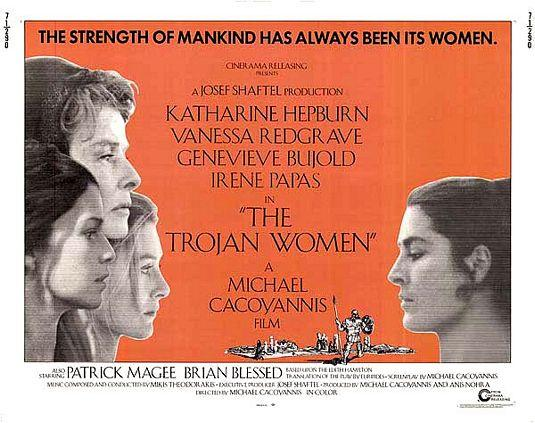
The Trojan Women (1971) – Comparative
It is evidently Hot Classics Summer. The girls are out with intense literary and film criticism, slinging ideas and interpretations like cold ones on the beach, and I am HERE. FOR. IT. So, let’s keep the party going but bring the mood way down with a review of Michael Cacoyannis’s The Trojan Women (1971).
I did spin the Review Roulette wheel this week, and as the fates would have it, it landed on Comparative as our approach. I was already going to do a bit of comparison with The Odyssey (2026), but Emily Wilson inspired me to really think about what it means to adapt a text, so we’ll use these two films as our case studies.
The Trojan Women is originally a play by Euripides from 415 BCE that centers the post-war experience of the women of Troy as they are divvied up among the conquering Greeks. Euripides captured the devastation, humiliation, and horror at the realities for those who survived the initial massacre even after their male heroes, champions, and kings had fallen. While the play focuses on four noblewomen specifically, there is a chorus of average Trojan women, and in the eyes of the Greeks, there is an equalizing factor in that all of the women are merely objects to be passed around, trophies to be won. The four women are Hecuba, Queen of Troy who has been chosen by Odysseus as his slave; her daughter-in-law Andromache, widow of Hector, who will be a concubine of Achilles’s son; Cassandra, Princess of Troy, chosen by King Agamemnon as his concubine; and Helen, wife of Menelaus who will return home with him. These four women and the chorus are the vast majority of voices in the play, and their experiences, pains, and suffering at the hands of the Greeks – and more widely, war in general – are the tragedy. You can see why such a thoughtful text would be adapted into a film in 1971.
Cypriot-Greek director Cacoyannis put together an international group of Western actors to portray these women: American Katharine Hepburn as Hecuba, British Vanessa Redgrave as Andromache, French-Canadian Geneviève Bujold as Cassandra, and Greek Irene Papas as Helen. And they perform the hell out of these roles. Hepburn grounds the film in her always-royal presence, Redgrave delivers a yowl like no one else, Bujold is absolutely cuckoo bananas as Cassandra should be, and Papas is alluring and mysterious and commanding as the most beautiful woman alive. Menelaus is played well by Northern-Irish Patrick Magee and the main male role is Greek messenger Talthybius, played by British Brian Blessed. It’s interesting casting, and each throws their performance as if on stage, projecting to an amphitheatre.
And I think that’s where I want to start. Overall, I think it’s a good adaptation and a bad film. It feels like a filmed performance of the play on location which I am never really a fan of. I love a dialogue-based film, but I want to feel as though I am looking into an established world when I watch a film. I want my screen to be a window into another person’s life and realm. When I watch a play, I want to feel as though I’m sharing an experience with the actors on stage right before my eyes. It’s a human moment to feel as though this real life person I could reach out and touch, this person in my contemporary world, is saying words to affect me and everyone around me. What this film does is find a mid-point between those two by having famous actors attempt the level of melodrama required by the stage, and it just doesn’t work for me.
Adapting a work is tricky because you cannot please everyone. The camps are too large and numerous: people who love the original and want it untouched; people who love the original and would rather a wild reimagining inspired by it; people who love a specific part of the original and only want that part; etc, etc, etc. So discourse on adaptations is the most fun of all because everyone has such varied starting points as their own associations with the idea of the original work clash with those of others, let alone their lived experiences and preferences weighing in on how they view the new interpretation. (Like Wilson calling Pattinson’s Antinous sexy and the best part of the film is a very, very personal preference I was not expecting.)
So, the artist doing the adapting gets to choose the hows and whats of what makes it into the final product and which camps to speak to, hoping to please at least one of them. In adapting The Trojan Women, Cacoyannis went in the direction of emphasizing the human aspect of the story, capitalizing on all of those amazing actors and their abilities to project extreme emotions. And in doing so, he made a decision that Nolan also made: he left the gods out of it (for the most part). Euripides opens the play with Athena and Poseidon discussing ways to punish the Greek armies not for the transgression of the horse, but for condoning the rape of Cassandra by Ajax. Not only is she a princess, Cassandra is a priestess of Apollo, and the rape of a priestess was an affront to the gods. Cacoyannis decided to cut this scene, though, and start directly with Hecuba after a bit of prologue about the Trojan War.
But, and here’s a fascinating bit, Cacoyannis doesn’t abandon the concept of the gods, at least for the Greeks. There’s a very odd use of language in this film in that when the Trojans lament to or even mention their faith, they say “God,” but when talking about the Greeks’, they use “Gods.” I don’t really exactly know what to make of that, the Trojans seemingly being monotheistic. I assume this is a veiled reference to Judeo-Christian monotheism vs. polytheistic cultures, but it’s intriguing regardless.
As I said in my review of The Odyssey, it’s hard to put these concepts to screen, and I appreciate the attempt. Personally, I love a bit of vagueness when it comes to the gods. I don’t want everything perfectly explained because I like when fantasy blends with reality. That’s where you can really get some introspection going to decide how you feel about a work and its wider implications/commentaries about the world around it. I like to think of the gods as constituent parts of a whole human – Aphrodite is our capacity for love, Ares our rage, Athena our wit – all hyperbolized in extremes, and the myths about them are a kind of social moralizing – when you get obsessive or rage-filled, bad things can happen. And I think both of these directors play with that idea a bit.
Nolan plays with the idea of Athena as Odysseus’s conscience helping him work out his own inner turmoil. Cacoyannis has Helen blame Aphrodite for walking with Hector and seducing her to leave Menelaus, a claim Hecuba scoffs at, calling her instead (paraphrased) a dirty horny lying golddigger. He also keeps Cassandra as a priestess of Apollo but shifts the Greeks’ affront from a previous event to a future one: Agamemnon taking her for his bed. By cutting the gods’ opening discussion and moving the transgression to the future, Cacoyannis is skirting the issue of the gods and instead placing much more emphasis on the will of man. Talthybius could stop this from happening; he could stop all of the horrors of the play from happening as our central stand-in for the Greeks’ will. Talthybius himself, stricken with grief and shame, orders Andromache’s child to be ripped from her arms and killed so he may never grow up to avenge his father. He delivers the allotment orders to the women, informing them of their enslavement and the deaths of yet more loved ones. By removing the gods as the players moving their pawns around on the earthly board, Cacoyannis underscores the actions and inactions of man.
And I think that’s a solid adaptation of one interpretation of the gods and the Greeks in the original play. Especially, I think it’s an adaptation that serves an audience of 1971, and more than anything, I think an adaptation needs to reach an audience. An artist picks a previous cultural touchstone to adapt because they themself find a resonance with it, something about the original speaks to them in a way that connects the present with the past. A good adaptation will convey that to the audience and create a universal, full-circle moment between 1971 and 415 BCE that says, “Maybe the things you’re dealing with now aren’t so new. Maybe you aren’t alone in feeling despair and tragedy. Maybe these things have happened before and also gotten better before. Maybe we’re on a cyclical wave of time and experience that we can learn from to better navigate our own times, experiences, emotions, and tragedies.” And I think that’s really beautiful.
I am definitely guilty of complaining that Hollywood needs to stop with the adaptations and sequels and prequels and reboots and remakes, begging for an original story. But a good adaptation is original in the same way Shakespeare is original. A really good adaptation takes a universal emotion and cultural reference and turns it into something that feels contemporary and also timeless, regardless of the execution. And I gotta thank the gods for Hot Classics Summer because I’m living my best classical adaptation life right now. Go have a critical conversation about some cultural piece, think and chat and work those brain abs for Athena, bbs! But not in a gross “she can’t sit with us!” way like some people have been. Literary and filmic criticism are for everyone!
Leave a Reply