
A Disciplinary Approach to The Odyssey (2026)
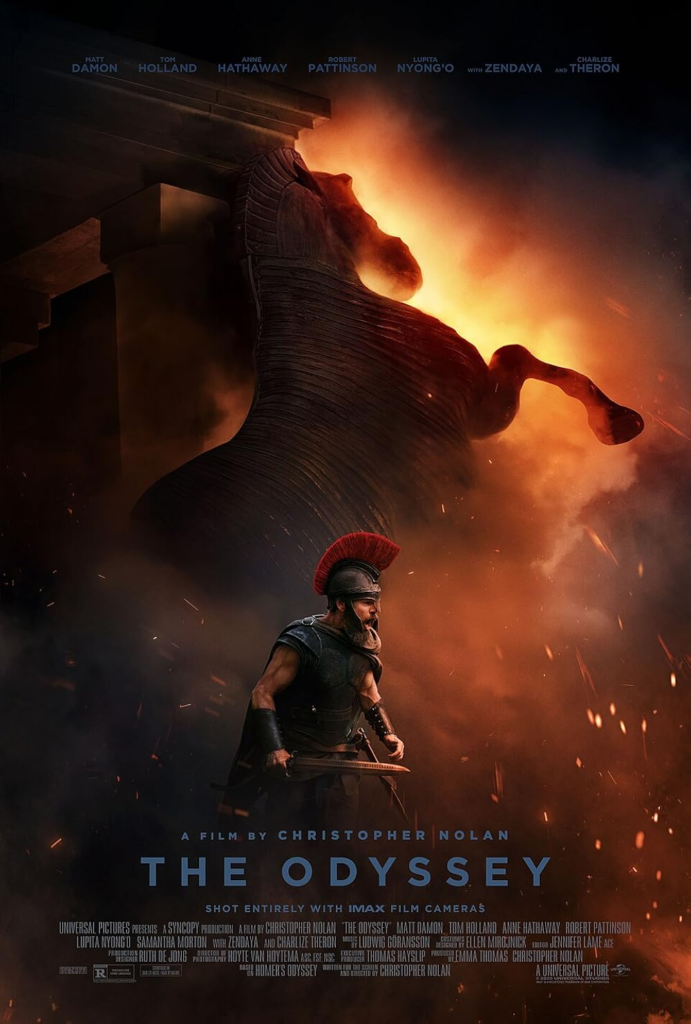
The Odyssey (2026) – Disciplinary
It’s not often that I get to revisit my first love, but when you get that chance after so many years, all the nostalgia, all your growth, all that has happened and become since that first feeling of knowing turned to a last Orphean glance back, everything comes flooding back in an emotional burst of a sad, longing ecstasy. Fuck you for that, Christopher Nolan.
God, it was beautiful. It was an epic. It was researched. It was thoughtful. It was way too god damn loud and the spectacle was absurd and the visual effects were sometimes actually so sickening that I was like “brain, are you okay?” because I could still see the strobing lights through my closed eyes turned away from the screen with my hands over them, and at a certain point hyper-realistic effects actually do become too real and break you out of the filmic immersion. It was what it was supposed to be. And I say again, fuck you for that, Christopher Nolan.
So, this week, I want to talk about The Odyssey and break my own rule about reviewing 21st century films. I am going to spoil some things, and you might say, “it’s a 3000 year old text, how could you possibly spoil anything?” and to that I say, “booooo, booooo, filmmaking choices are spoilable too, boooooo” and also, “nothing, and I mean NOTHING, in this world, especially the comfort of the text, could possibly prepare you for how FUCKED UP the scene of Circe transforming the men into little piggies is. You think you know. You read it or simply existed in the world and consumed it, you know, you know they go to Circe’s island and she turns the men into little piggies. That’s a fact we all know. But I promise you, I beg you to listen: you do not know until you see it. And, honestly, I don’t want that for you, so I am warning you now, you may think you want to watch every minute of the film, but it’s a Siren’s call. You do not want this. Look away from the little piggie production. Look away.”
I’m not spinning the Review Roulette wheel, but I am going with a familiar approach: Disciplinary. As you might know, I was not just one of the four types of child (marine biologist, dinosaur, egyptologist, or Greek mythology), I pursued the Classics for a BA and MPhil, learned Latin and Greek, wrote a kid’s book in Latin, became OBSESSED with paleocryptozoology, kneaded that into a MPhil thesis on the social phenomenon of inventing demonesses to explain one’s reproductive diseases and pains, and shoehorned Classical Reception studies into my MA thesis on the Goddess Venus in a 1940s comic book. As I’ve gotten away from the Classics in subject matter, I’ve maintained my Classics training and still get to use so much of what I fell in love with in the first place in my work. But, it is always so nice to get to dabble again with the details.
I want to do two things with this review. First, I want to explain why I think Nolan succeeded in such an ambitious endeavor even when he didn’t. Second, I want to talk about a film of his that I loathed, Oppenheimer (2023), because I finally realized exactly why I hated it so much when Ben and I discussed The Odyssey on our way home from the cinema.
I do think it is a spoiler to reveal how Nolan read The Odyssey because I think it departs from a mainstream reading and shows that he really understood the text from what I think is a Classicist’s perspective. I think a very common reading of The Odyssey in our pop culture (from Arthur through O, Brother Where Art Thou (2000)) is that Odysseus is a war hero who wants to go home and is prevented from doing so by more powerful beings. Most acknowledge his hubris and a bit of the give and take with the Gods, some like what you do so are favorable while others hate what you do and punish you for it. For someone more casually using it as a story structure or a quick cultural reference, fine, whatever, it’s a massive dilution of the story and its messaging, but you get the story beats.
Nolan went for a deeper understanding of the human in a way I am both shocked and awed by. In this reading, which is one I share, the Trojan War is, as my best friend put it, the last gasp of a dying civilization. The Greeks are a symbol of the future. They sit on this beach waiting and waiting for 10 years until Odysseus comes up with the plan to build the hollow wooden horse in the name of Athena, leave it as a gift for the Trojans, and, under cover of night within the impregnable walls of the city, launch their final attack from the belly of the horse. It’s the ultimate deception because it breaks every law of hospitality, humanity, and decency that held society together. And while the Greeks praise Odysseus as the clever one, the brilliant mind that won the war, he is shattered into as many pieces as they left Troy because he knows that those walls they snuck inside of were the last bastion of honor in a world succumbing to barbarity.
And beyond that, Nolan understood that Odysseus doesn’t want to go home. Homer is never straightforward. The Odyssey is messy. The politics and philosophy are tricky and overlapping and contradictory but in a way that makes complete and utter sense because life is tricky and overlapping and contradictory. It’s a deeply human, real story told through mythology, and therefore the gods are both real and metaphorical for our best and worst natures and everything in between. Athena’s wisdom is a guiding light that helps Odysseus understand his own inner turmoil that’s represented by the choppy waves Poseidon throws his way; but also the Cyclops really is there eating people and he really is Poseidon’s son and Poseidon really is pissed that Odysseus blinds his lil baby boy so those waves aren’t just a metaphor, Poseidon is fucking that man up. Odysseus is haunted by the thousands he led to their deaths on the battlefield, haunted by the choices he made as a commander that led to others dying under false politics or pretenses; but he also literally has to face them in Hades. The gods are in us, we are the gods, but it’s hubris to act as a god or defy them because ultimately you’re defying your best self which is a flawed god in itself.
Putting those things to screen is not an easy task, and even when the depictions were gross as fuck or so strobing I had a headache or simply odd (I, personally, was like, “what the fuck are these silver giants” and apparently they’re the Laestrygonians and, like, okay, that’s a choice), I think he nailed it. He rooted all of these contradictions in the simplest argument to silence all questions; the law of Zeus, the Golden Rule, the only one to live by: treat others as you want to be treated because you never know who might be a god in disguise. And if the gods are in us and we are all gods, then, simply, treat every being with respect and make amends for the times you did not. He nailed it. You have to be a self-loathing sociopathic narcissist with Agamemnon’s ambition and Oedipus’s hubris to attempt to make a film of The Odyssey, and my goodness did Christopher Nolan go for it. He certainly went for it, and he assembled the absolutely right crew to do so, and even when it wasn’t perfect, my god did it fit the narrative to even try.
On that crew, before we get to the other O, Matt Damon was phenomenal. Truly, I would watch just his scenes with Calypso (Charlize Theron) and Penelope (Anne Hathaway) a million times over. In fact, the whole cast was fantastic apart from some acting choices that just didn’t land for me with Robert Pattinson and Hathaway. John Leguizamo? Are we kidding me? My little Henri de Toulouse-Lautrec? You beautiful bastard. And Ludwig Göransson, ugh, good god. I honestly believe this is like what watching a young John Williams’s career unfold was like. The man can do no wrong. When he’s attached, I will most likely see it just to hear what he does.
And on that note, I wasn’t planning to see The Odyssey until my aforementioned best friend (a Classics professor and the smartest person I know) said I should. I thought Oppenheimer was so egregiously wrong for society that I did not want to watch what Christopher Nolan had to say about my beloved Classics. And I am so glad I didn’t listen to that instinct.
The weird thing is that the flaws I saw in Oppenheimer are some of the same contradictions and messiness that I adore in The Odyssey. Both of these works are about a man who is the mind behind the next thing to change society for the worse, and both follow that man as he has to live with the world he created or worsened, monsters, destruction, and all. But in The Odyssey, there is both a displacement from reality with literal monsters and also the breathing room to acknowledge that the world is something we make, we control, and we can influence for the better. Odysseus accepts his flaws at the end and sails out to make things right by the dead, leaving a ruler he trusts to guide his kingdom into a challenging future while striving to make it better. It leaves us with the message that it is our responsibility to be better.
And I just do not believe he hit that note in Oppenheimer. I think he did for a moment. One of the most powerful scenes I’ve ever witnessed in cinema is the test of the atomic bomb in Oppenheimer. Nolan’s use of silence in that scene is a masterclass. If the film had ended after the dropping of the bomb and Cillian Murphy’s horrified face realizing what his ambition had done, I think it would have earned all seven of those Oscars. But it didn’t. He left the last hour after that to explore the political machinations of Robert Downey Jr. and the politics of the Cold War.
I’m currently working on a chapter about narratives and time in the tv show Andor. It’s about how the show uses time as a narrative device and how we as the audience experience time as glimpses through windows on a train rapidly moving toward the events of Rogue One. So, time and sequencing are on my mind a lot right now, and it wasn’t until we were talking about why Nolan can’t seem to find someone who will tell him to cut a scene and Ben said that the RDJ stuff was bloat in an overly long film that it clicked. I think I enjoyed Oppenheimer up to a point and every minute spent after that point diluted the emotional peak of the film, and the further you get from that climax, from the peak horror, the closer RDJ’s actions and Oppenheimer’s actions become.
Having a second bad guy dilutes the first one. Oppenheimer becomes a victim of the Cold War politics he ushered in, and, yea, that’s what happened in real life. That’s the source material. But The Odyssey succeeds in telling the story of a man unleashing a world devoid of decency, processing the PTSD he has as a result, and trying to right it because it’s not real life. Odysseus is not the man who created the atomic bomb, a very real weapon that has been a looming, oppressive threat over all mankind with the power to destroy every living creature, plant, and ecosystem for 80 years since its creation. The Odyssey is mythology. And what Nolan did with Oppenheimer was try to mythologize him, make him a sympathetic, complicated character – not the man; the character, the one portrayed by Cillian Murphy. He made a film about one of the architects of the worst kind of terror, pain, violence, and vengeance in modern history, and he asked us to have a favorable view of him by casting Murphy and spending a full hour at the end suggesting that the wrongs – the very fucked up wrongs that I wrote a book about – of our civic institutions are anywhere near in the same league as the atomic bomb as to warrant being included in this film. A film that is not a documentary of history; a film that was a choice by the filmmaker to deliberately frame in this way. And I find that egregious, irresponsible, and entirely wrong. (I do not want a response about Oppenheimer. I am tired of arguing this with people, and I am not inviting a response about it.)
But The Odyssey? Phenomenal. We saw it in IMAX, and I really do think you should if you’re going to see it. It’s stunning. It’s what a cinematic epic should be. And it did what only art can do in the way only art does it: it invited me to get closer to myself, to better understand my own thoughts and opinions, to process traumas and angers and sadnesses and feel something beautiful for humanity. Oppenheimer left me feeling cynical and angry. The Odyssey rekindled an optimistic fight and intellect in me that I didn’t realize I’d lost to years of living in a world devoid of decency and humanity since our own horrific fate descended a Golden Escalator 10 years ago like the Greeks from the belly of the Trojan horse. And honestly? Fuck you for that, Christopher Nolan, and also thank you.
Leave a Reply