
An Environmental Approach to Robin Hood: Men in Tights (1993)
Robin Hood: Men in Tights (1993) – Environmental
Welcome back to our Mel Brooks-a-thon! For those who didn’t know this was Mel Brooks-a-thon, having watched The Producers (1967) last month, I decided that one review a month through June will be a Mel Brooks film in honor of the legend’s 100th birthday at the end of that month.
So we’re doing more Mel! This week we watched Robin Hood: Men in Tights (1993) and I immediately regretted it because I specifically wanted to do the other new approach I added to our Methodology, environmental (or ecocinema for the sticklers), and woof is this a difficult film for that. But let’s riff and see where it takes us.
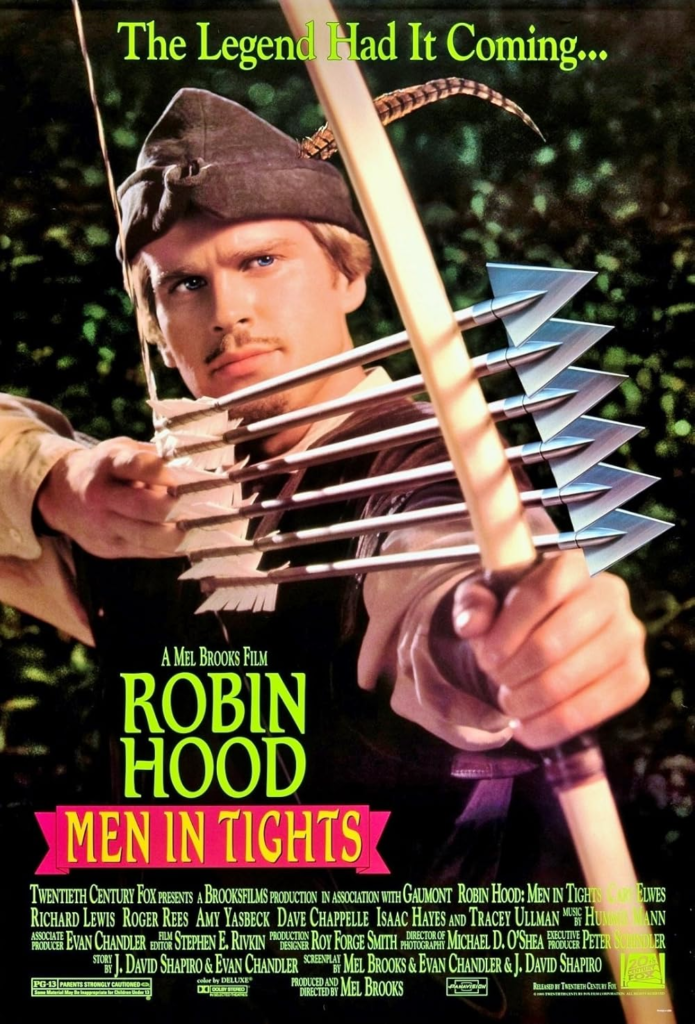
So, Robin Hood: Men in Tights is largely a parody of a specific film. Like Spaceballs to Star Wars, Robin Hood: Men in Tights parodies Robin Hood: Prince of Thieves (1991) starring Kevin Costner (Robin), Alan Rickman (Sheriff of Nottingham), and Morgan Freeman (Azeem, a fellow prisoner from the Crusades). In Brooks’s version, Cary Elwes takes the lead, Roger Rees plays the Sheriff, and Dave Chappelle is Freeman’s equivalent Ahchoo. The story plays out almost like the one we’re all familiar with, the most superior version of Robin Hood, Disney’s, with Maid Marian and an archery competition and even a little fox, and the little fox in Brooks’s film is kind of what I want to talk about.
I think this film makes interesting use of nature in two ways.
Firstly, animals get to be part of the jokes, and that’s fun. The horses have little banners like “just married” or “rent-a-wreck” that emphasize their relationship to humans, i.e. as transportation. These visual jokes highlight the horses’ utility while de-animalizing and objectifying them as merely the predecessor to cars. But in one scene, this otherwise consistent view of horses is challenged when subtitles offer a horse’s thoughts about being ordered to catch Marian’s plus-size lady-in-waiting. The horse’s refusal and exasperated disbelief at the order, returns agency to this horse in particular, suggesting that they are not entirely, simply proto-vehicles but rather are sentient, expressive beings in their own right. And I like that. This suggestion of depth undercuts their objectification and, while I understand that comedy does not have to be completely seamless in its applications of philosophical ecocriticism, I like that you could argue a whole essay on the idea that the film is a criticism of humans decentering animal lives for utilitarian purpose based on this one instance of a horse’s sentience.
Largely though, the film does focus on animals’ utility. At one point, we have Marian excited by a bluebird in her window. She holds out a finger for the bird to land on and for a moment is simply happy to be communing with nature. But then she says that it’s good luck and she must make a wish. The superstition of the wish again changes the bird into a tool for Marian’s desires rather than a neutral companion visiting with her.
The aforementioned little fox, though, is my favorite example of the utility of animals in the film. To alert the villagers that Robin Hood is in trouble, the Merry Men attach a note to a little baby little fox dubbed the “Twelfth Century Fox” and send him off to deliver the message. As he is running, a voiceover of a dolphin squeaking plays. 10/10 comedy. 10/10 ecocriticism. 10/10 social commentary. Love every second of it. I guess they chose dolphin because foxes make horror sounds and the juxtaposition is funny, but I prefer to read the insinuation that the news from 20th Century Fox (fairly recently acquired by Rupert Murdoch’s News Corporation in 1985) was spewing such nonsensical bullshit in 1993 that it might as well have been dolphin calls to the human ear. Imagine what animal they’d use for it today. (Probably just the horror foxes.)
The second use of nature I like in the film is similar in that it’s purely for comedic reasons, but if we take it philosophically, there’re interesting implications beneath the jokes. Several times throughout the film, there are both 4th and 5th wall breaks. 4th wall breaks break the illusion of the camera to the audience, but 5th wall breaks happen when characters interact with the production. I am a huge fan of 5th wall breaks; I find them fascinating, and the way Brooks uses them here breaks our understanding of the environment of the film. In one, a camera smashes through a window it’s zooming in on; classic Mel Brooks joke also seen in High Anxiety (1977). In another, the Sheriff interacts with crew members taking a break, looking through a window in the castle to what appears to be a functioning sound stage. And in the first, during the title credits, the iconic archers with flaming arrows of many Robin Hood movies are not just an establishing aesthetic but are instead apparently actually shooting their flaming arrows into the sky, from which they land on a village, burning roofs and causing mayhem. The villagers acknowledge this, saying “Every time they make a Robin Hood movie, they burn down our village.”
How FUN. The 5th wall breaks fully distort our relationship (as the audience) to the built and natural environments of the film. The visible sound stage seen towards the end of the film suggests that all that came before was a Hollywood illusion. The life-like, natural settings and the authentic-looking buildings may all have been manufactured by a well-paid IATSE local, and I just love that retrospective fuckery.
But really, the credits’ break is truly exceptional. It suggests from the very start of the film that everything is both real and constructed. A film generally asks for a suspension of spatial awareness, particularly in the credits that are typically a unit removed from the reality of the film. So Brooks saying, “actually, the atmospheric archers exist in some plane of existence where others must also exist, and their flaming arrows are not evaporating into the ether. There are no metaphysical actions in a grounded plane of reality, and therefore, what goes up must come down, including flaming arrows over an English village” just makes me happy. Rock on, Mel.
I don’t know, how was that? Was this anything? Did we get to an environmental, ecocritical view of Robin Hood: Men in Tights? I feel like we did. Anyway, you should watch at the very least the clip of the little baby little fox dolphin. He rocks.


Leave a Reply