
A Multi-Focal Approach to Snow White and the Seven Dwarfs (1937)
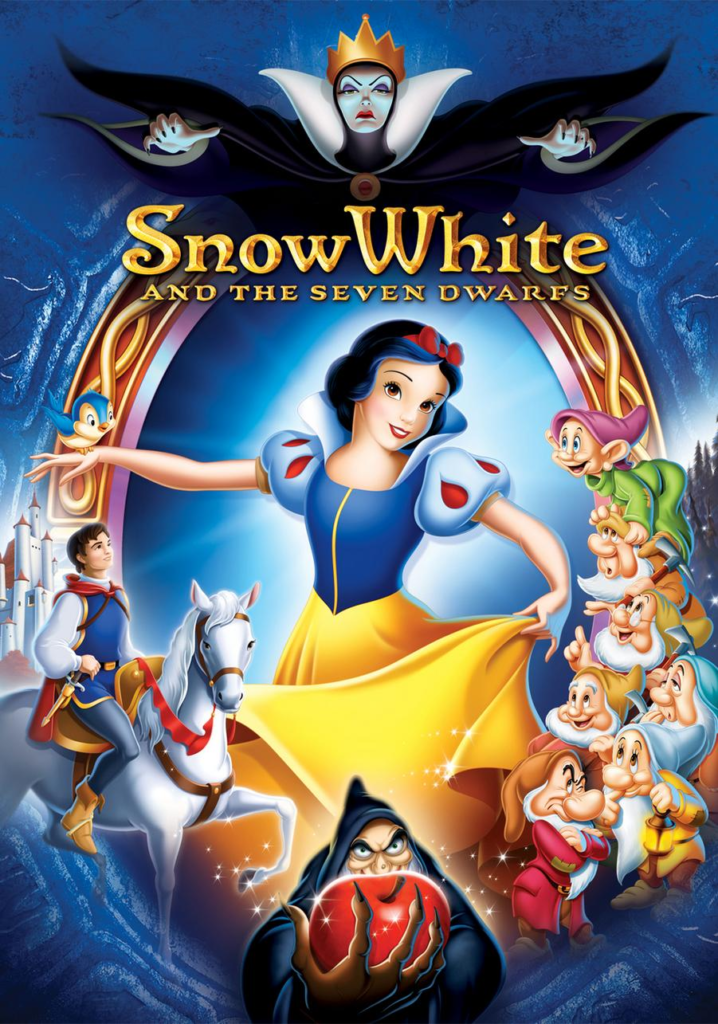
Snow White and the Seven Dwarfs (1937) – A Review Roulette Special
Last week, I showed my Witches students a couple clips from Snow White and the Seven Dwarfs (1937) and The Wizard of Oz (1939) as we get into a unit on 20th century depictions of witches. Just like with another Disney witch classic, Hocus Pocus (1996), one initial takeaway from a student was that the scenes with the Evil Queen in Snow White are much darker than they remembered, and I really have to agree. So, this week I watched Snow White and the Seven Dwarfs and my goodness do I have thoughts.
The Review Roulette wheel landed on Disciplinary for our approach, which I normally use to channel my Classics background, as for my review of Christopher Nolan’s The Odyssey (2026), but today I have to go with my over-active film analyst brain and point out a bunch of things that made me do the Tim Allen “ouughhraah” sound from Home Improvement. Also, I made my Witches students use my Review Roulette glossary for their own film analyses which I am now grading, so all of the approaches are top of mind.
This will not be very organized, but it will be a lot.
- From a cultural reception studies stance, I absolutely love that the film opens on a fairy tale book and flips the pages to set the scene, immediately transporting us to a cozy space for a bedtime story. The story book text tells us of the vain and wicked Queen who is jealous of her stepdaughter, Snow White. The Queen is desperate to be the most beautiful person in all the land, and so she dresses her stepdaughter in rags to make her look like a povvo I guess, believing this will counteract her natural beauty. And every day the Queen checks with her all-knowing enchanted mirror to ensure that she still is the most beautiful, the fairest one of all. And then we get into the story, and *TIM ALLEN SOUND* the first lines spoken of the film are the Queen saying “Slave in the Magic Mirror.” Girl, what? I know she’s evil and wicked and all those things, but I for sure forgot that the spirit in the Magic Mirror was enslaved and not just like a Magic 8 Ball kind of party trick. It makes sense that she’d have an enslaved sentient, body-less soul she has trapped to tell her she’s pretty, Donald Trump has the same thing with his semi-sentient, spine-less wonders gooping up the Cabinet, but in terms of things that surprised me on a re-watch, it was up there and it was immediate.
- From a film historian perspective, it’s hard not to notice how hard the whole Disney animation crew went on this film. There are so many scenes with water splashing and wind howling, and maybe I didn’t do it, but you KNOW a 1937 audience was filled with Tim Allen sounds every thirty seconds. It’s genuinely cool as hell how hard those animators went. They did wind, they did water, they did trees turning into ghouls, they did a hundred little critters running rampant through the forest. They made Snow White’s escape from the Huntsman really feel like a hand-drawn panic attack. What a moment to be in a cinema it must have been.
- From a person point of view, and I guess a historical one, I find it really hilarious that Snow White has no boundaries. She knocks on the door twice in rapid succession, and when there’s no answer, she says, “Guess there’s no one home,” and then just OPENS THE DOOR *ouughhraah*. Hilarious reaction to Goldie Locks a home, just hermit crab your way in there in the Great Depression. We love that.
- From an environmental approach, the little animals? My goodness, did you see those little friends? Watch this. Watch this clip. It’s literally seven seconds, and I need you to watch it. Did you watch it? Did you see the LITTLE BABY RACCOON CLEAN THE WINDOW? *Affectionate Tim Allen sound* These animals are so damn cute. The little bunnies and the little deer and the little squirrels. They’re so damn precious, and they’re, arguably, the most important characters in the story, as they are the ones who save Snow White from the elements by bringing her to the cottage, and they are the ones who do all the hard work cleaning the house, washing the dishes and the laundry, clearing the cobwebs and the soot from the chimney, and generally doing a hell of a lot more labor to improve the home than Snow White who “sweeps the floor,” and they are the ones who get the dwarfs to alert them to the Evil Queen’s poisoning of Snow White. What good little friends doing good little friend jobs.
- From an environmental and symbolism approach, I was really impressed by the two vultures in the film. When we first see the two cultures, they are intrigued by the Evil Queen’s death apple and follow her through the woods to find Snow White, hoping for yum yums. We are led to believe that the vultures, the symbol of death, are there to exemplify the danger Snow White is in, but *M. NIGHT SHYAMALAN TIM ALLEN SOUND* they’re actually there to foreshadow the Queen’s death, which I genuinely forgot happens. The dwarfs, riding deer-back, chase the Evil Queen up a mountain, and as she is trying to leverage a boulder to squish the noble steed deer, the ledge she is standing on is struck by lightning (a Disney death revisited more than 50 years later in Beauty and the Beast (1991)).
- From a Marxist approach, I had a baby Tim Allen sound when the dwarfs are singing their song about workin in mines and whatnot including the line “It ain’t no trick to get rich quick/ if you dig dig dig with a shovel or a pick/ in a mine/ in a mine.” Girls, what does this mean? What concept of “rich” do the dwarfs have? What are we even talking about? Why are they actually collecting gems? At the end of the day, they throw them in a vault loose in bags. What are they doing with all the gemstones they dig out of the walls of the mine? Is it a hobby? Why do they call it work? What economic system exists in this world in which the dwarfs strive for financial success? I don’t understand. WHAT ARE THE GEMS FOR, DOC? Why won’t they tell us?
- From a feminist perspective, you know what I really didn’t remember? The main thing that made me legitimately do the Tim Allen sound? Grumpy isn’t just Grumpy, he’s, like, an incel. Grumpy refers to Snow White, a 14-year-old girl, as “a female,” and I was like *OUUGHHRAAH* and then he repeatedly is like “females are gross and dangerous and bad for us and ain’t no FEmale gonna make ME, a MAN, wash my gross ass hands” and I was like WOOOOOF. That was a crazy addition. I forgot he is like a genuine woman-hater until he wants a kiss on his old ass man head and she gives him one and he blushes and grins. Mate, EW. Also, Dopey is a sex-pest. I’m sorry to open your eyes to this. You may be Tim Allening yourself now, but it’s a fact. He needs help.
Those are some of my thoughts, topically landing on seven. I know I recently reviewed a fun Gary Cooper, Barbara Stanwyck adaptation of Snow White in Ball of Fire (1941) (appropriately called “The Horniest Nerds You Ever Did See” in honor of that nasty freak Dopey), but thank you for indulging me on thinking through the OG. I hope that, in reading this, at least once you clicked the link to hear the sound that lives deep in my psyche as one of the most expressive sounds in the human vocal range (next to this sound that Doody makes in Grease (1978)).
Leave a Reply