
A Comparative Approach to Blazing Saddles (1974)
[Contains Spoilers of Blazing Saddles and Deadwood]
[Contains racial slurs and mention of suicide]
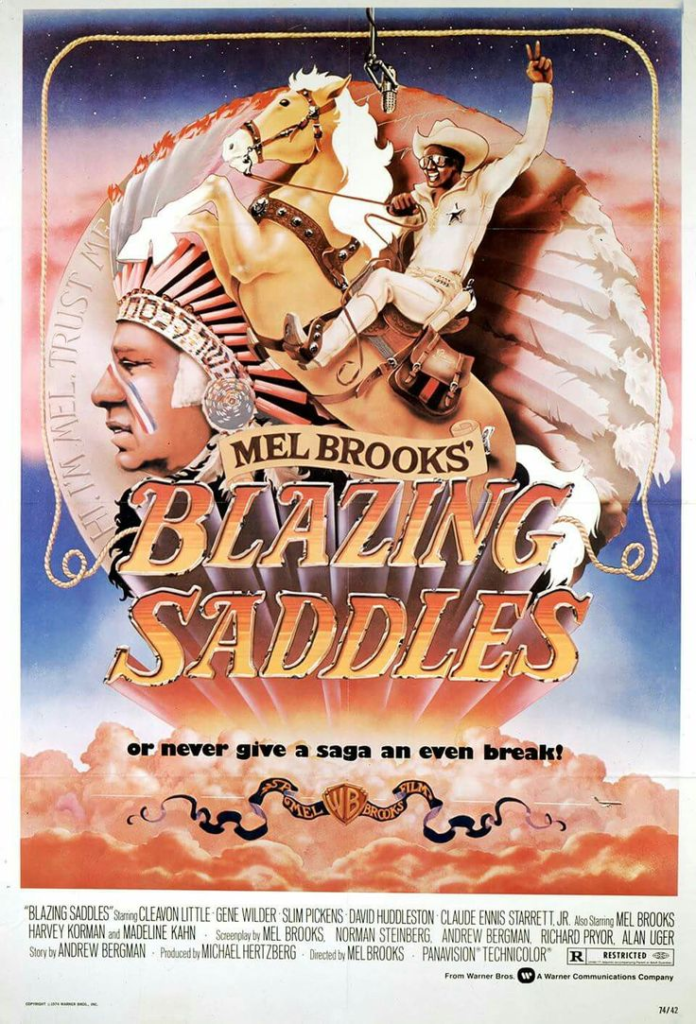
Blazing Saddles (1974) – Comparative
Happy 100th birthday to Mel Brooks, a king among kings in the comedy world, and boy is it good to be king. I saw someone point out on his actual 100th birthday (Sunday, June 28) that Mel Brooks has been alive for 40% of the US’s existence, and that feels more worth celebrating than the 250th this year, so, to mark the occasion, I’ve been reviewing one Brooks film a month since March: The Producers (1967), Robin Hood: Men in Tights (1993), and Young Frankenstein (1974) so far.
This week, I wanted to watch Blazing Saddles (1974), a film I knew and loved but which has taken on a new meaning in recent months as Ben and I watched the television series Deadwood (2004-2006; 2019). So, for this week, I want to forget about the Review Roulette wheel and do a comparative reading of the two.
If you’ve never seen either, I’m going to spoil some things, so decide now if you want to watch one of the most impressive tv shows I’ve ever seen without it being spoiled, go seek out Deadwood, watch three seasons, 12 episodes each, watch the film that concluded the abruptly canceled show 13 years later, and then come read this. Deadwood is a historical fiction about the real settlement of Deadwood in South Dakota and tracks the period from its inception as a lawless collection of ruffians and scoundrels through its development as an American community and eventual acquisition as part of the Dakota Territory. And it’s excellent.
Blazing Saddles is equally as excellent but in very different ways. Blazing Saddles is Mel Brooks’s take on the Western, a genre I have both thought too much and not enough about. The film tells a story of corruption, racism, and incompetency in the West all centered in the main wealthy white Territorial Attorney General, Hedley Lamarr (Harvey Korman), who wants a railroad to run through the center of an established town, Rock Ridge. To drive the townspeople away, Lamarr appoints Bart (Cleavon Little), a Black railroad worker, as Rock Ridge’s new sheriff. Bart, the clever, dashing sheriff, repeatedly outwits racist townspeople and ultimately saves the town from destruction and corruption, winning over the hearts and minds of his constituents and creating a more diverse community in the process.
Both of these cultural works are what I would call “Revisionist Westerns” in that they remark on and challenge established tropes in the Western genre. While Blazing Saddles is specifically a parody and therefore is doing that on purpose for comedic value, I think both works do an exceptional job of challenging the Hollywood version of history and reaffirming a more accurate, that is, a more diverse vision of the American West.
The story in Blazing Saddles culminates in a [Spoiler] Looney Tunes ass trick to construct the facades of the town’s buildings three miles away from the real Rock Ridge. In order to finish this immense task in just one night, Bart enlists the help of his railroad colleagues, who are mostly Black and Chinese men, with the promise of small parcels of land to each. When bringing the railroad workers and townspeople together, one says, “All right. We’ll give some land to the [n-word]s and the Chinks… but we don’t want the Irish. Ah, prairie shit. Everybody. Come on.” In a film riddled with slurs and racism in mockery of the imbeciles using them, it’s very Mel Brooksian to flip the script right there at the end to use them inclusively.
Deadwood is very much about the questions of how to form a society, who gets to be part of the community, and what values define that community. The town of Deadwood is far more diverse than Rock Ridge from the start, with a robust Chinatown and a livery service owned and operated by a Black man. Throughout the series, we see the Deadwood’s de facto leader Al Swearengen (Ian McShane) forming an increasingly real relationship with the de facto leader of Chinatown, Mr. Wu (Keone Young), despite the language and cultural barriers between them. In the film that finishes the series, Samuel Fields (Franklyn Ajaye), a Black Civil War veteran is central to the plot, which relies on the white characters, in particular the town’s white sheriff Seth Bullock (Timothy Olyphant), believing him and trusting his testimony.
Both of these stories rely on multi-culturalism, just like the real American West did. The post-Reconstruction era and turn of the century whitewashed the history of the West and revived the white supremacist ideals of masculinity that trickled into the cultural imagination as vaudevillian cowboys in Wild West shows and, eventually, the shit ass likes of John Wayne.
Blazing Saddles and Deadwood each also comment on the Wild West show vision of the West’s history. Wild West shows often paraded around famous figures such as Buffalo Bill, Sitting Bull, Wild Bill Hickok, and Calamity Jane to name a few, who dramatized their real experiences on the frontier for paying audiences. (Ben covered the contradictions and complexities of Wild West shows in this blog post). Deadwood features the last two of those examples, Wild Bill and Calamity Jane, in the aftermath of their unexpected fame and the juxtaposition of that fame with the horrors at the center of it.
Calamity Jane in Deadwood is a struggling alcoholic, choosing to drink her pain into submission after a lifetime of traumatic instances, military-adjacent service, and spectacle. Wild Bill [Spoiler] is deeply depressed with the reality of his reputation, and after one crazed parasocial fan verbally abuses him for not being a dancing monkey, he dies by, in effect, suicide after bruising the ego of an idiot with a gun and refusing to draw against him.
Similarly, in Blazing Saddles, Bart’s unofficial deputy, Jim (Gene Wilder), is a former gunslinger himself, The Waco Kid. Jim is also a deeply depressed alcoholic, wrestling with the reputation he earned and the gulf between its gruesome reality and the obsessive allure it has for unassuming strangers, some as young as even 6 years old.
These depictions of the American West and its “stars” feel far more human than the cultural stereotype of the unfeeling cowboy in a desert sea of white people constantly under threat of anyone in darker hats or skin.
And I would be remiss if I didn’t bring up one of my other favorite cultural works revising the nostalgic image of the American West in a similar way: Bruce Springsteen’s 2019 album Western Stars. Western Stars is a damn near perfect album that builds a world of the next generation of Wild West show performers. Where Deadwood and Blazing Saddles situate the famous gunslingers as real men grappling with the pressure of the public’s imagination and awe clashing with their heavy lived experiences, Western Stars centers actors who portrayed those same gunslingers in Hollywood grappling with their own imaginations and self-image as they age, particularly in the title song.
Both Blazing Saddles and Deadwood also comment on the constructed reality of “the West” that Springsteen’s stars are contending with. In the latter, the show introduces a travelling troupe of performers, taking a more subtle approach to reminding us of the performativity of many Western tropes, including those used in the show.
In Blazing Saddles, and in that very Mel Brooksian style, the film devolves into an MC Escher-esque production in which the fake Rock Ridge built to fool the imbecilic white supremacist hoard is revealed to be a soundstage at Warner Bros studio. The characters in the film spill out onto the lot and into other sound stages and the studio canteen, disrupting other productions and forming an all out brawl in which some of the Blazing Saddles cast are still in character and some are breaking that 5th wall (as I talked about in the Robin Hood review linked above), acknowledging that they work for Mel Brooks. The meta plot takes us into the Chinese Theatre for a showing of Blazing Saddles, and we finish the film back on that cinema’s screen, but with the characters again ending in a further embedded meta situation. Christopher Nolan could never.
This surrealist ending shatters every wall, but underscores a lot of the revisionist work the film had been doing the whole time. It reminds us that all of this is a constructed vision of our collective past, and it invites us to think about what we choose to remember and how we choose to remember it.
All three of these cultural works, Blazing Saddles, Deadwood, and Western Stars, are leagues more interesting and fascinating to me than anything John Wayne and Co ever did. All three also remind me of the just brilliant film High Noon (1952) (I also invoked Bruce for the title of that review “Imminent and Inevitable Darkness on the Edge of Town” and in a stage production of High Noon from this year on the West End in London, the director chose to set the story to modern music centering around Bruce’s work. It’s all coming together.)
As someone who has never been a big fan of Westerns in the most stereotypical sense, I think these three are some of my favorite cultural works out there because of how rich and thoughtful the social and cultural critiques are in nearly perfect works of art. Just exceptionally well-conceived engagements with nostalgia, public memory, parasocial relationships with stars, and questions of history, community, and belonging. 10/10 across the board.
Honorable Mentions
I don’t know how to shoe horn these in, but other things I love deeply in these works:
- Mel Brooks’s insistence on portraying Native Americans as speaking Yiddish and showing solidarity with Bart’s family.
- Brad Dourif’s character Doc Cochran in Deadwood is very likely the most affecting television performance I have ever seen. I’ve thought a lot about it for months, and it’s just breathtaking. Almost all of the performances in Deadwood are superb, Al in particular is beyond excellent, but Doc, woof. Stunning. (Brad Dourif on the other end of his career from his debut in One Flew Over the Cuckoo’s Nest (1975).)
- “Hitch Hikin’,” the first song on Western Stars, is a straight up love letter to Americans along a western highway a la Route 66. Beautiful song.
- All of the Looney Tunes shenanigans in Blazing Saddles, and, of course, Mondo’s existential realization of power in a hierarchical society.
- Brian Cox is in Deadwood, and I just like that. That’s nice.
- For the film version of the album, Bruce Springsteen invited like 30 people to listen to him perform the album in its entirety in his barn with a live orchestra, and I like to imagine that in another universe, I was there.

Leave a Reply