
A Symbolism Approach to The Maltese Falcon (1941)
[Contains spoilers]
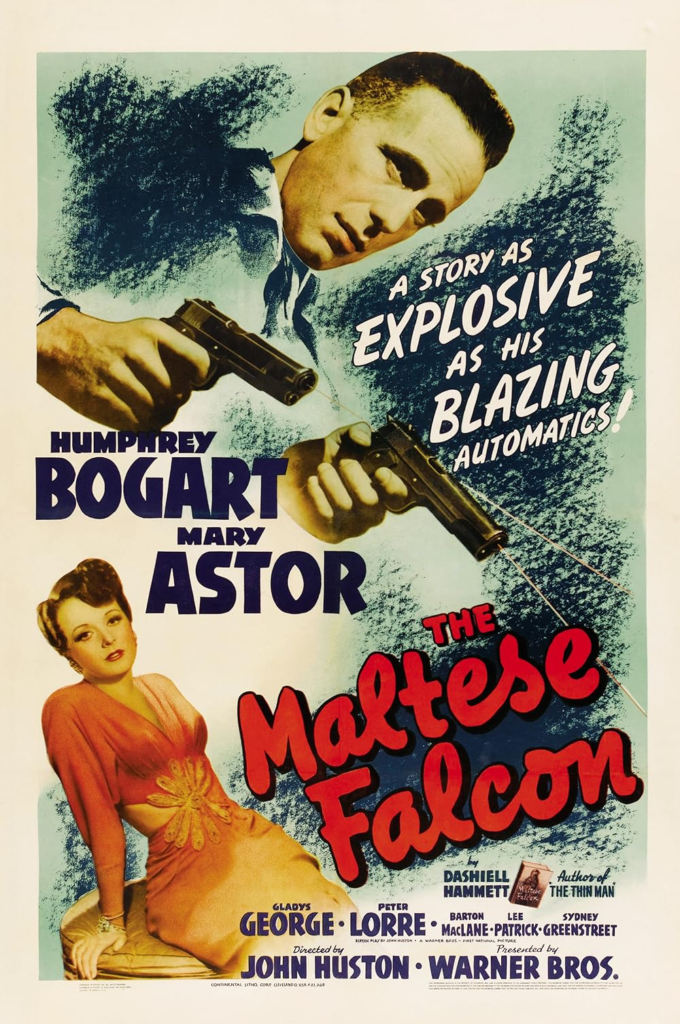
The Maltese Falcon (1941) – Symbolism
Happy 101st review, lovelies! I’ve loved this project since I first thought of it, and I am so happy with both how it has evolved and how I have because of it, so thank you for joining me on my cinematic journey through time. Cheers to the next 100!
This week, I was feeling a noir, and to introduce one of our new methods, Symbolism, I couldn’t think of a more iconic one than John Huston’s The Maltese Falcon (1941). Unfortunately, in order to talk about the symbolism, I do have to spoil two things about the film, so avert your eyes, go watch the film, and come back if you don’t want to be spoiled.
For those who haven’t seen it and don’t mind, I’ll say something perhaps sacrilege to those who have: think National Treasure but subtract 21st century Hollywood’s aversion to disappointing an audience with an unhappy ending (e.g. no treasure and Diane Kruger killed Justin Bartha). Many people prefer the novel The Maltese Falcon by Dashiell Hammett, but in the novel you don’t get to watch Humphrey Bogart do his thing, so it’s all tomatoes, innit?
So, we are told in an introductory pre-Star Wars scroll that in 1539, the “Knight Templars” of Malta gifted the king of Spain a golden falcon that was encrusted with jewels “from beak to claw,” but before the bird could reach Spain, the ship was seized by pirates and the fate of the Maltese Falcon remains a mystery. Enigmatic ellipses. Atmosphere set. Done. Noirs are so moody, I love it.
We open on San Francisco where detective Sam Spade (Bogart) is hired by a woman we eventually learn is named Brigid O’Shaughnessy (Mary Astor) after multiple aliases. Brigid initially hires Sam and his partner Miles Archer (Jerome Cowan) to tail a man Brigid says stole her sister away from New York. Miles ends up dead, the man they were tailing ends up dead, and two new characters, Joel Cairo (Peter Lorre) and Mr. Gutman (Sydney Greenstreet), enter the scene. After many twists and turns and double crosses and triple crosses and double triple crosses, we return to the legend of the Maltese Falcon. Sam comes into possession of the bird, and after money changes hands and a fall guy is chosen, we finally come face to face with the Falcon, only to learn that it’s a forgery. In the fall out, our charismatic detective lays out what he has known all along: Brigid killed Miles and Sam is sending her to jail for it.
The film is rife with symbolism, like any good noir, especially one based on a novel. Take our femme fatale for instance. Brigid first appears in Sam’s office as Ruth Wonderly, wearing a fur coat, draped off one shoulder. Instantly, we know to question her motives and capabilities. Fur symbolizes wealth on the surface, but can also suggest a willingness to buy and sell life or even deal out death. (There’s a case study on mink in my book!) Immediately, her story doesn’t sound real and is wonderful and fantastic as her alias’s name suggests. When we next see Brigid and learn that name for her, we are in her apartment in the mid-afternoon. How do we know it’s mid-afternoon? Because her horizontal blinds are casting down a shadow almost in almighty judgement, bathing both her and her home in the slanted, foreshadowing bars of a jail cell. If we are familiar with noir symbolism, we know from the jump that Brigid is guilty of something, it’s just a matter of figuring out what and why.
The falcon itself is the most prominent and obvious symbol in the story, almost too straightforward to talk about. The idea of the treasure that’s not a treasure driving people to commit heinous acts and dedicate their lives to the pursuit of glory and riches beyond their wildest dreams is a tale as old as time. Sam even says, when asked what the bird statuette is made of, “the stuff that dreams are made of” to really make sure we didn’t miss that the falcon is a symbol of fantastic desires made manifest in the shorthand of legendary treasures. But maybe the real treasure was the murders they committed along the way.
The statuette being a falcon specifically and not some other type of animal could be considered more interestingly as a symbol of man’s potential for a relentless pursuit of material excess that could conceivably grant him freedom from financial constraints. The imagery of a bird that could take flight at any moment suggests both that freedom and also a fleeting ephemerality of the glory and wealth it could bring. It being a bird of prey could symbolize the violence that has taken place over the centuries in pursuit of it, and the black enamel that was supposed to be hiding gold and jewels galore could represent the shroud of reality over the dreams of man. Depending how far and in what direction we want to take the symbolism, there’s a whole class dynamic we could imagine out of the bird between the grounded detective who sees everything and the wealthy treasure hunters flitting around the world burning cash to find more cash who see nothing, as if hooded like a falcon.
I was weary about adding symbolism because every approach we have in the methodology is only enhanced by analyzing the symbolism inherent to each lens, but it’s fun to just think about the possibilities and potentials for each symbol. “If we read something in x way, what could it be?” is a fun way to just think about movies and let the imagination out for exercise, so I think I’m happy with the addition to Review Roulette. And it’s always super fun to do a noir and to watch Humphrey bogart the screen.
Because I’m Never Done When I Say I Am
Actor’s Oeuvre
There is no other actor whom I find more captivating than Humphrey Bogart. I don’t know what the quality is that I personally find so engrossing, but good god is he the most entrancing actor ever put to screen (for me). There’s something deeply affecting about his performances, especially Casablanca (1942), that just grabs the audience. I know, it’s a groundbreaking opinion I have here, but for real, it’s mesmerizing. I will never not lament his untimely death as a truly devastating loss for what art he could have made in a longer life.
Leave a Reply