
A Rant Inspired by Dr. Strangelove or: How I Learned to Stop Worrying and Love the Bomb (1964)
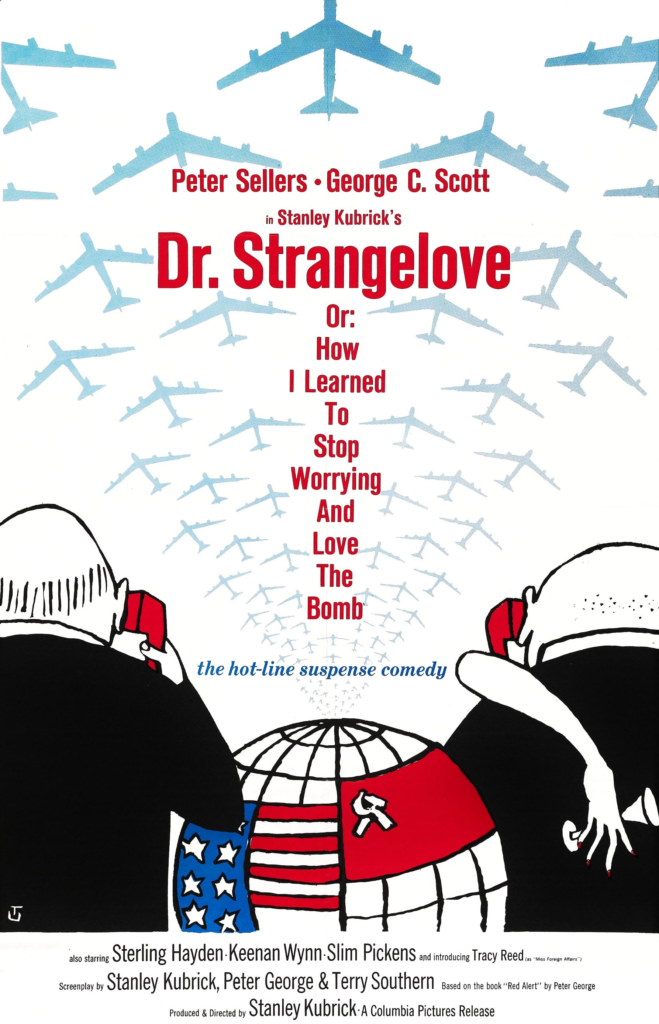
Dr. Strangelove or: How I Learned to Stop Worrying and Love the Bomb (1964) – A Rant
Bruh.
BRUH.
God, he’s such an apocalyptic fuck.
This review is my 100th on Review Roulette and I was going to do my favorite film of all time to mark the occasion – Garry Marshall’s Pretty Woman (1990) – but no, the President of the United States has to openly threaten genocide on his social media app in the only way he knows how as a failed reality show host: teasing a prime time reveal of whether or not we committed war crimes and crimes against humanity to cover for his and Hegseth’s glaring idiocy and feed their insatiable bloodlust. Art of the deal indeed.
So, instead, I watched Stanley Kubrick’s Dr. Strangelove or: How I Learned to Stop Worrying and Love the Bomb (1964) this morning while baking my first ever sourdough boule because life is both complicated and relentless.
I didn’t spin the wheel because I have things I want to say. Namely, I have spent years, literal years, thinking about how people felt in the 1950s re: nuclear threats. We call it the “Nuclear Age” and refer to the “Nuclear Family” and think of the white picket fences of the nostalgia-laden suburbs where a Stepford wife bakes her own bread, smiling while her husband drives his new Ford to work as a middle manager in an American industry, but these terms and ideas have become so casual that we forget how fucking terrifying that decade was for people living through it.
The wives were on amphetamines and barbiturates, the husbands were afraid their co-workers were Commies, the “nuclear” part of the “nuclear family” was the idea that the family was the only thing they felt they could control in an out-of-control world, and the kids were doing nuclear bomb “Duck and Cover” drills in school as if a wooden desk and an animated turtle could keep them safe from the worst weapon our sorry species ever created.
(I linked to Chapter 3 of my book for that middle one about the nuclear family because that chapter is about the social conservative turn of the 1950s and the manifestation of these exact fears in Hollywood media.)
When I say I’ve thought about it a lot, I mean both for work and personally. Trying to get into the frame of mind of terror in the early Cold War was important to me to understand the pressure on filmmakers in the post-war period. I also was in 4th grade in 2004 when the assault weapons ban lapsed, and shortly after that, we had regular school shooter drills, intruder drills, and bomb threat drills at my public schools. When I learned about “Duck and Cover” drills in high school, I was, as you could understand, fucking livid that we would subject more children to that type of terror. Obviously the politics behind the reasons for D&C and school shooter drills are very, very different: one was a sad reality of global affairs that we started, the other was simply our politicians’ choice.
And speaking of the American political choice to be terrorists, that brings me back to our dear leader who has never once experienced a consequence in his whole entire life. I really don’t know what to say that would grasp the enormity of the threat he is making or pay the proper respect and regret to the Iranian people, citizens of the world, and Americans who have been protesting this abhorrent embodiment of the worst of us for a decade.
What I do know how to do is turn to media for historical record and sentiment. Kubrick’s Dr. Strangelove does so much to ridicule monstrous leaders, not unlike Mel Brooks’s The Producers (1968) in which neo-Nazis are mocked relentlessly. Strangelove himself is a literal Nazi whose Nazi tendencies emerge as he giddily concocts a male utopian fantasy in which several thousand people descend into mines to wait out the effects of the Russian Doomsday Device the Americans are in the act of triggering. In the mine, sexy women would outnumber men 10:1, but also somehow be enslaved to repopulate the earth because men really think they’re that fucking powerful. The sexual fantasy tied to the eugenics of it all gives Dr. Strangelove the same exact Heil-boner affliction Elon Musk had at Trump’s inauguration rally last January, just incapable of keeping his fascistic excitement down.
Of course, the Americans and Strangelove are just trying to make the best of the situation, trying to stop worrying and love the bomb which has been ordered to be dropped by a deranged RFK Jr. type who thinks the Communists are using fluoride in water for nefarious means or some shit.
What I’m trying to get at is that satire is dead in 2026, but we have to keep trying to challenge these deranged fucks: impeachment, ridicule, comparison to the Nazis of reality and media, etc. We have to use what we got, and what I got is media literacy skills.
In 1964, Kubrick put on screen these words:
“[Clemenceau] said war was too important to be left to the Generals. When he said that, fifty years ago, he might have been right. But today, war is too important to be left to politicians. They have neither the time, the training, nor the inclination for strategic thought.” – the deranged, paranoid lunatic giving the orders, Brigadier General Jack D. Ripper, in front of a poster that says “peace is our profession”
“There’s nothing to figure out, General Turgidson. This man is obviously a psychotic.” “Well, I’d like to hold off judgement on a thing like that, sir, until all the facts are in.” – The President of the United States to General Turgidson and vice versa while being briefed in the War Room
“And I got a fair idea of the kind of personal emotions that some of you fella’s may be thinking. Heck, I reckon you wouldn’t even be human beings if you didn’t have some pretty strong personal feelings about nuclear combat.” – Major Kong, the earnest pilot unaware of the reality of his orders
We see an obviously unwell man circumventing the law to issue a catastrophic order, an enabler who reserves judgment of the obvious, and a Major who believes he is doing his patriotic duty at the peril of his and his men’s own consciences. If Dr. Strangelove isn’t the film to be thinking about today, I don’t know what is, apart from, of course, the evergreen choice, The Manchurian Candidate (1962).
Our media, especially our comedy, has the power to force us to confront truths our brains don’t want to approach alone, and Strangelove‘s truth, 62 years later, is that the President of the United States, Donald J. Trump, is a terrorist, a psychotic terrorist.


Leave a Reply to Joh Sances Cancel reply