
A Feminist Approach to Dirty Rotten Scoundrels (1988)
[Contains Spoilers]
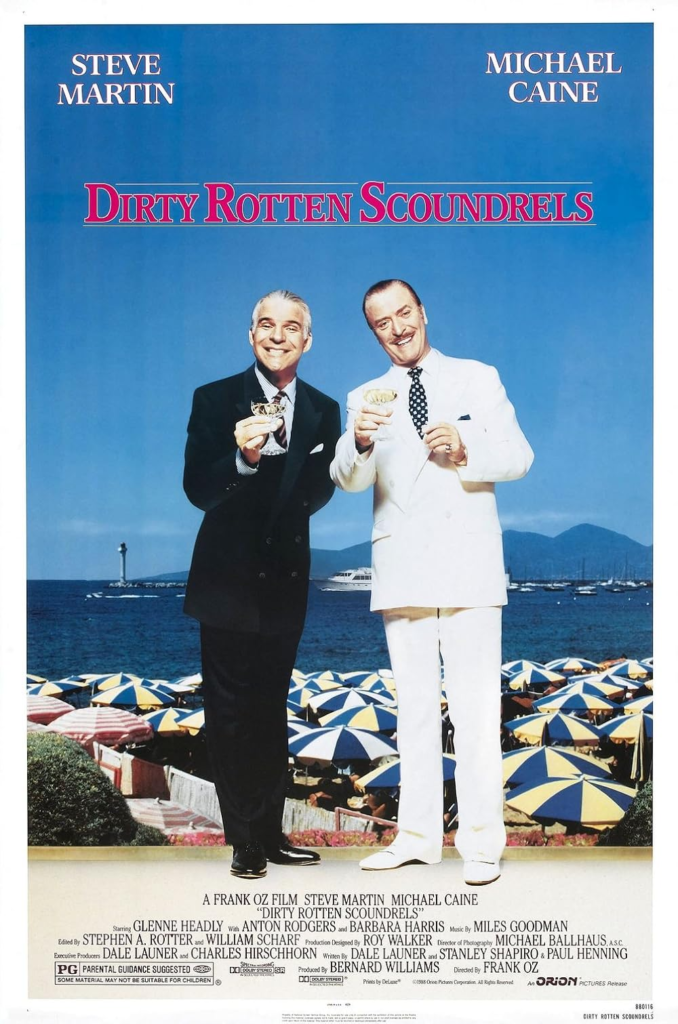
Dirty Rotten Scoundrels (1988) – Feminist
Yesterday was my second day in my Monday/Wednesday classes and one student said, “You’re my favorite professor so far.” Hell yeah I am, fuck yeah. Let’s go. Party class at 8AM where we learn some valuable critical thinking skills and look at pictures of Biscuits, hell yeah.
So I’m riding that high right now. The “so far” qualifier did feel a little like a threat, like I could drop out of this student’s Top 8 if I was too much of a hard ass or something. (I’m kidding – these students were born the year MySpace stopped being cool).
Anyway, I’m in a good mood this week so I wanted to watch a fun little comedy, one I’d never seen before. So I chose Frank Oz’s Dirty Rotten Scoundrels (1988), and I spun the Review Roulette wheel, and it landed on Feminist as our approach, and I was like “huh, I’m sure there’s something interesting to say about gender in a film with Steve Martin and Michael Caine in the leads,” and then I pressed play. And I was like “oh god, holy shit, not like this” until the very end. Unfortunately, for this review I will have to spoil the ending.
For those who haven’t seen it and don’t care about the spoiler, Dirty Rotten Scoundrels is about two guys who are what our government officials think they are: smooth, irresistible con-men. Lawrence Jameison (Caine), great name, is very much so that. He’s a British man living in a small town, Beaumont sur Mer on the French Riviera, where wealthy women from all over the world come to vacation and gamble. He and the police inspector have a hustle to scam those wealthy women by pretending that Lawrence is a prince from a war torn country they’ve never heard of, playing to their sympathies until they simply insist on funding the Freedom Fighters on secret missions they can never tell anyone about.
Freddy Benson (Martin), worse name, is an American who scams women for a meal here or there. Freddy gets by on small sums, a couple hundred here, 20 bucks there, with a schtick about a sick grandmother who raised him. Freddy and Lawrence become acquainted on the train to Beaumont sur Mer and eventually go through a My Fair Lady-esque makeover and etiquette training montage in which Lawrence has agreed to teach Freddy all he knows in an effort to drive him out of town. After a series of scams that I can only describe as “peak 80s Steve Martin,” Freddy is fed up with the whole situation and places a bet with Lawrence: the first to successfully scam a woman of $50,000 wins, and the loser has to leave town for good. Which is low-key ludicrous because Lawrence literally lives there.
Now, there are two things I want to talk about here that the movie plays with regarding both masculinity and femininity. First, there’s a class element to this film that emphasizes the difference between Lawrence’s masculinity and Freddy’s while maintaining both of their misogyny. Lawrence is culturally refined. When training Freddy, Lawrence refuses to give him any earnings from their scams because he doesn’t trust Freddy to spend it well. He shows Freddy the wine cellar he has stocked with vintage bottles he’ll never drink, his villa’s magnificent centuries-old garden that he saved from ruin, and the art and sculptures he has decorated his home with. He uses the money he steals from “wealthy and corrupt” women to embrace culture and beauty, and in this way he justifies it like if Robin Hood was an art-critic.
Freddy, on the other hand, is a European’s idea of a typical American. He’s loud, obnoxious, dresses poorly, has jerky mannerisms and movements, accosts women in the streets, and, crucially, thinks Lawrence is insane for using his money to buy or restore luxurious objects of culture and beauty. Which, I have a question about, what the fuck else do you spend money on? This is what I don’t get about billionaires I guess. I guess they either don’t spend money at all or just use it for purchasing modes of communication and technological advancement to doom all of society, but I don’t get that vibe from Steve Martin’s character. Like, you’re in the French Riviera. What else is there but culture and beauty? Gambling I guess? But he doesn’t seem like a gambler. Food? That’s culture AND beauty. I just don’t understand what he’s balking at. He literally says he wants the luxurious villa with the view and the beauty and all of it, and then he’s like “bro are you INSANE?” and I just don’t see the alternative.
Anyway, there’s a specific difference here that I think is key to their masculinities. Lawrence has a sort of moral code about his theft, as though he’s liberating funds from undeserving sources. To do this, he has the police inspector vet each target, and he plays to their sympathies about an entire oppressed people too proud to take charity from strangers, facing extinction from political threats. His theft is in the tens to hundreds of thousands range or in exquisite jewelry that would seemingly fetch similar prices. Freddy is just your run of the mill sad boy, also playing to women’s sympathies but with a notable difference. Freddy has this story of the grandmother who raised him needing an operation, all his money goes to her, he can’t afford a meal, etc. He’s just hounding any woman he sees.
And that’s interesting, right? Freddy sucks, you’d cross the street if he came near you, and Lawrence is so smooth and sympathetic. But Lawrence does more financial damage to these women and his story is less plausible, so it feels worse somehow. But, at the same time, Freddy is so fucking annoying and shitty he’d probably be the Secretary of the Treasury in 2026. Freddy is also using a woman’s sympathy for another woman to exploit her which is like doubly bad. And all of this is wrapped up in a conversation of masculinity and men’s place in the world when Freddy says, “We’re the weaker sex. Men don’t live as long as women. We get more heart attacks, strokes and prostate trouble. I say, it’s time for a change. I say, let them give us money. Let’s live off them for a while.” You know, like an asshole.
And that brings us to the second point about femininity. For the first 45 minutes of this movie, every woman we meet is naive and an easy mark, swooning at the idea of a prince from a country they’ve never heard of or a man who might possibly give a fuck about his grandmother (low bars, ladies). And it very successfully makes you think, “wow, this movie hates women, fucking hell.” But it’s Frank Oz, so you know he doesn’t. And I think it’s really well done to settle you into the idea that everyone sucks here.
So when we meet the central mark of the film, United States Soap Queen Janet Colgate (Glenne Headly), we’re like okay she’s another vapid rich lady taken in by a wildly offensive and absurd premise to gain her sympathy and extract $50,000. We’re even offered the twist that she’s not actually wealthy, and she asked her dad to sell his car and all their possessions to raise the money for Freddy’s therapy (he’s paralyzed from the waist down because of sadness.) causing Lawrence to call off the bet and attempt to save Janet from Freddy. In the end, Janet comes to Lawrence explaining that Freddy has stolen everything from her, including the $50,000 her father raised, and Lawrence white knights it, giving her $50,000 of his own cash.
But get this, my girl played these fools like fiddles. Beautifully. Expertly. Used the hell out of their sympathies and, specifically, their low expectations for women. Lawrence recognized Freddy’s game immediately, and Freddy took a little longer to see Lawrence’s, but neither considered for even a moment that Janet would be capable of cleaning them the fuck out. And, impressively, I think Frank Oz’s direction and Dale Launer’s script based on the 1964 Marlon Brando and David Niven Bedtime Stories make the twist just so damn juicy. This is not the ending to the original, and I think they pull it off so amazingly by using social expectations of women as nurturing and sympathetic and naive as opposed to witty, cunning, and capable of getting their asses.
When they discover the truth about Janet, Freddy is furious, absolutely disgusted that a woman could do this to them, and Lawrence is utterly charmed at the simple beauty of her con, fully in character for both of them and supporting Freddy’s point that men are indeed the weaker sex.
It’s a very fun movie apart from the “peak 80s Steve Martin” bit that is also, interestingly enough, in the Brando version and I am concerned now that I will have to watch the earlier one because I just cannot imagine Brando doing what Martin did. Of course, I can, actually, but I just don’t want to. Dirty Rotten Scoundrels really is about dirty rotten scoundrels though, they nailed that title and also nailed the different types of dirty rotten scoundrels that exist in this dirty rotten world filled with scammers, con-men, and naive women who fall for blatant stereotypes (me, I’m the naive woman, I didn’t respect Janet’s game until it was too late).
Leave a Reply