
A Genre Approach to La Bamba (1987)
La Bamba (1987) – Genre
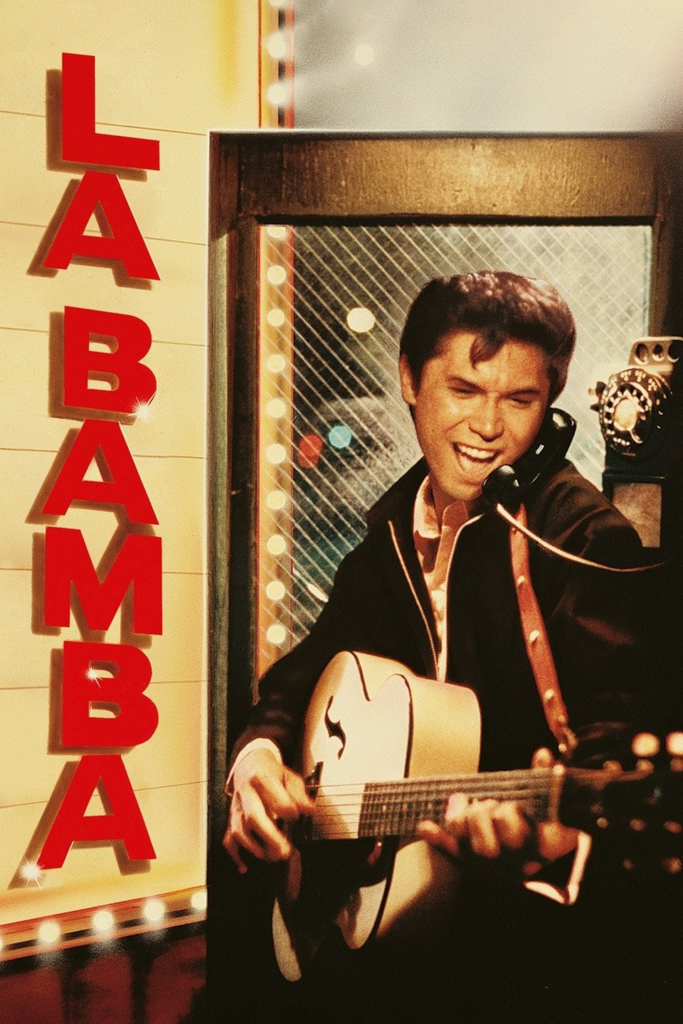
Happy Cinco de Mayo! This week I thought we’d watch a film celebrating (and mourning) a Chicano cultural icon written and directed by a Chicano cultural legend in his own right: Luiz Valdez’s biopic of Ritchie Valens: La Bamba (1987).
The Review Roulette wheel landed on Genre as our approach, so I want to think about what makes a good biopic, and in particular, I want to think about titles. Some biopics are very bad in my opinion, and frequently that’s because they are extremely long 3+ hour slogs because the director feels the need to do justice to every part of the person’s life. Personally, I don’t like that in a biopic. I prefer a microcosm, i.e. a short snippet of a person’s life that exemplifies or explains a whole part of them (a virtue, a value, a moral code, etc.). That way you can really get into the specifics of a week to a couple years, a period of someone’s life in greater detail and a sharper film than a wider scope in an overly long film. Different strokes and all that, of course, but that’s my preference.
La Bamba tragically only has a short period of time to work with as its subject, Ritchie Valens, died at the age of 17 in the plane crash that also took the lives of Buddy Holly and The Big Bopper on “The Day the Music Died,” February 3, 1959. Just under nine months earlier on May 14, 1958, Valens was signed by Del-Fi Records in Hollywood, kicking off a whirlwind career of concerts, television appearances, and even a film cameo in Go, Johnny, Go! (1959) filmed prior to the crash and released posthumously.
The fame Valens reached in those eight and a half months under contract is extraordinary in its own right, let alone that he was the first Latino musician to be welcomed into mainstream rock. The film portrays Valens (Lou Diamond Phillips) from the ages of 15 to 17, starting with his family’s migratory life as farm workers in Northern California through their move to settle in San Fernando and his meteoric rise. From what I have read, the film seems to be considered faithful to life, with some liberties taken, but generally it seems to be accepted as historically accurate, especially as it was created in collaboration with the Valenzuela family, Ritchie’s real last name.
Regardless of the reason, La Bamba is a perfect microcosm for the focus of a biopic. It’s a crisp 108 minutes long, you know I love that, and it’s a really beautiful film. There are three relationships the film follows but one really central one that opens and closes the film. First and most centrally, the film is very much about Ritchie and his older half-brother Bob (Esai Morales). Bob, in the film at least, grew up feeling lesser than Ritchie; less loved by his step-father (Ritchie’s bio dad), less important to their mother, and less supported by anyone.
The film is framed with Bob. After a prologue of Ritchie having a nightmare about a plane crash that occurred when he was young, the title credits roll over Bob on a motorcycle rejoining the family at a migrant camp in Northern California. The film closes with Bob screaming his brother’s name in agony with a flashback to the start of the film when they were reunited. Throughout the film, Bob feels slighted by Ritchie, taking what he can from him at any point, including his first girlfriend and her virginity prior to them even leaving the camp. Bob’s jealousy of Ritchie only grows as Ritchie begins to realize his dreams of being a musician while Bob earnestly attempts to follow his own creative talents in vain.
Their relationship is fraught, and Ritchie really comes off as a verified saint when dealing with his brother, but I do wonder if Bob is played up as a foil to Ritchie. Especially in the 1950s but really at any point in American culture, Latino men were constantly fighting society’s stereotyped racist ideas about who they were. Chicano people in particular in the 1950s were fighting for rights at the highest level of government, and I think Bob is more an amalgamation of the perils of a society that believes Chicano men are lesser in the ways Bob felt in his early life than a real person. Ritchie becomes an alternative Chicano icon and success story to the stereotyped bad boy image of Bob, challenging (both in real life and the film) the images and ideas of communities we put to screen.
Second, there’s Ritchie’s relationship with his girlfriend Donna (Danielle von Zerneck). Donna is a white girl Ritchie went to school with and her father, a racist, attempts to keep them apart, driving Ritchie, the most faithful teenage rock star ever to have existed, to write his most famous song “Donna” and perform it on American Bandstand for her. (In real life he performed it on The Dick Clark Show.”) Their relationship is absolutely precious.
Third, the film engages Ritchie’s relationship with his ethnicity. Born in California, Ritchie remarks in the film that he cannot speak Spanish and had never been to Mexico before Bob whisks him there on a drunken night out to reconnect with his roots. On that drunken night, Bob chastises Ritchie for allowing his music producer to change his name from “Richie Valenzuela” to “Ritchie Valens,” saying “with a name like that, no one would even know you’re Mexican.” Shortly after, Ritchie hears a mariachi band playing the Mexican folk song “La Bamba” and decides to adapt it into a rock hit.
Throughout all of these relationships and the film is also the idea of fate in almost a little too heavy handed a way. The plane crash that opens the film is a recurring nightmare of an event that really did happen in Valens’s life, though at 15 not in elementary school as is suggested. That’s a crazy real life coincidence that is just inexplicable. The film, I think, plays it up a bit much but pulls these relationships together through it. While in Mexico with Bob, a healer gives Ritchie a talisman to protect him from his plane crash nightmare. Later, during a fight between the brothers, Bob rips the talisman from Ritchie’s neck while saying “I’ll kill you” and even later, is shown dangling it over his baby daughter sweetly while Ritchie’s plane crashes. That’s a little much, right? Like the brother doesn’t have to be the reason for the fated crash, we don’t have to go that far. But I do see the appeal of trying to find any justification for why this incredible pioneer of Chicano culture as mainstream American pop culture dies so horribly and so young.
But anyway, apart from the heavy handed fate stuff, La Bamba is one of the best biopics I’ve ever seen. The three relationships are well-balanced and the story is thoughtfully conceived out of the real life events it’s reflecting. A perfect example of what the genre is and can do for illuminating parts of the human experience of the humans we collectively feel something for.
One thing I find particularly interesting about the film is the title. “La Bamba” wasn’t Valens’s biggest hit at the time; that was “Donna”. It’s not even the main focus of the film, but I do think it encapsulates something more important. The title of a film guides our thinking before the camera can even guide our eyes. We have certain expectations of a film from its name, and I think Luis Valdez, a Chicano pioneer of the arts himself and former migrant worker, wanted us to see the arch of Valens’s life as a complex dance with fate, La Bamba itself. He invokes both the song and the foreshadowing plane crash immediately so that we might see each step of Ritchie’s teenage years and rising fame as both improvised and choreographed, a complicated dance between a traditional past, a pioneering present, and a predetermined future.
Further, Valdez’s title also highlights a legacy beyond the film. While “Donna” was higher in the charts, “La Bamba” has the longest lasting legacy of any of Valens’s songs. As Valdez emphasizes in the film, Ritchie was only just beginning to reconnect with his Chicano heritage and immediately had a Top 40 hit in Spanish on the Charts. His eight months alone as a recording and touring artist inspired Latin bands and musicians including Los Lobos (whose covers are used in the film), Los Lonely Boys, and Carlos Santana. His guitar playing influenced Jimi Hendrix, the Beatles, and Led Zeppelin to name a few. Imagine how much more good Valens could have done if only he had more time. Titling the film “La Bamba” inspires that imagination and points us to the incredible legacy that 17-year-old left.
I’m not normally a biopic fan, but I thoroughly enjoyed this film. I have been on a 50s music kick recently too (I play a Sinatra radio mix when I cook Italian food and I’ve made a lot of gnocchi recently), so that might have helped, but it’s really a near perfect biopic for me. Well-paced, interesting, balanced, apparently accurate, and above all, reasonably timed. And Lou Diamond Phillips was exceptional in it, his debut film.
Because I’m Never Done When I Say I Am
Feminist (on biopics)
When thinking about what I wanted to say here, I searched biopics to get the mind whirring and was disappointed but not surprised by what I found. Every single film on this IMDb Top 50 Greatest Biopics of All Time list is about a man except for, I guess, tangentially The Blind Side (2009). That sucks and it reminded me that, following on from thinking about titles here, the recent Priscilla (2023) pissed me off to no end. The film Priscilla is ostensibly about Priscilla Presley, right? It’s named after her. That makes sense. But the film is only about her association to Elvis and her suffering heartache as his abuses and addictions became worse. And it ends with his death. I know I just said above that I prefer a biopic to be a microcosm, not a whole life, but bruh, come on, she had a whole life after that. She was in The Naked Gun franchise for god’s sake! That film feels so disrespectful and also led to one of the more insane conversations I’ve ever had with a young person in which she (~20) said she wants a romance like theirs and I was like “sweetheart, seek help.”
Leave a Reply