
A Symbolism Approach to In & Out (1997)
[Contains spoilers]
In & Out (1997) – Symbolism
Happy Pride Month, beloveds! This week, we’re working to a theme of Queer Joy in all things because nothing will ruin a bigot’s day faster than a happy minority. A queer smile is their biggest weakness.
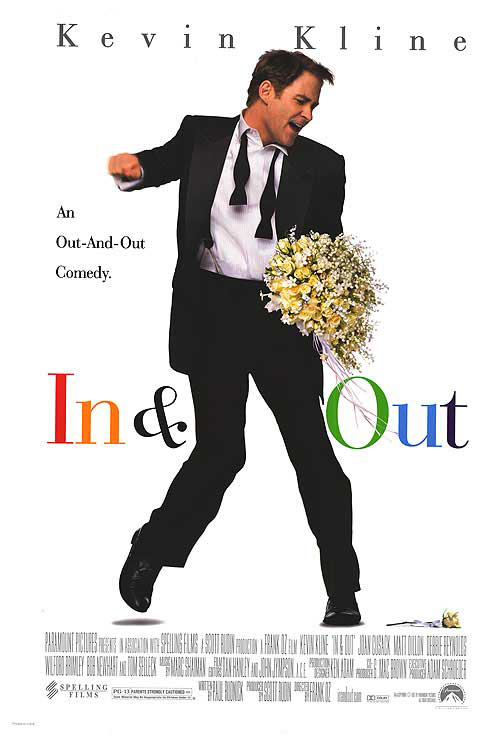
So, this week, I watched an absolutely delightful film, Frank Oz’s In & Out (1997), starring Kevin Kline (sans moustache) as an Indiana high school English teacher who is outed at the Oscars by a former student, Cameron (Matt Dillon), just days before his wedding to his fiancee Emily (Joan Cusack). The peak 90s comedy also features Debbie Reynolds, Wilford Brimley, Bob Newhart, and Tom Selleck (also sans moustache). Truly, it is a god damn delight. And I’m going to spoil it, so if you want to experience it fresh, stop reading here.
The Review Roulette wheel landed on Symbolism as our approach, and, I’m not gonna lie, I was straining for most of the film like “what the fuck am I going to talk about?” because the only identifiable symbol I could write about (before the last couple minutes) is Barbra Streisand. But then, a beautiful, tearful moment towards the end served up a perfect full circle moment embodied by the most recognizable body in Hollywood: the Oscar statuette.
Side bar: This is fully, completely, 1000% beside the point, but in my dissertation-turned-first-book, Selling Out Santa, there’s a chapter that begins with a quote from a voiceover attributed to an Oscar statuette, and my supervisor and I argued about this chapter intro for weeks, w-e-e-k-s, WEEKS, because he didn’t like how I was interpreting the significance of the Oscar as a symbol of Hollywood. And, coincidentally, that was also a Debbie Reynolds movie, an absolutely insane one called Susan Slept Here (1954). It’s Chapter 3, open access if you’re interested. Absolutely bonkers. But anyway, I’m having a mid-distance stare, flashback sequence of my own over here writing about the Oscar.
So, anyway, In & Out is riotously funny and also moving and witty and the aforementioned god damn delight. There’s a lot I want to capture about this movie, but it would really just be transcribing the script, so let’s settle for a plot summary. Howard (Kline) is a wonderful man and teacher who brings Shakespeare and poetry to life for his students, brings culture and comedy to his friends, and brings loving, supportive friendship to his fiancee. He doesn’t even seem to know that he is gay until his former student, thanking him for being that wonderful teacher, acknowledges him in his speech for Best Actor at the Oscars and outs him.
The film Cameron wins the Oscar for is To Serve and Protect, which we get to see some select scenes from as part of Cameron’s nominee introduction. It’s terrible in a very funny way and about a soldier in Vietnam who falls in love with another soldier, is dishonorably discharged, and asks a statue of George Washington if he is still a good American. Now, I think this is really quite brilliant, not only comedically but also as fodder for the full circle moment with the Oscar, primarily because his performance is so bad, and yet he wins it anyway.
Throughout the film, Howard is tortured with having been outed on live-television, asking questions of himself and trying to understand why Cameron believes this and if it is true. The torture, notedly, is only within himself and an off-screen, invisible “parent” who lodges a complaint about his possible homosexuality. Apart from that inner turmoil and invisible threat, and a brief scene of boys covering up in the locker room, everyone in this small town does not really care whether he is gay or not. They are largely indifferent or supportive. And the best lines of the film come out of their love for him.
The first morning after the Oscars, which were, I guess mid-week, Howard’s students try to postulate why Cameron would have thought he is gay. They list off reasons as to why someone might think this including that he is an English teacher, likes poetry, he’s smart, well-dressed, and really clean, he leads the drama club and rides a bike, and he’s a “totally decent human being” so of course, it’s understandable someone would believe he is gay. I love this whole scene because it really reflects the film’s underlying message of Pride. It’s never disparaging of homosexuality; if anything, the film suggests that gay people are all around better people at a significantly higher percentage than straight people.
At his bachelor party, when Howard feels the need to act extra “masculine,” he expects his friends to have a collective porn watching party, I guess, but they planned a different evening. They tell him, “We’ve been working on this for weeks. We got all your favorite stuff, everything you love!” and this group of like 8 or so small town Indiana white men hand him a copy of Barbra Streisand’s Funny Girl (1968). Howard thinks they’re making a gay joke, but one says “you had that film festival last year,” another “we watched all her movies,” and “it was fun.” And that’s when you know that this movie is perfect. This group of straight men believe their friend is straight and have no qualms about their masculinity or sexuality in full-heartedly suggesting they all watch Barbra Streisand movies for his bachelor party. When Howard objects, they offer A Star is Born (1976) and Yentl (1983). Gems.
Later, after accepting his sexuality and telling his fiancee, Emily gets a long ranting speech about how wronged she feels, specifically due to her own self-esteem issues. Emily says,
I loved you and believed you and pretended not to notice the Streisand thing. I thought you were just creative. I thought you were just smarter than me and more sensitive and more interesting. I thought you were the most wonderful man who ever lived. I thought you could change my life and show me the whole world and teach me about art and life and magic. I thought you could make me feel like a beautiful woman instead of the girl nobody wanted.
This whole speech reinforces what the students said earlier, “smart, clean, totally decent human being? Gay.” The obvious conclusion. But the bachelor party scene with the friends shows us that anyone can be a totally decent human being, like Streisand, and also be straight.
That brings us, roughly, to the ending, when Howard loses out on the teacher-of-the-year award for homophobic reasons prompted by that invisible parent. Cameron offers him something better, handing him the Oscar he won for his terrible performance as a gay man.
There are two ways to read this, and I prefer the second for its more positive framing. First, you could see it as recognition for a terrible performance as a straight man, bad actor to bad actor, game recognizing game. Howard gave an unconvincing performance as a straight man his whole life and loses his job, mirroring Cameron’s character’s dishonorable discharge. Both, however, are supported by their loved ones and community despite the institutions’ lack of progress. This one is complicated a bit by the fact his straight friends also like Barbra Streisand though.
Second, Howard actually deserves the Oscar for giving a perfect performance of himself. He never knew he was gay, he just knew he liked being clean, smart, and a totally decent person. He was always himself, regardless of his sexuality, and that’s what made him so decent.
It really is such an excellent, funny, touching film, and all the performances are fantastic. (And there’s much I didn’t spoil!) I love that it plays with the idea of Hollywood films, as a Hollywood film itself. Frank Oz loves playing with our perceptions of cultural institutions, and I think he nails it here. Cameron’s film about the Vietnam vet is so, so bad, and yet it’s Oscar worthy. Including those scenes from the fake film suggests a kind of inside joke, a jab at the film industry itself like “Hollywood hubris is a hell of a drug” within a film in which the emotional climax is giving the Oscar to an English teacher that got the actor into acting in the first place. It’s playful, and it’s quite beautiful.
Anyway, happy Pride, darlings! Always strive to be smart, clean, and a totally decent human being, and find some loving joy to spread all month long.
Leave a Reply