
A (Kinda) Formalist Approach to The Bingo Long Traveling All-Stars & Motor Kings (1976)
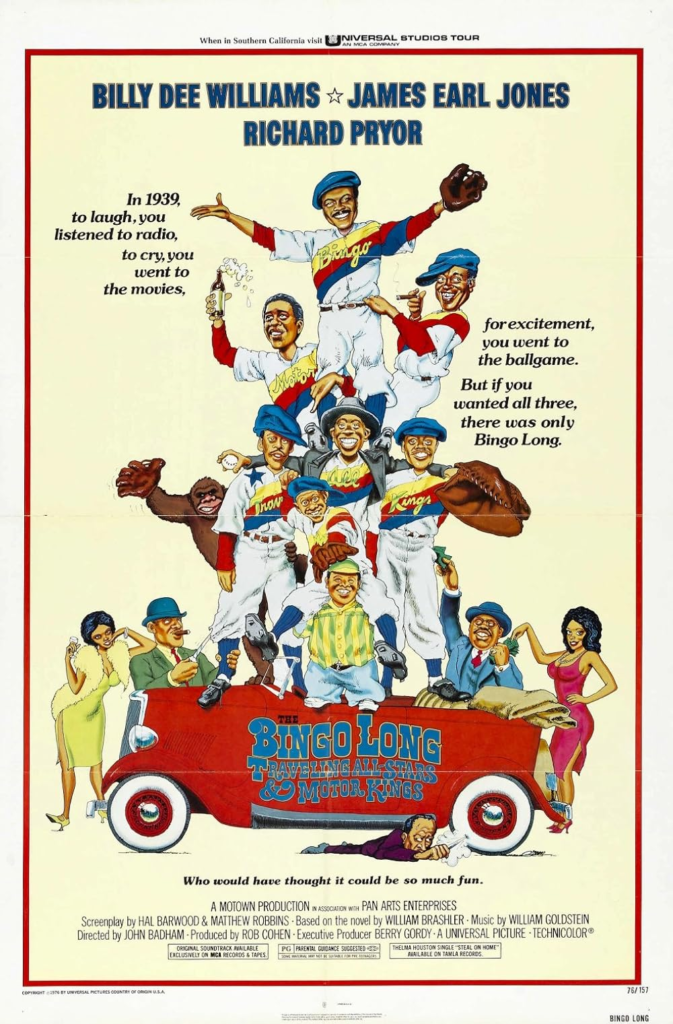
The Bingo Long Traveling All-Stars & Motor Kings (1976) – Formalist (Kinda)
I’ve thought more about baseball in the last six months than ever in my life, but not, exactly, by choice. Or in as much as marriage is a choice and the things that your partner is passionate about become your interest, too.
As I mentioned in my review of Mulan (1998), the second season of Ben’s podcast Baseball, Bigotry, and the Battle for America, “Diamond in the Rough,” was researched, recorded, and released this past spring, and it was an absolute honor to be in the room where it happened. I love watching and listening to Ben work (and he has worked A LOT), especially when it’s about something that ticks every box of best, worst, and hope in American history while intersecting with something that would have made little baby Ben so happy, like baseball. So, I’ve been thinking about it a lot and not even modern MLB, old school diverse American baseball. Japanese professional teams and the Negro leagues baseball.
Because of all his excellent work on the subjects, Ben was invited to talk about The Bingo Long Traveling All-Stars & Motor Kings (1976) on a podcast recently, and so naturally after we watched it for his prep, I also wanted to write about this fantastic film I had never heard of. If you haven’t heard of this film or seen it, go. Go now. It’s so fun and interesting and the cast is unbelievable.
The Bingo Long Traveling All-Stars & Motor Kings is a film starring Billy Dee Williams, James Earl Jones, Richard Pryor, and Stan Shaw. (As I said, GO. Go now.) It follows fictional rival Negro league players Bingo Long and Leon Carter (Williams and Jones) who are fed up with their exploitative treatment by their teams’ owners and decide to create their own barnstorming baseball team with a shared-ownership model among the players during the Great Depression. The film follows the group’s conception as Bingo and Leon poach all-star players from other Negro league teams and their smashing successes on the road, despite the challenges and sabotage thrown at them by the league owners and American racism. Ultimately, the league teams, suffering losses in ticket sales and reputation, wager a spot in the league for the The Bingo Long Traveling All-Stars & Motor Kings if they can beat the league’s remaining all-stars in an exhibition game or face dissolution with all players returning to their former teams.
I did spin the Review Roulette wheel and it landed on Formalist. While watching, I wasn’t quite sure what I wanted to write about. The use of color is really brilliant in the film. The team wear striking uniforms with red, yellow, and blue streaks across them, and the way they learn to strut into 1930s towns, in particular towns’ African American communities that had been depressed economically for much longer than a decade, is simply beautiful. Their colorful, exuberant, strutting is reminiscent of New Orleans Second Line traditions with communities coming out to join their dancing. It is the epitome of Black joy, and the film’s form portrays this so exceptionally.
And I think that led me to a realization that I came to in another film review last September: Bingo Long is an American nostalgia film in the best way, that is, in the same way The Blues Brothers (1980) is. Once I had that epiphany, I started to see the similarities in the films’ structures that I had previously been attributing to The Muppets: the leaders of a group get the gang/band/team together in a fun montage of glimpses into the lives of the players; once assembled, the group has to travel (here and in The Muppets by map) through the US playing gigs to hostile crowds, finally leading to a big exhibition of their talents in service of an existential threat that ultimately proves their value to one another. But unlike The Muppets, both Bingo Long and the Blues Brothers have to outrun the cops in long chase sequences that result in a lot of property damage.
But it’s not just the structure, it’s the sentiment. Bingo Long and The Blues Brothers (and, yes, The Muppets) portray a far more accurate vision of America’s pastimes than our public memory seems to remember. As I wrote about in that review of The Blues Brothers, that film has the overall message of “the only way out of racist, systemic bullshit is through setting the culture right.” The Blues Brothers does this by reaching back in American history and pulling Black American blues and soul legends forward to save a community and orphanage. Likewise, Bingo Long uses nostalgia not to repaint history in a maybe cream or egg shell color that justifies some heinous shit in the present but to strengthen the argument that America has always been diverse, joyful even in depression, resilient, and resourceful, and, most assuredly, that its successes in culture in particular are built on the tireless talents of some of our finest Black Americans.
The year before Bingo Long was released, in April 1975, Frank Robinson became the first Black baseball manager in the Majors and faced ample racist abuse for it. In his debut game as a player-manager, the pitcher tried to strike Robinson out by throwing just outside the plate before Robinson clocked the intended humiliation, leaned in, and hit a home run. In Bingo Long, this film that came out just one year after, Leon has a nearly identical experience in the exhibition game with the Negro league all-stars. The film seems to be echoing Robinson’s experience and elegantly making a powerful point against the racism he faced for simply existing in the space others felt a white man should. The only way out of racist, systemic bullshit is through setting the culture right, and Bingo Long reaches back, back before Jackie Robinson’s groundbreaking debut in the previously-all-white Major Leagues, back to the Negro Leagues and barnstormers who brought their talents and love of the game to every diverse corner and audience of the nation and had, crucially, always been a part of the game.
In a recent article on the Savannah Bananas (gift link), a modern barnstorming team reviving historical barnstorming and Negro League legacies, Ben wrote about the histories of these teams and their significance to the wider American context and appreciation for baseball throughout the 20th century. The Bananas’ home stadium, Grayson Stadium, interestingly was used for some of the ballpark scenes in Bingo Long.
In form and sentiment, The Bingo Long Traveling All-Stars & Motor Kings is an American nostalgia film that tells a necessary story about a historical reality often under-remembered in our public memory. And on top of that, it does it with a phenomenal cast in a funny, emotional, philosophically brilliant, joyful, entertaining movie. And, AND, Billy Dee Williams has one of the best wardrobes I’ve ever seen in a film. Every outfit is utter perfection. What more could you want in a film? And what better celebration of the, then, 200th and, now, 250th anniversaries of the US could you ask for than remembering our cultural diversity as led by the best looking Black man of the 1970s (a highly competitive list)?
Leave a Reply