
A Feminist (Kinda) Approach to The Birdcage (1996)
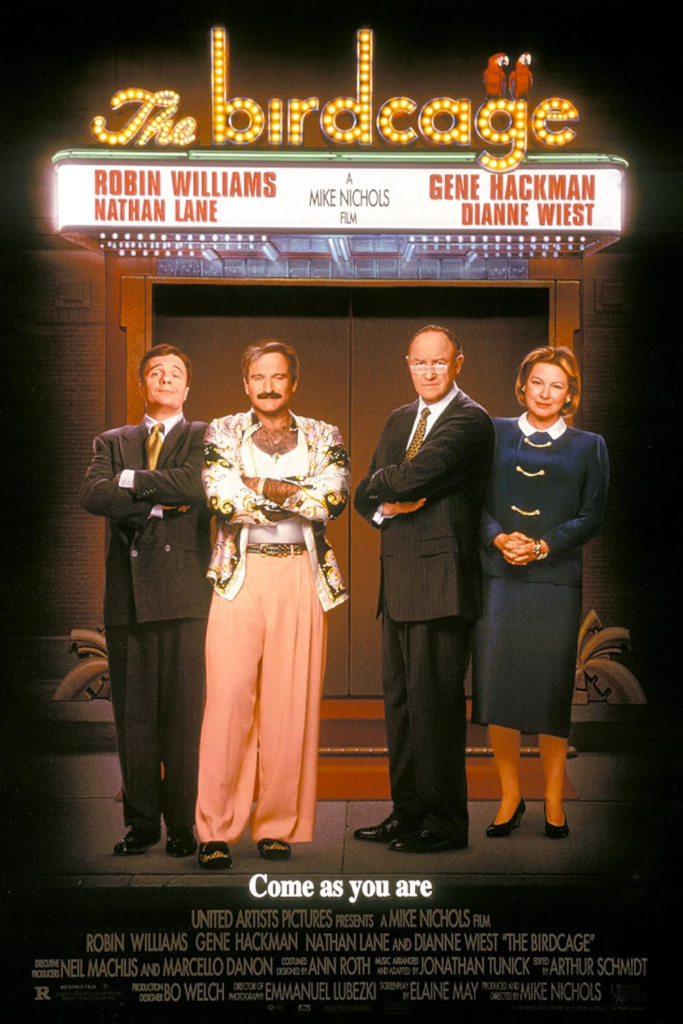
The Birdcage (1996) – Feminist (Kinda)
I don’t know about y’all, but I am exhausted. This week’s review is a couple days past due because I’m so sleepy after travelling for a very intense 4-day conference where I volunteered for all the things. It was wonderful and fun and I did all the Networking™ and mentee-ing for career advice, so wish ya girl some more luck as I enter year 2 on the job market.
It genuinely pains me to acknowledge that I haven’t been in a classroom in 2 years (as of the end of March), but c’est la vie (la vie), amiright? It heartens me, though, to know that I have you all who are still seemingly interested in the words I write and thoughts I think about films, so from the bottom of my heart, thank you for being here with me as we close in on one hundred reviews (also at the end of March).
This week, I want to talk about The Birdcage (1996) which I watched recently with my best friend in London. It’s uncommon that I review a film weeks after I watch it, but this week is the 30th anniversary of the film, and we just have to commemorate that. I had seen it before (and the play it’s based on, La Cage aux Folles, in Regent’s Park – absolutely delightful theatre in the park show), and we were watching it because it’s her late-father’s favorite film, so I wasn’t thinking of it for a review, but she had said something that made me think a little more critically about it.
Because this is another film, like last week’s Jurassic Park (1993), that I wasn’t expecting to write about, I didn’t spin the Review Roulette wheel. (I’m sorry, we’ll get back to regularly scheduled programming next week.) But, because it’s The Birdcage, I want to think about gender (which in our methodology falls under Feminist critique).
So, if you’ve not seen it, go watch it and then come back.
…
Deeply lovely story, right? You also want to slap Val silly, right? Good.
If you skipped that direction, The Birdcage is a perfect movie in which Robin Williams and Nathan Lane are a gay couple who raised a son, Val (of Williams’s Armand and Christine Baranski’s Katherine). Armand owns and operates the drag nightclub The Birdcage in Miami in which Lane’s Albert is the star. Val comes home to tell Armand he is getting married to the daughter (Barbara – Calista Flockhart) of a conservative Senator (Gene Hackman) and a traditional homemaker, Louise (Dianne Weist). That was a lot of names, but the cast here is just phenomenal, except for Val, who sucks so damn bad.
So, Val is marrying Barb and Barb’s parents are ultra-conservative, and they’re coming to dinner, so Val has the ingenious idea to utterly betray every lesson of pride, equality, and civil rights we presume he had as the child of Armand and Albert. He asks Armand to pretend to be straight, change his Jewish last name, and remove any hint of gay energy and iconography from his home, including Albert whose flamboyance offends Val. Armand and Albert agree to this, though visibly shattered, just heartbroken that their child would even consider asking them to change everything about themselves and ingratiate themselves in a lie that presumably would last a lifetime, let alone be such an unrelenting prick about it. Ultimately, Albert dresses in drag to perform as Val’s mother at the dinner, winning over the Senator before further complications.
So much of the film is about gender performance and identity in really thoughtful ways. Albert initially suggests he can be at the dinner as Val’s “uncle Al”. He tries to perform masculinity by imitating John Wayne’s walk and adopting aggression as a primary emotion but fails to change his nature in an afternoon. His drag performance as Val’s mother is much closer to his own personality, especially as he RAISED VAL, and Val still wanted to send him away.
Honestly, I love this movie and I love that it’s a Guess Who’s Coming to Dinner kind of updated comedy . I love that it plays with 90s Miami as a setting, and I really love that Armand and Albert have the same last name (Goldman). It’s thoughtful and playful while dealing with a truly serious subject, and I think it’s a brilliant adaptation of the stage show. But I do hate Val. Burning rage for him. The actor way overplayed the shittiness as an expectation that everyone would drop all of their emotional context and identities to placate him and is annoyed when Armand and especially Albert are hurt by such a horrific request. Dickhead.
Anyway, the gender performance aspects are fascinating. I haven’t even mentioned the stand-out performance of Hank Azaria as the Goldmans’s house-boy Agador Spartacus. But because there is so much commentary on gender performance from the drag performers, I never thought about the moms.
My friend remarked on Dianne Wiest’s character and the subtle change in her voice as the film progresses, and I think this is just a brilliant observation. If you’re familiar with Wiest’s acting, you probably can hear the exact softness she brings to a lot of her roles. She has a higher-pitched, delicate voice that really whispers “classic cultural stereotype of a 50s housewife,” a “dinner’s ready, dear” kind of trill. And because she’s an excellent actor, this tone is often juxtaposed with dissonant dialogue, but here it’s the character Wiest is playing as the conservative Senator’s wife.
But, when we near the climax, she is getting increasingly annoyed with the Senator who is absolutely smitten with Albert’s drag performance as Val’s mom, fully convinced she is the perfect woman, mother, Christian, and homemaker. Wiest finally snaps at her husband and her voice is much lower than that sing-songy trill, which, in the context of this film, suggests that Louise really is also acting in the role. Wiest is performing as Louise who is performing as the Senator’s wife, the type of femininity she believes is necessary to support her husband, even in intimate settings.
Maybe this is an obvious observation to some of you, but I had never considered the gender performance of Louise, or, for that matter, Katherine. Katherine had Val after a one-night-stand with Armand and didn’t want the baby, but Armand did, so he supported her career and she supported his choice to raise Val at first alone and then with Albert. It’s suggested that Katherine had never really met Val after giving birth to him. Which is 100% correct for all parties here. Val was raised by parents who loved him dearly, and Katherine wasn’t beholden to the consequences of one night in her twenties.
It’s probably because I first watched The Birdcage in the late 2010s, but I never once blinked at Katherine’s story. I’m now realizing that her whole character is another kind of femininity that conservatives would frown upon, and I love that addition. She is complicated even further by the fact that her unspecified job is in the business of women’s exercise – yet another layer of gender performance and societal expectations.
This movie rocks, guys. Really, if you haven’t seen it, I would highly recommend it – and you know I don’t do that often. If only for another hour 57 with Robin Williams, this film is worth watching and very much worth thinking about and talking about with friends. As groundbreaking as it was in 1996, The Birdcage is equally as important on its 30th anniversary for its loud, defiant stance that the check boxes of gender expectations are impossible to fill; humanity is far too interesting to be what small-minded conservatives wish it to be, and even they know that.
Because I’m Never Done When I Say I Am
Auteur
This is the third Mike Nichols film I’ve reviewed here, and each is so powerfully connected to its contemporary context while maintaining a throughline of questioning conformity. The Birdcage is this gorgeous challenge to homophobia and queerphobia in the 90s. Working Girl (1988) is about a lower class woman assuming the identity of a white collar girlboss. The Graduate (1967) is about a guy right out of college who is totally and completely lost, spiritually, emotionally, and mentally trying to find an identity to distract from the depression of his stagnation. Fascinating.


Leave a Reply to Ilene Railton Cancel reply