
A Guest Post by Alexander Ludwig
When confronted with the Latin text “Dies irae, dies illa,” a reasonable person might throw one’s hands up in the air. Latin is a dead language after all, despite its presence all around us. In the case of film music and music history at large, the “Dies Irae” is not so much an example of a dead language as it is the language of the dead. As poetry, it exists as far back as the 13th century, but as a melody it is infamous today as Hollywood’s sonic signal of death, whether that death has just occurred or is about to take place. You’ve heard the melody even if you don’t know its name: it almost always appears in slow, steady beats low in the orchestra mimicking the hooded monks that originally sang it.

We hear the “Dies Irae” melody, in Wendy Carlos’s haunting version, when Jack Torrance drives his yellow car up to the Overlook Hotel, The Shining (1980). We hear John Williams’s shortened version of it when Luke Skywalker discovers the burnt corpses of his aunt and uncle, in the original Star Wars (1977). And most audaciously, we hear Gottfried Huppertz’s “Dies Irae” woven throughout the entire second act of Metropolis (1927) as the main character dreams about the impending apocalypse threatening his city. These films are only three from hundreds of examples where the “Dies Irae” accompanies scary, morbid, and often macabre sequences. When a composer includes a reference to the “Dies Irae” melody, he or she invokes the tremendously rich narrative history associated with this melody — a narrative that is shaped entirely around the depiction of death on screen.
The concept of death is part and parcel to the history of the “Dies Irae.” This sacred liturgical chant began its life in the 13th century as part of the Requiem Mass for the Dead; its text describes Judgement Day with a “Dantesque vividness” featuring trumpets blaring, fire and ash falling, and skeletons escaping their tombs. For hundreds of years, this melody was performed at funerals in the Catholic Church, creating an indelible connection between images of
death, funerals, and the “Dies Irae.”
This vivid imagery was later exploited by the French composer Hector Berlioz in the fifth movement of his Symphonie fantastique (1830). He deployed the “Dies Irae” to depict a graveyard populated by skeletons dancing and witches flying around a cauldron, thereby debasing its original sacred setting within a more tawdry secular environment. This setting sparked the imagination of composers in the late nineteenth century, many of whom were the inspiration for the first generation of composers of film music.
References to the “Dies Irae” exist in the silent film era (c.1895-1927), too, when so-called “cue books” and “cue sheets” were produced to help musicians to pick music to play during silent films. These manuals frequently recommended the melody for film sequences with skeletons and witches, echoing the Berlioz example from a hundred years prior. Although no explicit witches appear in Fritz Lang’s Metropolis (1927), they are invoked through the figure of “False Maria”—a robot disguised to look like the protagonist’s new love—as she is sent into the titular metropolis to wreak havoc on its populace alongside frequent statements of the “Dies Irae.” Freder, the protagonist, is driven mad by the images of the “False Maria”; and his apocalyptic dreams culminate in visions of Death himself wielding a scythe, underscored by the medieval melody “Dies Irae.”
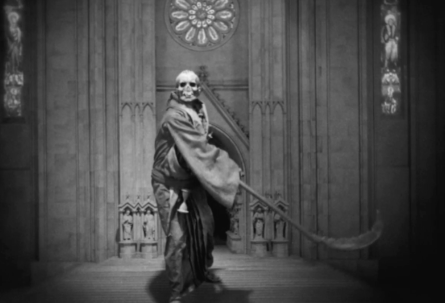
The first generation of composers during the “sound” era—as opposed to the “silent” one that ended around 1927—avoided the “Dies Irae.” Max Steiner, Franz Waxman, and Erich Korngold, all Jewish immigrants, fled Europe ahead of World War Two, but carried turn-of-the-century musical traditions with them. The “leitmotivic” score that they championed remains a staple of film-music composition, with roots tracing back to operatic scoring traditions in the 19th century. A “leitmotif” is a melody that represents a character, place, object, or emotion—in short, a theme song. The “Dies Irae” is by definition a leitmotif: when composers deploy it, they are invoking the extensive through line of narrative tradition attached to the melody.
The Russian-born pianist turned composer Dimitri Tiomkin became known for scoring the sound of the American West, working on iconic Westerns like Gunfight at the O.K. Corral (1957) and High Noon (1952). But it was his partnership with Frank Capra that generated the most fruitful film scores of his career. Tiomkin littered his scores with frequent references to the “Dies Irae,” none more so prominently than in the holiday classic It’s a Wonderful Life (1946). After seeing the nightmare of Bedford Falls turned into Pottersville, George Bailey returns to the bridge where he earlier attempted suicide and begs for his life back. It should be no surprise that Tiomkin underlines this scene with the “Dies Irae”: asking for forgiveness in the face of his guardian angel is no different from any other sinner sitting for judgement as depicted in the original 13th-century text.
Like Tiomkin, Bernard Herrmann was not shy about deploying the “Dies Irae.” His scores for Citizen Kane (1941), Psycho (1960), and Jason and the Argonauts (1963) all feature prominent examples of the medieval melody. Famous for its special effects creations by Ray Harryhausen, this latter film features stop-motion skeletons emerging from the ground to battle the titular Jason. Unsurprisingly, Herrmann scores this sequence with the “Dies Irae,” unable to avoid the dramatic parallel between the text and the film. The first notes heard in Orson Welles’s Citizen Kane are a variation of the “Dies Irae.” According to Herrmann, “…the very first bars I wrote are a series of a few notes that dominate the entire film…in my mind, it was a sort of variant of the ancient hymn, ‘Dies Irae.’”1
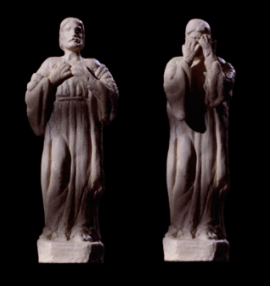
But this ancient hymn works just as well in comedic contexts as it does in more ominous ones. Consider the film Airplane! (1980): directed by the ZAZ comedy trio (David Zucker, Jim Abrahams, and Jerry Zucker), this sharp comedy satirizes the genre of disaster films that dominated the 1970s by placing washed-up fighter pilot Ted Striker—played by Robert Hays—behind the controls of a commercial airliner. With Striker in the cockpit and the other pilots sick with food poisoning, the plane’s doctor (Leslie Nelson) delivers a succinct overview of the situation: “Everyone on the plane is in a desperate situation. Mr. Striker is the only hope we’ve got.” Lightning flashes, and the screen flashes to a dashboard figurine of Jesus, which quickly covers its eyes. The score, appropriately enough, accompanies this mocking gesture with a sardonic gesture of its own, two statements of the “Dies Irae”—this time in its incipit form of only the first four notes.
More often than not, the four-note version of the melody appears as a musical response to a murder or otherwise scary situation in a film. For example, the sixth Friday the 13th film (“Jason Lives” in 1986 — if you’re counting), includes frequent modified “Dies Irae” references composed by Harry Manfredini, many of which immediately follow the discovery of another Jason Vorhees victim. But the clearest example of the incipit “Dies Irae” as a response occurs in Home Alone (1990), scored by John Williams. Each time his elderly neighbor scares Kevin McCallister, in 1990’s Home Alone, we hear the iconic four notes (followed by Kevin’s even more iconic scream). But the adversarial relationship between Kevin and “Old Man” Marley thaws when they both attend church on Christmas Eve, listening to the choir while talking through their differences. To further drive home the point, the choir sings “Carol of the Bells”—a melody that begins by repeating four notes that identically match the beginning of the “Dies Irae” melody—before Kevin runs off to defend his house. By removing the “Dies Irae” from the remainder of Home Alone, we understand as an audience that Kevin’s mortality is no longer in danger.
Film music shapes our understanding of a film beyond what most of us even recognize. Subconsciously, it can elevate or enhance what we see on screen in powerful ways. The “Dies Irae” carries a special significance because of its rich history, connecting the film music of today all the way back to its roots in sacred music of the 13th century. Despite its popularity, even appearing in films from this year like Project Hail Mary and Zootopia 2, the “Dies Irae” is not widely understood or even recognized by name. I hope that the next time you watch a film you keep an ear open for the “Dies Irae,” that infamous sonic marker of death.
- Ted Gilling, “Bernard Herrmann: A John Player Lecture,” Pro Musica Sana, 1974. ↩︎
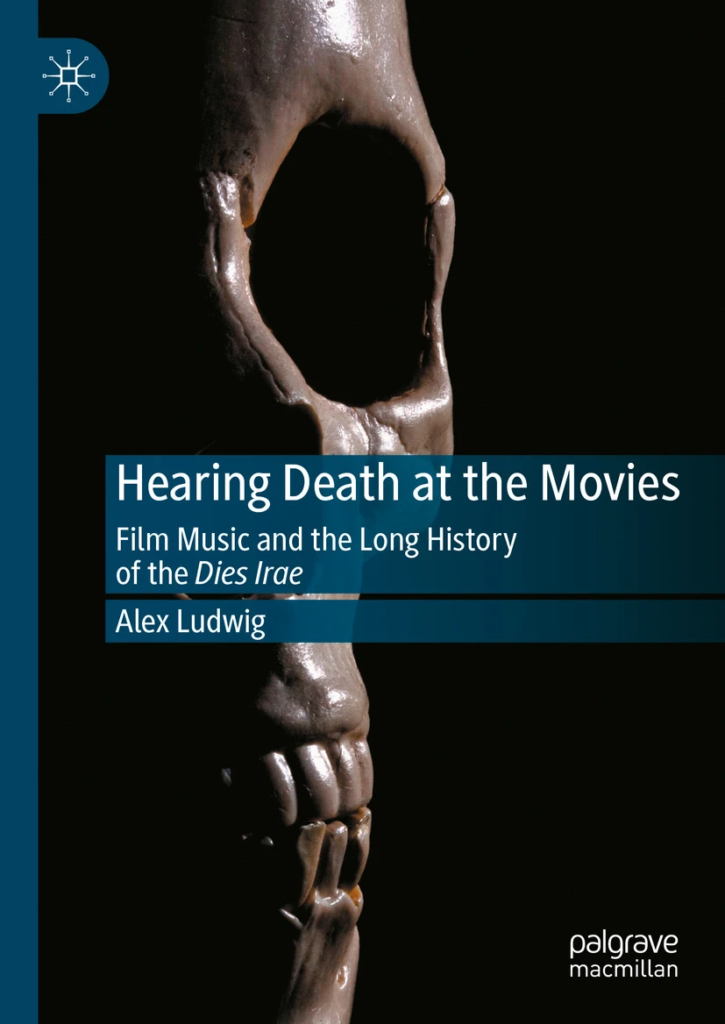
Alex Ludwig is a music historian and media scholar at the Berklee College of Music. He specializes in the teaching of film music history, and recently wrote a book on the topic titled Hearing Death at the Movies: Film Music and the Long History of the Dies Irae (Palgrave Macmillan, 2025).
Bluesky: @celexo.bsky.social
Leave a Reply