
The Shop Around the Corner (1940) – Feminism (Kinda)
The Shop Around the Corner (1940) – Feminism (Kinda)
Happy holidays, darlings! I hope your celebrations or preparations for future ones have been wonderful so far this year. 2025 was some booty, but I hope the end of it can be nothing but a joy to you all!
I have been incredibly busy as you will see in tomorrow’s #ScholarSunday thread and on our More Public Scholarship page, so this week’s review will be a bit shorter and, as always in December, crass as hell.
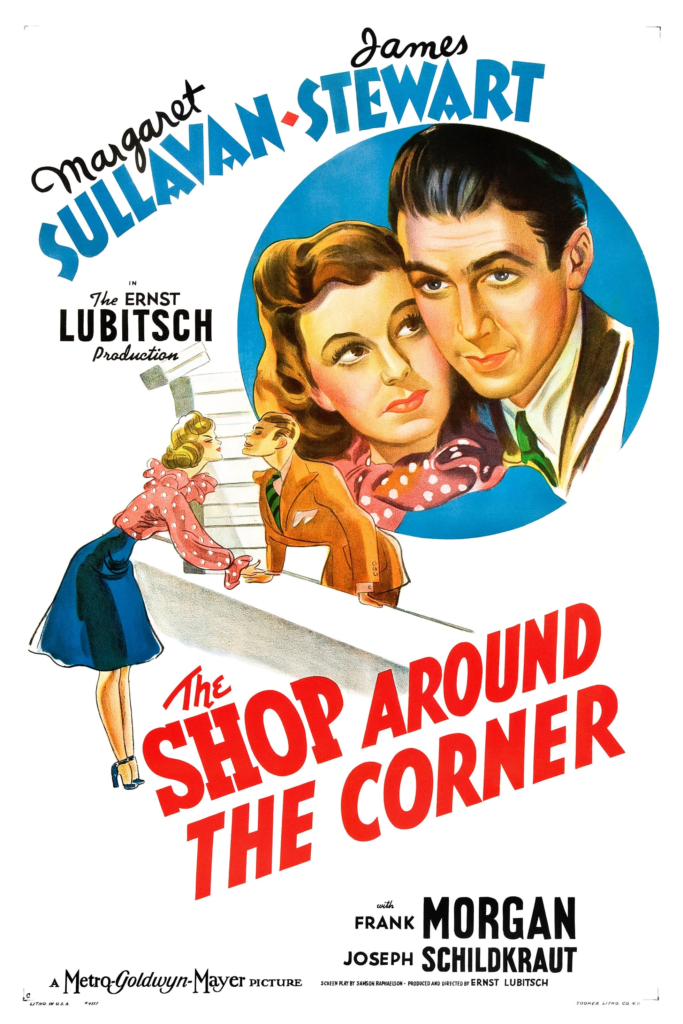
This week I watched a film I shamefully had not seen before, and I’m so glad I corrected that because it’s easily a new top suggestion for mid-century Christmas films, my literal expertise. The Shop Around the Corner (1940) starring Jimmy Stewart, THE Wizard of Oz Frank Morgan, and Margaret Sullavan is simply a god damn delight. It’s heartwarming, emotional, thoughtful about its contemporary context, layered, and laugh out loud funny, largely due to one baller of a character named Pepi (William Tracy).
The Review Roulette wheel landed on Feminist as our approach, and I want to broaden that a little to think about gender inclusively in both this film and a later version that I was more familiar with: You’ve Got Mail (1998).
These two versions are similar, but there are some significant differences that deserve attention. So, in The Shop Around the Corner, Mr. Kralik (Stewart) works at Mr. Matuschek’s (Morgan) leather goods shop in Budapest where Ms. Novak (Sullavan) is recently hired. Kralik reveals early to a colleague that he has a pen pal with whom he talks about cultural subjects, and he finds himself rapidly falling in love with her. Meanwhile in the shop, Matuschek is becoming paranoid that Kralik is banging his wife, and Novak is doing everything in her power to be snide and rude (for no reason other than he asks her to do her job) to Kralik, who, in turn, is increasingly hostile to her. Eventually we learn that Novak is Kralik’s pen pal and he has to decide if he’s ready to fall in love with her as she is in real life, reconciling his love and hate for the woman. And the whole time, through everything, Pepi fuckin rocks.
So, similar plots, but I think they did interesting things in modernizing the story for a remake. You’ve Got Mail is set in 90s New York and instead of being colleagues, Tom Hanks and Meg Ryan work at separate book sellers; Hanks for a chain retailer, Ryan for a family-owned indie children’s bookstore. The two also, crucially, have partners already who suck just enough to justify our romantic leads screwing them over harder than Matuschek’s wife did him. Hanks, in his corporate role, is an aggressive dick most of the time and only sensitive in his communications with Ryan.
So we have the personalities kind of gender bent. Sullavan and Hanks are much more aggressive characters than the more sympathetic Stewart and Ryan. Maybe this is just me, but I really was like “fuck this lady????” every time Sullavan opened her mouth. She gets the job in the shop by lying her ass off to a customer, trying desperately to convince her to buy a cigarette box that plays music when you open it, telling her that it’s a candy box that will discourage you from eating too much candy by playing the song as a punishment every time you open it. Girl. Fuck you? Fuck you. And then we get a time jump marked by the boxes going on clearance because, spoiler, being a shitty person isn’t actually a sustainable sales technique. Shocker.
And that’s closer to the pre-Amazon Amazon depiction of Hanks in You’ve Got Mail. He’s eager to open a new chain location blocks from Ryan’s bookstore affectionately named “The Shop Around the Corner”. He’s like salivating to compete with her business because she expressed disdain for the larger store and its owners. So in both of these we have Ryan and Stewart who are advocating for a more personal, thoughtful approach to consumerism and commercializing their products with the customer in mind, while Hanks and Sullavan are like “Sales are sales, babyyyyy.”
And in the earlier one we can justify it a bit more. Sullavan’s Novak is out of work and desperate for a job. The film engages the unemployment crisis and global economic depression throughout the 30s. Times are tight and it’s set immediately before WWII kicks off, even if we are only a year or so into it, that context is important. In the later film, Hanks is just munching up dollars and small businesses for funsies, which, to be far, is not not engaging with or reflecting the world around the film’s production. It’s actually quite prescient, but they stumbled on the part where he’s a thoughtful person who is interested in culture and women.
I think it’s really interesting they flipped these personalities, though, because who is a better successor of Jimmy Stewart than Tom Hanks? Hanks is 1000% our Capra-corn darling. I wrote about this exact thing without realizing it a few months ago when Trump said Tom Hanks of all fucking people was un-American. He’s the face of American idealism in the late 20th century and especially into the 21st. He’s soft spoken, unconventionally handsome, a versatile actor, and a patriot arguing through his work for all of us to be more critically engaged in our communities and nation. One to fucking one. Never thought of it before, but I can’t unthink it now.
So, it’s fascinating that the soft but stern, tender but measured masculinity of Stewart’s Kralik would be updated to be that in the private expressions of Hanks but also have this new layer of post-Wall Street jackass publicly. It feels like a commentary on how out-of-place a Jimmy Stewart classic would be in a late 90s rom-com, and also on the belovedness of Meg Ryan that she couldn’t be the absolute worst like Sullavan.
There are many more layers in The Shop Around the Corner – itself an adaptation of a play – that were stripped away for the remake and which make it a far more interesting, far better film in my opinion, but I’m intrigued by the choices made to make the 90s version more palatable for a 90s audience. And what’s a better Christmas present to myself than watching a film that will make me think for a full week? It’s a Christmas miracle, darlings!
Wishing you all lovely celebrations tonight, tomorrow, and over the next couple weeks as the festivities continue!
Also, I have a new book! Selling Out Santa: Hollywood Christmas Films in the Age of McCarthy is Open Access from the publisher and the ebook download is free from Barnes & Noble, but I would ask that if you like what you read, please consider buying a copy for yourself and/or a friend because I am unemployed and by the time royalties pay in July 2026, I will have been unemployed for over 2 years. I’m sorry to ask, but if you can swing it, please do or if you enjoy the book and you’d like to leave me a little holiday present that’s not the full price, please consider a little Venmo gift this Christmas (@Vaughn-Joy). Thank you, darlings!
Leave a Reply