
A Personal Reflection on Desperate Housewives (2004-2012)
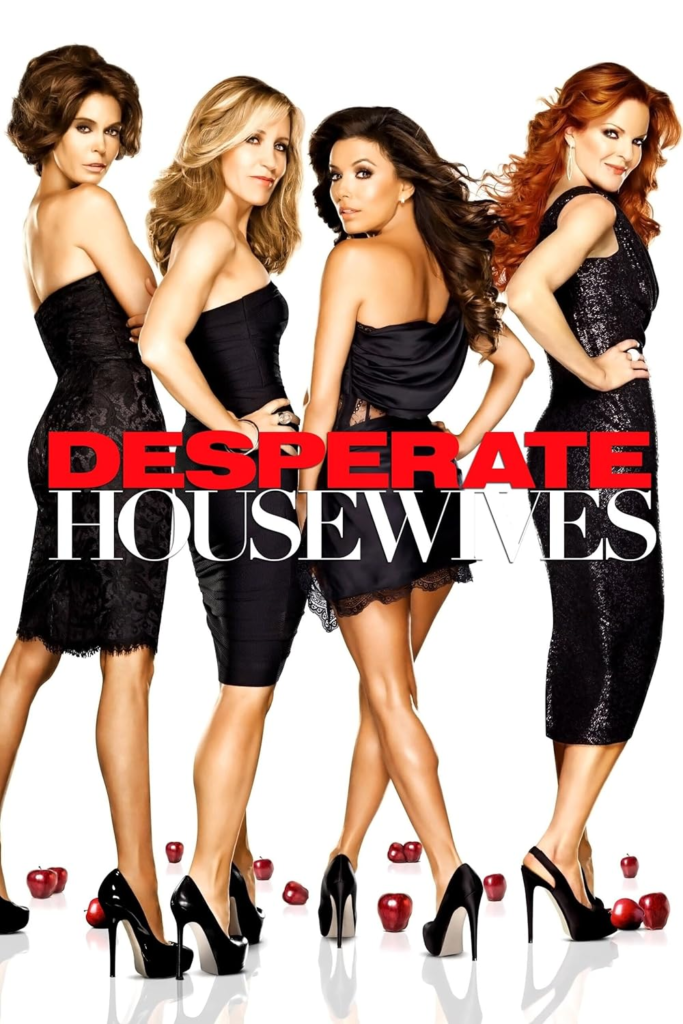
Desperate Housewives (2004-2012) – A Personal Reflection
We’re doing something different today because I need to get my feelings out. Last night, after 15 months, Ben and I finished Desperate Housewives. It has been a significant part of our first year living together, and the loss will be felt. So, this week we’re doing a personal reflection on my kooky ass emotional support housewives.
I started bingeing Desperate Housewives for two reasons: 1) I needed something to have on in the background to distract me from the fact I was packing to leave London for good, and 2) my grandfather wasn’t doing well health-wise (he’s good now!) and his two favorite things in the world are messy gossip about strangers and women, so his favorite show ever is Desperate Housewives. And, girl? I get it. We had so much fun.
After I started bingeing it, I realized that Desperate Housewives is the perfect accompaniment to my next book project that is gradually taking form. So, with all that in mind, I am going to say something that might be controversial: with the benefit of retrospection, I think Desperate Housewives is the natural cultural counterpart to The West Wing’s (1999-2006) political commentary on the early 2000s.
The West Wing is a show that idealized the civility of our democracy while not engaging with our real contemporary politics, instead leaning into an alternate reality that was rooted in an invented, nostalgic vision of what our politics could be. Whether this was truly purposefully by Aaron Sorkin, the effect is a complicated optimistic view of what we actually had and have in Washington.
Desperate Housewives was more self-aware of the nostalgic invented past that it was playing with, but it still engaged it in a similar way. Housewives was determined to bring back the prime time soap (which it did very successfully), and with that comes the Vaseline smeared camera lens on society (not literally in this case, the cinematography of the show is actually quite interesting). In spirit, Housewives smooths out reality in favor of the most toxic trash tv you can imagine wrapped in beautiful dresses and a quaint suburban street.
By 2008, the show was kind of forced to mention the financial crisis but it only affected one character really. Other than that, you’d be very hard pressed to describe the state of the US through the show’s reflections. No Iraq War, no Obama, no Katrina, no national conversation of gay marriage, no school shootings, no bad reality. (While Bree is a gun toting conservative, we really don’t get much commentary on that apart from a few scoffs. What a simpler world.)
Instead, Desperate Housewives offered pure escapism into the best kind of escapism, other people’s toxicity to make you feel like a better person for wanting a reprieve from the worsening world. The show gives us so many murders and abhorrent behaviors and health scares and family drama and actual real issues that you get really emotionally invested in (leave Tom and Lynette ALONE). It comments on very real social problems including, most forwardly, gender roles in the modern world in complicated ways that do make you think and feel for the ways they affect both men and women. It makes you really care about the characters as if they are your neighbors (but in a way that doesn’t exist in the mainstream anymore because most people don’t hang out with their neighbors like the girls in the show).
On that note, the nostalgia is really important here. The show laments that the invented suburban ideal we have a collective nostalgia for in our pop culture is, in fact, invented and ideal while also acknowledging that it can’t really exist. I do think the show argues for a middle ground because there are storylines in which the friendship between the neighbors is truly some of the best representations of friendship, e.g. Lynette’s cancer diagnosis and Karen in the final season. It reminds you that we, as humans, are capable of such immense love and care, and it is real even if the suburban ideal is not. But being kind to your neighbors, checking in on each other, helping each other out once in a while, that doesn’t have to be a nostalgic ideal, that can just be a thing we do.
But this show is also insane. Like batshit at points. There’s a four episode arc, four (4), in which Lynette suspects a new neighbor of being a child molester and gets the community riled up enough to protest outside his house. The stress of the community accusing and ostracizing him literally kills his disabled sister and he THANKS Lynette for freeing him up to molest more children. That’s in season 3 of 8 and we never hear about this guy again and Lynette never has any more remorse about letting this guy loose on society because he leaves the Lane and we just forget. Insane.
The show has a very short memory, which was probably fine for watching one episode a week for 8 years and not 8 seasons (180 episodes) in 15 months. It asks you to forget a lot but also accept a lot. Like in season 5, for the 100th episode, a long-beloved handyman, Eli Scruggs (Beau Bridges), has just passed away. All the girls have flashbacks to lovely times they had with him, including one of them having slept with him. All well and good except he has never once been mentioned or seen before this episode, they just wanted a way to get Beau Bridges in there, I guess? It’s a fun episode, but also what? But that’s just the magic of a 22-episode per season sitcom we’ve lost to streaming. Magic that we like to call filler episodes.
Anyway, these are just some thoughts on a show I loved revisiting and then watching in full as I was a child when it first aired and never finished it or really knew what was happening a lot of the time. My grandfather and I were pen pals when I was a little older and he would sometimes include notes about what “The Girls” had been up to in the latest episode, and it was fun to piece together memories I had of those notes with the actual show. All in all, great use of our escapism time, thoroughly enjoyed it. I’ll miss our cuckoo ladies, but we’ll find another show to fill the chaotic void they’ve left behind.
Leave a Reply