
[Matt Dworkowitz is a third year undergraduate student at Sacred Heart University, who majors in Health Science, and minors in American History and Chemistry. This past semester, Matt worked with Dr. Kelly Marino on an independent study of the World Wars. Upon graduation Matt has plans of attending medical school.]
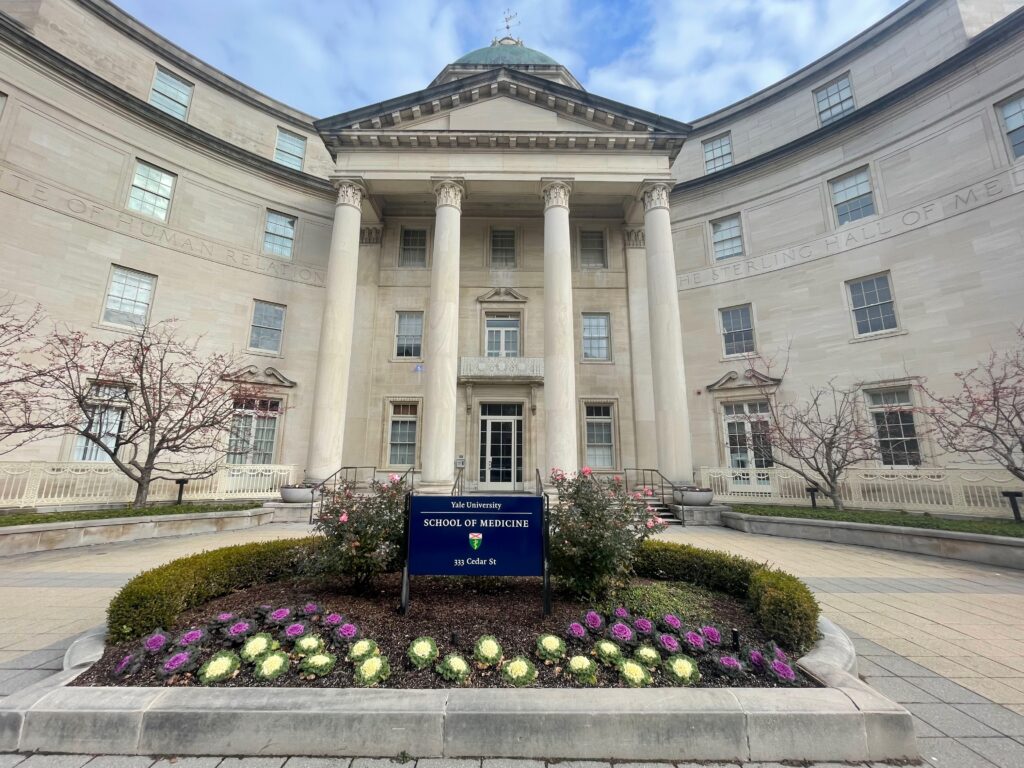
Modern medicine owes one, if not its most critical cancer treatment, chemotherapy, to a
pioneering effort at the Yale School of Medicine during World War II (WWII). While
chemotherapy is now an oncological cornerstone, the true story of its origin was obscured by lost
records for over six decades. Thanks to the diligence of two Yale surgeons, Dr. John Fenn and
Dr. Robert Udelsman, the foundational account of chemotherapy’s first use has been
rediscovered and officially rectified.
The subconscious discovery of chemotherapeutics is rooted in tragedy. After WWII,
researchers noted that mustard gas, a chemical weapon, had a devastating effect on human tissue.
It destroys lymphatic tissue and bone marrow (Yale School of Medicine, n.d.). These
observations eventually led scientists to consider whether the same chemical properties might be
harnessed to destroy rapidly dividing cancer cells. Progress accelerated during WWII when the U.S. government tasked institutions, including Yale, with studying chemical warfare agents. At
Yale, assistant pharmacological professors Dr. Louis S. Goodman and Dr. Alfred Gilman began
studying nitrogen mustard, derived from the toxic mustard gas. for its potential therapeutic effect
on lymphoma. Animal experiments yielded positive results, showing tumors in mice
significantly shrank (Yale School of Medicine, n.d.).
The first clinical trial was allegedly initiated in August 1942. The patient was known only
in the records as “JD”. JD was a 48-year-old man suffering from terminal lymphosarcoma,
cancer of the lymph nodes. His condition had worsened rapidly, and he had become entirely
unresponsive to radiation and exhausted his surgical options. All signs pointed towards
experimental nitrogen mustard as a last gasp, which they referred to as “a lymphocidal” or “substance X” due to War Department censorship. JD received his first dose of intravenous
chemotherapy on August 27, 1942. His tumors softened within two days, and by the end of his
initial 10-day treatment course, his tumors had remarkably vanished. Though JD relapsed shortly
thereafter and would pass away, the experiment had provided the innovative framework that
chemicals could cause tumor regression (Christakis, 2011).
For decades, the story of the first chemotherapy patient was based primarily on personal
recollection because JD’s medical chart had been misplaced. In the early 2010s, Dr. John Fenn,
Clinical Professor of Surgery, and Dr. Robert Udelsman, Professor and Chair of the Department
of Surgery at Yale, became determined to locate the missing records and confirm the historical
facts. Their diligence paid off in May 2010 when, through “sheer fortune,” they found JD’s
medical chart in an off-site storage facility (Christakis, 2011).
The rediscovery of the chart allowed them to piece together the story. JD was a Polish
immigrant, born in 1894, who had worked in a ball bearing factory in Connecticut. His full name
remains unknown. The chart revealed specific medical, clinical, and personal details that
corrected long-standing inaccuracies. Drs. Fenn and Udelsman presented their groundbreaking findings in 2011, detailing the life and sacrifice of the patient whose illness sparked a medical
novelty (Christakis, 2011).
The discovery of medicinal nitrogen mustard paved the way for a new generation of
chemotherapeutic agents and instantly altered the field of medical oncology. Research by the
National Institutes of Health (NIH) since the 1950s has shown effective chemotherapy treatments
for many cancers, and a dramatic increase in childhood cancer survival rates from 5% before
1950, to 85% today (Cancer, 2025). The story highlights the courage of JD, a terminal patient
whose willingness to undergo an uncharted experimental treatment made a monumental advance
possible. His full account, restored by Drs. Fenn and Udelsman, proves scientific breakthroughs
can emerge from the darkest moments of human conflict. JD’s story of fearless innovation will
surely never be misplaced again, and deserves to be recognized as an essential chapter of Connecticut’s history.
References
American Cancer Society. (2023). What is Chemotherapy? | Chemo Treatment for Cancer.
Www.cancer.org.
https://www.cancer.org/cancer/managing-cancer/treatment-types/chemotherapy.html
Burnham, J. C. (2015). Health care in America : a history. Johns Hopkins University Press.
Cancer. (2025, June 5). National Institutes of Health (NIH).
https://www.nih.gov/about-nih/impact-nih-research/improving-health/cancer
Christakis, P. (2011). The Birth of Chemotherapy at Yale: Bicentennial Lecture Series: Surgery
Grand Round. The Yale Journal of Biology and Medicine, 84(2), 169. https://pmc.ncbi.nlm.nih.gov/articles/PMC3117414/
Dodson, H. (2011, February 22). Setting the record straight: The birth of chemotherapy at Yale.
Yale News.
https://news.yale.edu/2011/02/22/setting-record-straight-birth-chemotherapy-yale
Douglas James Guthrie, & Rhodes, P. (2017). History of medicine – World War II and after. In
Encyclopædia Britannica.
https://www.britannica.com/science/history-of-medicine/World-War-II-and-after
Fenn, J. E., & Udelsman, R. (2011). First Use of Intravenous Chemotherapy Cancer Treatment Rectifying the Record. Journal of the American College of Surgeons, 212(3), 413–417.
https://doi.org/10.1016/j.jamcollsurg.2010.10.018
Rutkow, I. (2010). Seeking the Cure. Simon and Schuster.
Yale School of Medicine. (n.d.). Chemotherapy: From the Trenches of Warfare A Weapon to
Fight Cancer. Medicine.yale.edu.
https://medicine.yale.edu/ycci/clinicaltrials/learnmore/tradition/chemotherapy
Leave a Reply