
A Reception Approach to North by Northwest (1959)
[Contains some spoilers of North by Northwest and Mission: Impossible II]
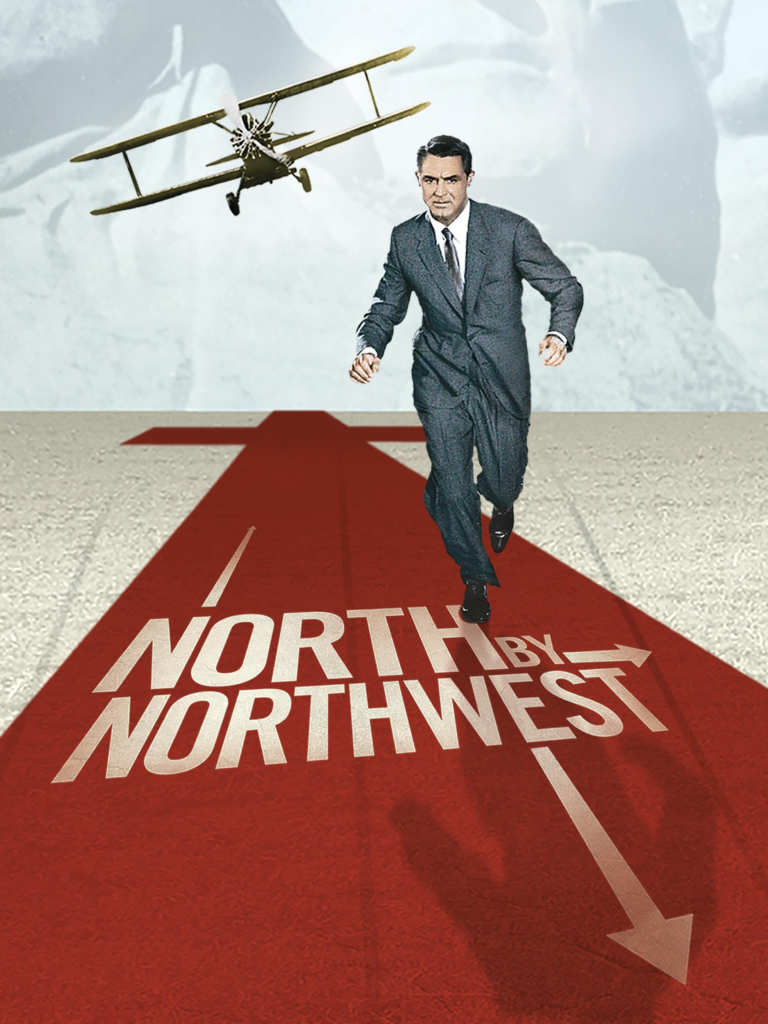
North by Northwest (1959) – Reception
You know when you just gel with a director and you already know that you appreciate every film of theirs without having seen them all? That’s how I feel about Hitchcock. I’m a big fan of Hitchcock’s – not an expert by any stretch, but a fan. That’s mostly where Review Roulette started. I was never a Film Person™ before I switched into film for my PhD, so I wanted to expand my film knowledge by watching a film I’d never seen before and thinking about it critically in context of the era I study. My first review here was of Hitchcock’s Rope (1948) because I’d already seen a couple of his films and just knew there was room to fall madly in love. And I did. I appreciate his cinema and that it gives me that wonderful fulfilling feeling of watching something that broke ground, that did things differently enough to change the paradigm forever. Like watching Steph Curry essentialize threes or Elvis gyrate on Sullivan or listening to anything John Williams has ever done.
Generally, I have waited until October to review a Hitchcock like last year’s of Vertigo (1958), but 2025 is god awful and Hitchcock makes me happy, so we’re doing another now. This week, my husband and I watched North by Northwest (1959) after the Review Roulette wheel landed on Reception as our approach, and, man, I really just love this whole way of watching with a lens. There’s so much to be said for watching a film with no preconceived research questions or analysis filters; I’m fully on board with just watching a film and analyzing what comes to you (we’re seeing Superman this afternoon and I can’t wait to just enjoy that film). But, going into a film looking for specific things, as I do for these reviews, introduces such a different and interesting viewing experience on top of the enjoyment of watching, say, a new-to-me Hitchcock for the first time. So, we were thinking about how North by Northwest would have been received at the time, but instead what the film delivered was how it has been received since. Instead of recapping that it broke box office records, had mostly positive reviews at the time, and is considered one of the top 25-100 greatest films of all time depending who you ask, I want to talk about the influences it has had on other media.
North by Northwest is, as the excellent contemporary trailer calls it, a “deadly game of TAG and Cary Grant is ‘it’.” While Cary Grant is always “it” for some of us, he is here the center of a case of mistaken identity and is forced out of his life as an advertising executive and into that of a man-on-the-lam trying to clear his name of a growing list of crimes.
Now, obviously nothing is new. Threes existed before Curry, pelvises moved before Elvis’s, Ennio Morricone beautifully scored desert landscapes well before Tatooine was even conceived. Even Hitchcock drew influence from the real world and other films, especially genre tropes of noirs and spy thrillers. But it’s the way these greats use their tools not to reinvent the wheel but to innovate the hell out of it. So, I’m not saying everything Hitchcock did in the film was original and brand new, but I am saying that just like Jaws (1975) invented the Summer Blockbuster, North by Northwest invented the modern action film and so much more.
Some influences from the film that are well known are more obvious, such as Sean Connery’s second James Bond film From Russia with Love (1963) which takes direct inspiration from North by Northwest by recreating the iconic crop duster scene only replacing it with a helicopter. But I think the crop duster can be traced further through the lineage of action films. In North by Northwest, the red crop duster biplane is such a brilliant vehicle (although highly impractical for the purpose) to use in that scene to show the resources of the villain. It’s a formidable, over the top, kind of ridiculous mechanism for murder, and I think that’s the heart of so many action film villains who prize creativity and originality over results, which, honestly, I can’t really knock them for. I love a bit of panache. And you know who else does? That charismatic psycho Tom Cruise.
Which brings us to the Missions: Impossible. In the eighth M:I, the final vehicle that Ethan Hunt (Cruise) has to conquer and survive in the entire series is a biplane (first a red one like the one in North by Northwest, and then a yellow). I have to think that this was a purposeful decision to pay homage to the Hitchcock classic that really revolutionized the genre.
What was likely not an homage but rather a bit of a cheeky copy/paste situation was Mission: Impossible II (2000) recreating an entire scene and concept from North by Northwest. When Dougray Scott and his right hand man are in his Frank Lloyd Wright inspired modernist house that’s barely a hideaway in a gorgeous location and the right hand says “we can’t trust Thandie Newton, she’s double crossing you” and Dougray Scott assaults him and says “yea no shit, only unique henchman. I’m smarter than you. I obviously know that and am dealing with it”? That’s Hitchcock’s twist on a twist begetting a further twist and rescue by our dashing hero.
Speaking of the Mary Sue of advertising, Cary Grant’s character seems to have inspired a couple roles of our modern Grant equivalent: Jon Hamm. Hamm’s Don Draper in Mad Men (2007 – 2015) is surely based on the alternate reality of Grant’s Roger Thornhill in which he doesn’t get kidnapped but still leans into the machismo confidence of his character at the end of North by Northwest. His suave manner and shrewd perspective on manipulating perceptions make him both the perfect ad exec and/or aggressive investigator, which leads to Hamm’s other role, Fletch.
Fletch did not originate with Hamm but rather in Gregory McDonald’s series of novels Fletch that were first adapted to the big screen in 1985 with Chevy Chase in the titular role. Fletch as a character is an investigative reporter who is a master of disguises and sarcasm. He’s quick-witted and prone to humor and willing to make an ass of himself if a situation calls for it, much like Grant’s Roger in one particular scene in which he must think quickly to create reason for a witty escape. I think the characters have a lot in common and I might have to review Chase’s Fletch one day to think more about it.
I think the real shining brilliance of North by Northwest is its legacy and influence as a thing to be emulated. Grant is excellent in the starring role and Eva Marie Saint takes your breath away when she absolutely shatters that Hays Code, just rolls it in the dirt, and somehow still comes out like her last-namesake. There are so many interesting layers to the film, too, like the questions of self identification vs. public perception – something Grant might have had a deeply personal connection with – and the role of advertising and media as a potentially fatal power in society that still resonate today (possibly maybe too much). Its influence is staggering and I’m sure if I watched it again, I would think of even more examples of media made in its legacy. That’s the significance of sheer greatness and dedication to your craft. The Curries and Presleys and Williamses and Hitchcocks that fundamentally change the game by playing it so well that their legacies will reverberate for ages in every direction, north by northwest be damned.
Leave a Reply