
An Auteur Approach to The Producers (1967)
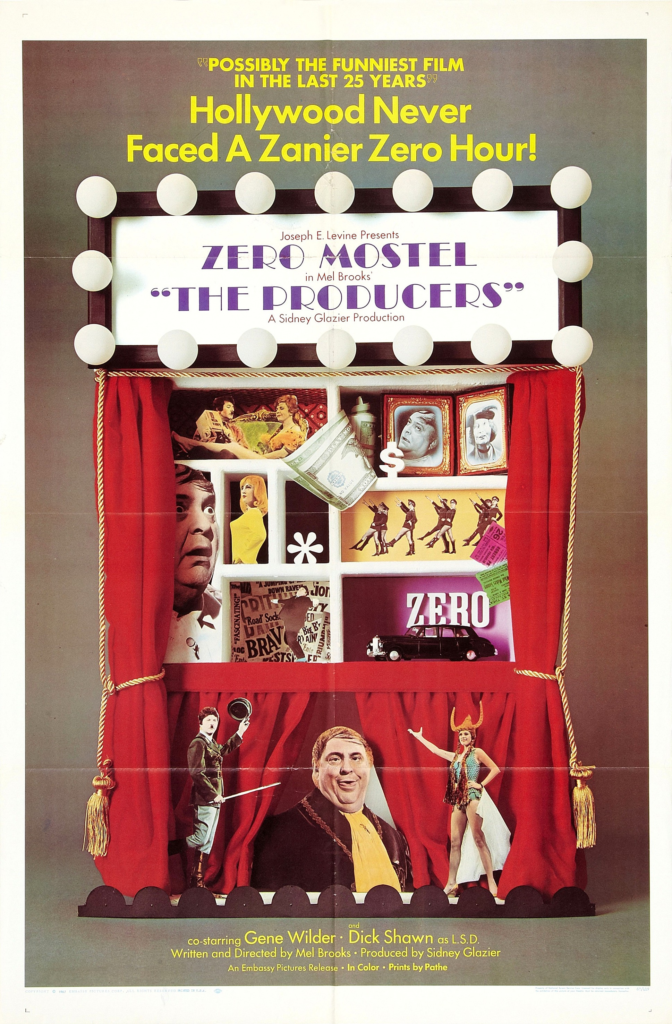
The Producers (1967) – Auteur
Happy Spring, lovelies!
What better way to celebrate the solstice than with a little rendition of “Springtime for Hitler”? Every year it gets stuck in my head right about now, and this year even more so because our dumb ass dear leader has dragged us into a springtime war and there’s nothing he hates more than ridicule. So, this week, we’re doing The Producers (1967).
Right before I spun the wheel, I was thinking I wanted to write about Gene Wilder. This is Wilder’s first lead role in a film after his screen debut earlier in 1967 as a hostage in Bonnie & Clyde. There are very few actors who have absolutely perfect first performances as a lead, and Wilder’s is top 5 for me easily. Prior to The Producers, Wilder was a theater actor, mostly off-Broadway until the early 60s when he was cast as Billy Bibbit in the Broadway production of One Flew Over the Cuckoo’s Nest opposite Kirk Douglas and when he led opposite Anne Bancroft in Mother Courage and Her Children (Berthold Brecht) in ‘63. Bancroft was dating the one and only Mel Brooks at the time, and despite his recent work being dramas, Brooks recognized the unmatched potential in Wilder that would lead to a number of collaborations between the two.
But I spun the wheel. And the Review Roulette wheel landed on Auteur. And if I can’t write about the genius of Wilder, I can write about the genius of Brooks.
And that led me to an idea. Mel Brooks turns 100 years old in June, so from now through June, one review a month will be a Mel Brooks film in honor of the first filmmaker who didn’t just make me laugh but made me appreciate the art of comedy as well, and that all started with watching The Producers way too young.
Prior to filmmaking, Brooks was already a known comedic genius (among comedy-heads at least). He and Carl Reiner thrived as writing and performing partners, having met in the writer’s room of Sid Caesar’s variety show Your Show of Shows (1950-1954) with other comedians Neil Simon, Woody Allen, and Larry Gelbart. Much of that crew also worked on Caesar’s Hour (1954-1957). Brooks and Reiner released their comedy album The 2000 Year Old Man based on a bit between friends that took off in comedy circles and later on television. In 1965, Brooks created the show Get Smart about a bumbling James Bond-type.
And all the time, he was dreaming of a novel turned play turned play within a film turned musical within a film, a musical called Springtime for Hitler: A Gay Romp with Adolf and Eva at Berchtesgaden. When Brooks met Wilder in 1963, he knew that Wilder had to be his Leo Bloom and made him promise to check with Brooks before making any long-term contractual commitments until he could get the film off the ground.
If you don’t know The Producers and you’ve read this far past “Springtime for Hitler,” kudos for sticking it out, and I encourage you to watch the film. Unfortunately for Mel Brooks, a lot of real life producers and studios could not read past “Springtime for Hitler” and felt the film was too controversial to make, distribute, or exhibit. The film had many obstacles, but Brooks being Brooks refused to succumb to them.
There’s something truly special about Mel Brooks, and his brand of comedy is best summed up in The Producers. It’s a film about two men who want to produce a flop of a show in order to embezzle the funds and believe that a show called “Springtime for Hitler” is the most offensive, fastest way to do this. Ultimately, the show is not a flop as it becomes a savage satire of the dictator. The way Brooks taps into that satire echoes Charlie Chaplin’s The Great Dictator (1940); the way the film offers meta-commentary on the entertainment industry parallels the experience he had producing it; the way he cast the film deepens that commentary and satire. He’s a brilliant, brilliant comedian, truly one of our finest.
The casting is significant beyond his ability to see Wilder’s potential as Leo. Brooks cast Zero Mostel as the formerly famous Max Bialystock who seduces wealthy old women in exchange for funding, manipulates Leo into joining his embezzlement scheme, and tries to put together a play he believes is praising Hitler. Not only are both Wilder and Mostel Jewish, Mostel was blacklisted from Hollywood not once but twice.
In the early 1940s, Mostel’s contract with MGM was terminated for a number of reasons, among them his protesting of the MGM film Tennessee Johnson (1942) for its downplaying of Andrew Johnson’s racism. During his brief time in the military, he was found to be a Communist. It was seven years until his next film in 1950 with none other than Elia fucking Kazan who claims he “rescued” Mostel from the blacklist. In 1951, Mostel’s new contract with Twentieth Century Fox was also abruptly cancelled and soon after, he was identified to the House Committee on Un-American Activities (HUAC) as a Communist and subpoenaed for testimony. His HUAC testimony is powerful, principled, and an example of pure resistance in the face of suppression.
So Mel Brooks said “this is the guy who has to produce Springtime for Hitler,” and he was 100% correct. People were blacklisted out of fear and ignorance, the idea that art was one thing (either it’s Communist or it’s not), that people are simple and audiences are undiscerning. Mostel as Bialystock produces the play believing these things, that people will be offended by the surface level thought of something offending their sensibilities and that audiences will be incapable of reading a further level in the musical (satire).
In interviews about The Producers, Brooks has said that his goal was to ridicule dictators. In a 2001 interview, Brooks said,
I was never crazy about Hitler … If you stand on a soapbox and trade rhetoric with a dictator you never win … That’s what they do so well: they seduce people. But if you ridicule them, bring them down with laughter, they can’t win. You show how crazy they are.
In a direct way, The Producers ridicules Hitler, Nazis, and neo-Nazis. In an indirect way, the film ridicules all dictators, tyrants, and acts of tyranny, which, when taken in context of Mostel’s past, includes Hollywood and its blacklist, the very industry unwilling to produce The Producers.
Brooks’s comedy is smart and silly, thoughtful and natural, principled and shocking. He walks an elegant, careful line of societal critique while producing sequences that stick with you, lines you can’t forget, and lyrics that come around every spring with a fresh new resolve for resisting ridiculous fools who think violence and control are power but can be done in with one refrain of “Springtime for Hitler.”
I’m excited to do a series on Brooks. As I’ve said before when I wrote about The Naked Gun franchise, writing about comedy is hard, but that challenge is so worth it because comedy is the most powerful artform for social commentary, especially when wielded by a legend like Brooks.
Leave a Reply