
A Formalist Approach to An Affair to Remember (1957)
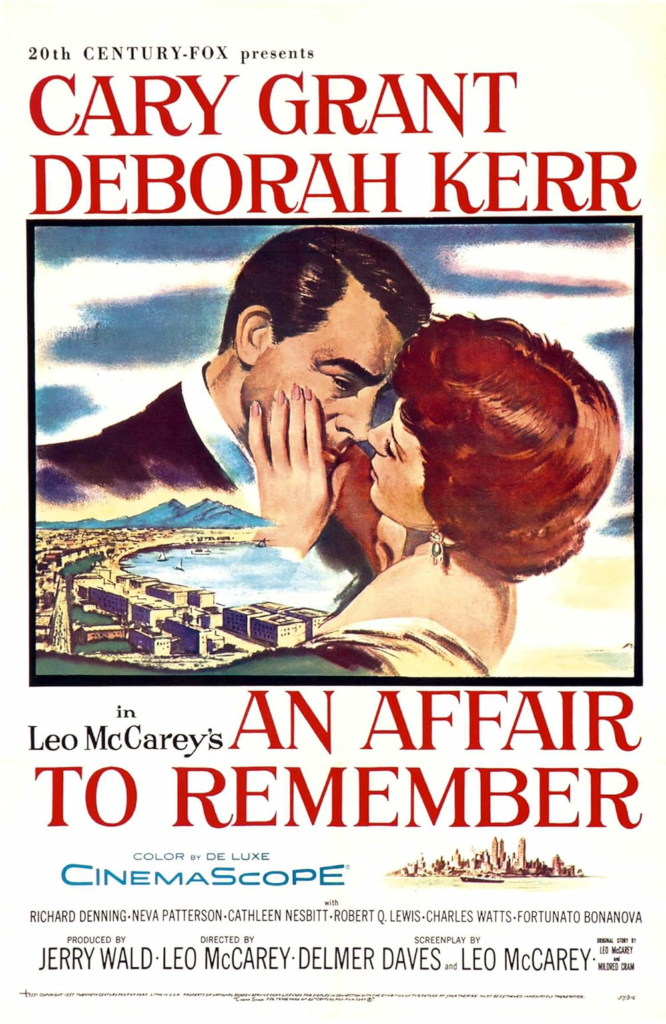
An Affair to Remember (1957) – Formalist
Happy New Year, darlings!
This review counts as the last in December because mind your business. Pretend it’s New Year’s Eve still and 2026 still holds promise instead of whatever the fuck happened this morning. So pop some pink champagne and get lost in a hearty rendition of Auld Lang Syne cause we’re dropping that ball again (which I missed because I was looking at Biscuits. I specifically turned on Dick Clark’s 30-Word Title celebration, got all excited for the 60-second countdown, realized my phone hit midnight like 30-seconds faster than Dick Clark’s ball could move, looked at Biscuits and was like “happy New Year, Biscuits, we love you” and then looked up and they were all cheering and playing New York, New York, and I was like “oh.”)
So, anyway, this one is informal too because I’m not ready for all that yet. Happy end of December! We’re closing 2025 with a film that I was fully invested in for like 85% and then I was like Ruh Roh and felt very conflicted about at the end, but that’s the 50s for you, babyyyyyy. We’re doing An Affair to Remember (1957).
The Review Roulette wheel landed on Formalist for our approach, and there are a couple things I’ll say about the movie as a whole, but there’s one scene we need to talk about in detail.
An Affair to Remember is a deeply fascinating rom-com about a man (Cary Grant) and a woman (Deborah Kerr) who are so fucking charming their lives implode when they meet. It’s like dividing by zero but with love. Niccolo (Grant) is a world-renowned playboy for some reason. Normally when there’s a world-renowned playboy he’s super rich, a world-renowned millionaire playboy, but it’s important to know that Niccolo is seemingly an individually poor hottie who bounces between ultra-wealthy women, but the film isn’t really all that admonishing or praising of this – very interestingly, it’s just the state of things that we accept and move on. Terry (Kerr) is similar in class, a poor woman with a wealthy partner, but different in bounciness – her relationship has lasted five faithful years (which we will get to, don’t worry). The two meet while traveling solo from Europe to the US where they will each meet their partners, Terry’s long-term boyfriend and Niccolo’s millionaire fiancé.
Because Cary Grant and Deborah Kerr are incapable of being anything but irresistibly alluring, they fall in love on the voyage, which includes a day’s stopover in France. While ashore, Niccolo brings Terry to meet his grandmother, a delightful little woman who approves of Terry as a good woman who can help Niccolo be his best self – specifically, a painter. This section with the grandmother is significant and really makes this film stand out in the vast genre of rom-coms because you really can understand how strong feelings might have manifested over the week or so they’re on the voyage. So often in rom-coms the main couple “fall in love” over the course of a few days and you’re supposed to suppress the reality of the situation like it’s gauche to point out that Romeo & Juliet isn’t an aspirational romance; it’s a warning about the overconfidence of youth. But – and maybe it’s because of the DEFCON 1 levels of charisma in this film – you can’t help but buy that these two have a real connection.
And that’s only enhanced by the fact that they BOTH act on it. This is so rare in rom-coms. When they get off the boat on New Year’s Day, they both immediately break up with their partners and seek employment. They willingly go back into economically depressed situations, leaving their cushy apartments and furs and finery in order to try to prove to the other that they can support one another in a marriage. They agree to give it 6 months of trying to get their shit together on their own, and if they make it work, they’ll meet at the Empire State Building on July 1st.
That’s so rare! In so many rom-coms the people we’re supposed to be rooting for are dragging along partners who are often perfectly fine people and we’re like “yea, screw that person, end that shit” which we would never do in real life. Like a film similar to this one, Serendipity (2001) makes me feel some type of way because their partners are actually delightful people but we know that the main two are just holding out hope for the stranger they think is their real love for YEARS. I would be so god damn heartbroken, man. But Niccolo and Terry, credit where it’s due, immediately end their relationships when they find love.
The last bit of the film is a bit dicey and very ableist, and I won’t spoil it, but it also made me feel some type of way.
So, formalist. This film is very well-shot. There’s an excellent use of color, especially at the grandmother’s cliffside villa that’s bathed in warmth and flowers as opposed to the muted colors of the cruise ship and the general greyness of New York. The blocking of the film is really exceptional also, especially on the ship. In one scene, when the two finally kiss, we don’t see it. They’re walking down stairs together into the frame. Cary Grant’s face just becomes visible as he walks in front of Kerr, who stops him short and pulls him back up to her. All we can see is mid-torso and down, but these two make you feel it. I am a huge proponent for showing intimacy on screen, but the discretion of this scene is nothing short of cinematic. Just stunning use of space, emotion, and the audience’s imagination.
Reflections are also used exquisitely in this film. In one shot as Terry is breaking up with her man, Ken (Richard Denning), she steps out onto the balcony for air and delivers a devastating blow to Ken’s heart (Ken, pleading with her not to leave their 5-year relationship: “I’m in love.” Terry: “So am I.” GIRL.). As she reacts to that heart wrenching admission, she leans against the balcony door which lightly opens, gradually revealing a perfectly-framed Empire State Building. I live for this shit. (There’s also a second perfect reflection at the end of the film but that’s in the spoiler zone.)
Visually, it’s stunning. Pacing is great. Choices were superb. One choice in particular though, 10 out of 10. You can’t possibly get better than one scene on the ship that has fuck all reason to be there (okay, there’s one big reason, but this film makes it its own in such excellent fashion).
So, Terry is on her way to the cocktail lounge when she hears a child calling for help. A 6-ish-year-old child is stuck in a railing entirely of his own accord. Terry tries to disentangle his limbs as Niccolo is passing by, and she asks for his help. The two are trying to stay away from one another for the sake of their relationships and reputations, but the child brings them together, as almost every rom-com needs a reminder that the two leads are not only inevitable lovers but also potential parents. Fine, we got the kid in there. But this kid is fucking funny? Like he called for help and then is like “the fuck you bothering me for?” Terry tries to console him while imparting some wisdom not to do it again by saying that she had a similar incident as a child in which she broke her leg. This kid is like “oh is it hurting you now?” and she says “well, no” and he’s like “then what you crabbin’ about, lady?” And come on. That’s brilliant.
In a genre that has this common requirement of invoking children to show what kind of parents the love interests would be, and in which the child is often wise beyond their years or somewhat angelic, it’s kind of brilliant to have a kid who’s as funny, witty, and charming as the two of them. They’re both like “get a load of this kid” who is acting exactly like both of them, almost flipping the convention not to show what kind of parents they are but rather what kind of kid they’d raise. Brilliant touch. He never comes up again in the film. He’s like a little harbinger of loving doom. I love that kid.
This film is filled with excellent decisions by the filmmakers. Again, the ending conflict is not sensitive by today’s standards, so just remember if you watch it that it wasn’t made for today’s standards. I would really recommend it to anyone who loves rom-coms as an honest OG in the genre. It’s invoked in so many other films including Serendipity and Sleepless in Seattle (1993), and it’s just fun, much like The Shop Around the Corner (1940). Regardless of which you watch and from which genre, I highly recommend throwing on a comfort film and watching it as a weekly or biweekly habit in this new year! We’re gonna need that guilt-free escapism.
Because I’m Never Done When I Say I Am
Genre
[SPOILERS]
Despite the title of this section, I haven’t done one of these in a while, but I have more I want to say, specifically about Ken. My boy Ken. Ride or die Ken. It’s important to know that more than in any other rom-com I have seen, the partners who are screwed over are still head-over-heels for the leads but in the most respectful ways possible. They are simply incapable of being in love with Cary Grant and Deborah Kerr, and mate, cast the first stone, amiright? But Ken, oh my sweet Ken. He needs someone to tell him he is Kenough. He needs Ryan Gosling to go back in time and welcome him to the Mojo Dojo Casa House because Ken, sweet special Ken, needs to love and respect himself as much as he loves and respects Terry. Here’s the spoiler: Terry is hit by a car as she arrives at the Empire State Building to meet Niccolo, and she is paralyzed from the waist down (we assume). And Ken seemingly puts his life on hold to help take care of her on her terms, begging her to let him tell Niccolo what happened so they can build their relationship together. Oh, Ken, my good-time boy, you’re too kind for this world. By the end of the film, I was a little like “oh actually fuck Terry a little bit?” because yowch. It’s a mamma mia spicy meatball situation towards the end there.
Also, the class stuff is fantastic.
Leave a Reply