
A Contextual History Approach to Clue (1985)
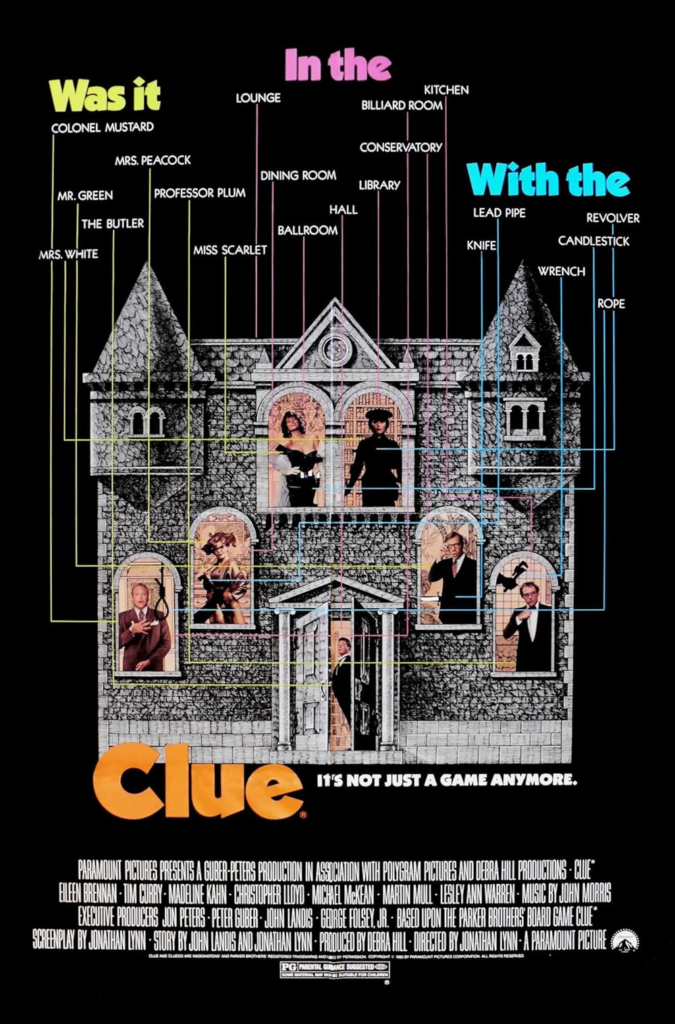
Clue (1985) – Contextual History
Why did no one tell me Clue (1985) is about McCarthyism? I saw an ad for Clue returning to cinemas for the 40th anniversary and thought “oh, isn’t that a cute date idea” and I got tickets and my husband I went to the Alamo Drafthouse at the Seaport in Boston and I was like “oh, so fun, wow I love movies” and because it’s the Alamo there was a whole dog film about dognapping and the music video for Dog Police and I was like, “okay, kinda weird but on brand,” and then BAM, it was Senator Joseph McCarthy in the kitchen with the TV.
So, this week we’re doing Clue and contextual history because how very dare no one tell me?
Clue is a murder mystery film set in 1954 New England and based on the boardgame Cluedo or Clue depending on where and when you played it. The cast is phenomenal with Tim Curry as the butler Wadsworth, Christopher Lloyd as Professor Plum, Michael McKean as Mr. Green, Martin Mull as Colonel Mustard, Lesley Ann Warren (NOT Susan Sarandon) as Miss Scarlet, Madeline Khan as Mrs. White, and Eileen Brennan as Mrs. Peacock. Rockstar cast, just perfect casting. Huge respect for the casting. Anyway, there’s a lot of murder.
I don’t want to spoil any of the goodness for the people like me who didn’t know it’s a perfect film, so we’ll stick to things that are revealed in the first half hour or so of the film, that being occupations of our perfect cast. As in any good mystery, thanks to Agatha Christie, our stars are invited to a remote mansion for dinner with the promise of a comeuppance for the person blackmailing them. Juicy. Love it. I would also go to a spooky mansion in New England for hot goss and justice.
Once there, it is revealed that the blackmailer is on the premises which inevitably results in murder, and hilarity does, in fact, ensue. (Side bar: The first murder is of a man appropriately named Mr. Boddy, which is really just such a brilliant touch.)
During dinner, however, we begin to learn that several of our stars, or, as they soon become, suspects, live in Washington DC, and, man, I hit that Leo Dio meme so fast pointing at the screen like “OH I KNOW THIS. THEY’RE DOING A RED HUNT” and I got so damn excited. Then we learn that they all have connections to DC. Then we learn Plum works for the UN and Mustard for the Pentagon and WHITE’S DEAD HUSBAND WAS A NUCLEAR SCIENTIST. GIRL, THIS MOVIE WAS MADE FOR ME. MR. GREEN IS A GAY MAN WORKING FOR THE STATE DEPARTMENT, DO YOU KNOW HOW EXCELLENT THAT IS TO INCLUDE IN A 1985, STILL VERY MUCH COLD WAR FILM DURING THE AIDS CRISIS?
Side bar: Let’s talk about that one first. Mr. Green’s sexuality is definitely played for a laugh with Plum uncomfortable sitting next to him and the whole group being most put off by him over alleged murderers and philanderers. That’s not great representation, I am aware. But it’s immensely interesting that in 1985 the film puts a spotlight on how fucked up it was for the House Committee on Un-American Activities (HUAC) to be investigating homosexuals solely for that fact of their identity. Mr. Green proudly states that he is being blackmailed because he is gay, and the only reason he isn’t out is because he would lose his job, which injects a very stark reality into the grandiose silliness of the film.
The balance between that stark reality and grandiose silliness is really thoughtful throughout the whole film. It’s almost absurd to think that this story was originally conceived as an adaptation of the board game and not the other way around. For someone to think “Clue murder mystery in 1985? Obviously a perfect allegory for 1954 HUAC, right?” is absurd to me, but that lightning struck and it struck hard.
The whole McCarthy era is defined by the idea of “guilty by suspicion”, the un-American counterpart to the very American “innocent until proven guilty”. And what is Clue if not a board game in which your expectations color your suspicions and you accuse someone of a crime based on confirmation bias alone? (Unless you’re a Sherlockian child, be honest with yourself about how that game really went when we were kids).
It’s a stroke of brilliance to make this film historical fiction and to set up a whole elaborate ruse of a mousetrap mansion with twists and turns and the pressure to name names whether true or not, all in the shadows of McCarthy, J. Edgar Hoover, and HUAC. And then, AND THEN, to emphasize the violent absurdity of HUAC with the most perfect line in all of cinema: “Communism was just a red herring.” Guys. I barked. I guffawed. I made a sound for which Miss Scarlet would charge.
“Communism was just a red herring” is the tagline of McCarthyism, of the Cold War, and of our moment right the fuck now. It is ALWAYS just a red herring and a distraction from the real killer and crime-propagator that the film names and shames: rampant, unchecked, Conservative-led capitalism. This one-two-punch that communism is a red herring and capitalism is the root of most evils in a Cold War, REAGAN-ERA FILM? Please.
This is how you do IP films. Just like Barbie (2023) used the IP to tell an interesting, original story, Clue made STATEMENTS in such an inspired adaptation of a game to screen. They didn’t do it because they thought Clue was a cash cow of a property; they did it because they wanted to tell an interesting story in a playful, approachable, funny way. It wasn’t Rampage (2018) or Battleship (2012) feeding people absolute slop and hoping nostalgia equaled profit like it so often does.
Clue is smarter than that and purposeful in adapting a game in a way that I’ve only really seen in Dungeons & Dragons: Honor Among Thieves (2023) and The LEGO Movie (2014). It plays with the border of the 4th wall and showcases a self-awareness that the thing behind the story and framing it is a whimsical cultural touchstone largely enjoyed by young people. In Clue, this manifests in the most interesting and boldest cinematic marketing I think I’ve ever seen in that the film has three different endings and audiences would have had to go to three different showings to see them all, hunting through newspaper reviews to find which theaters showed which ones. At the time, that “gimmick” is credited as to why it flopped at the box office, but it’s also why it has become a cult classic because ARE YOU KIDDING ME? The board game is different each time you play it, within reason, so why shouldn’t the film be, within reason? Multiple endings is so smart and also hammers home the criticism of HUAC throughout the film by saying there is no one truth pointed to by the supposed evidence, anyone can be accused with the same set up.
What a perfect film. 10/10. The critics wholly disagreed with me, but any film willing to be that playful while making multiple cultural and political points is a god damn winner to me. You should go watch Clue, especially if it’s at an Alamo so you can see the dog film about dognapping.
Leave a Reply