
A Contemporary History Approach to Waiting for Guffman (1996)
Waiting for Guffman (1996) – Contemporary History
Happy February, lovelies! You made it through another god awful January, and I am so proud of you.
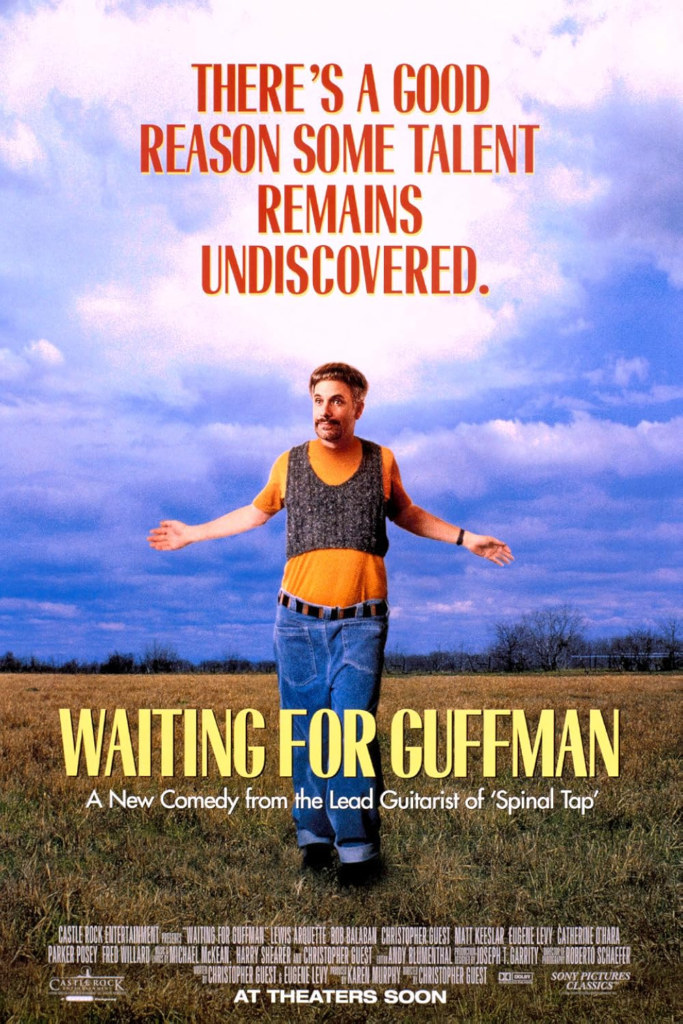
Among all of the horrendous, heartwrenching news from January was the sudden passing of Catherine O’Hara, which, man, come on. Really? So, in memory of Catherine O’Hara, this week I watched Christopher Guest’s Waiting for Guffman (1996), a mockumentary about a Missouri town’s 150th anniversary as captured through community theater. And as always, she was brilliant.
The Review Roulette wheel landed on Contemporary History as our approach this week, so I want to talk about how fucking lucky we are to have lived at a time when Catherine O’Hara, Christopher Guest, Eugene Levy, Fred Willard, Parker Posey, Michael McKean, and Harry Shearer (among others) were generous enough to share their comedic brilliance with us.
At a time when it’s so easy to be filled with anger and fear and hopelessness and more anger and even rage, it’s important to practice gratitude for anything and everything that brings us joy. These comedy legends bring me joy. I laughed so much at Waiting for Guffman that I gave myself a headache, and it was so wonderful to have those 90-minutes of escapist joy.
So, we’re taking the “contemporary” part to be inclusive of the latter 20th century and early 21st. I often find comedies the most difficult to write about critically, similarly to how actors often say comedy is the hardest genre to perform. I quoted Edmund Gwenn in my review of The Naked Gun (1988), who allegedly said on his deathbed “dying is easy. Comedy is hard,” and I think there’s a great deal of truth to that idea that can be extended to negative emotions. It’s very easy to fall into despair or wallow in hopelessness and helplessness or curl up cozy with your depression. It’s so tempting to give into those emotions and let them wash over you, and doing something productively human, such as creating joy in others, is so much harder than simply giving in to the comforting embrace of misery. I know, I feel it every day.
And yet, Guest and O’Hara and Levy and Willard and Posey and McKean and Shearer made all these brilliant comedies that just give you joy and a happy ending while gently inviting you to later reflect on the themes more. Take This is Spinal Tap (1984) which I reviewed a couple years ago. It’s riotously funny, has a heartwarming finish with a little musing on the value of friendship, and it also poses the philosophical questions of what is truth and what is fiction if only one dares to ask. Waiting for Guffman is riotously funny, has a heartwarming finish on the value of wanting more from your life, and it also confronts the philosophical questions of existentialism. You don’t have to engage with those philosophical questions directly, but they do linger in reflecting back on the film.
The title is a reference to Samuel Beckett’s play Waiting for Godot, and we get loose reference to it throughout the film. This town is celebrating its 150th anniversary with a musical rendition of its history (that totally pays off – the film wouldn’t work if it didn’t) as portrayed by members of the community, most of whom we are told have never left Blaine, Missouri. We see them all in their own stagnant stages like Vladimir and Estragon as they wait for Godot, but Guffman dares to confront the existential.
Whereas Godot can be read to be an absurdist existentialist play, in that the characters stand in stagnation, lightly amusing themselves while they wait for meaning to come into their lives, Guffman takes a more positive approach to existentialism. Instead of wallowing in the comforts of homeostasis, the mere idea of Guffman (a broadway scout) coming to their performance inspires our cast to make meaning in their own lives.
Levy’s character, the town’s dentist, has never acted before, but loves to make people laugh. He tells us early on, “I-i love to make people laugh. And I’ve been doing it since, you know, school. People ask me, ‘were you, uh, were — you must have been the class clown.’ And I say, uh, ‘no, I wasn’t.’ But I sat beside the class clown. And I studied him…and saw how he made people laugh. And– and so I picked some things up. And, you know, at parties and family functions, I have to say, I love, you know, breaking people up.” (I can’t find a clip, but if you’re familiar with Levy, you can hear his delivery, and it’s perfect.)
He watched and he studied others when they made people laugh. I think that most likely improvised line is quite important to Levy’s character. He finally decides to audition for the anniversary musical and joins the consistent players in the community theater, developing and growing throughout the film. Ultimately, all of our cast and the musical’s director, Corky St. Clair (Guest), leave Missouri in pursuit of more.
Again, you don’t have to engage with any of the existentialism to find this film wonderful, but that thoughtful nuanced philosophical take delivered through a mostly improv script is just exceptional filmmaking. And we are lucky enough to be around while they do it.
O’Hara in particular is a favorite of mine, as is Levy, so when the pair reunited for the show Schitt’s Creek (2015-2020), I was over the moon. I think that show is even better than the brilliant movies these comedians collaborated on from the 80s to 2010s, but I also think it’s fully in line with them. The show balances the comedic genius of O’Hara and Levy (among others) with a wholesomeness and earnestness that make you feel good by the end. Years later I still think about how beautiful some of the presentations of humanity were on that show while also laughing every time I even think of folding cheese.
And I think that comes down to the core philosophy of Waiting for Guffman that says you could stay in your own isolated, comfortable world, or you could push its boundaries and share yourself with the world, bringing joy to others and, by extension, yourself, making meaning where before there was only existing. And that’s what these comedians did for decades and some still do.
It’s a deeply funny film made by deeply funny people, and if dry understated mockumentary comedy is your thing, you’ll love it. If it’s not your thing, go watch something that is and give a little thanks to the actors, writers, and filmmakers who made it just so you could experience a little joy when you need it.


Leave a Reply