
A Queer Approach to Bell, Book, and Candle (1958)
Bell, Book, and Candle (1958) – Queer
Merry Christmas, boos! That’s right, ya spooky bitches, it’s time for tinsel and holly and thawing Michael Bublé. So, this week I watched a film that’s both Christmas and Halloween that even has the line “Somehow it seemed more like Halloween than Christmas.” I know it’s Election Day and I could’ve done an election movie or an optimistic movie or a movie about the Civil War, but I clearly jinxed shit last time, so we’re doing Hallowmas Christween instead.
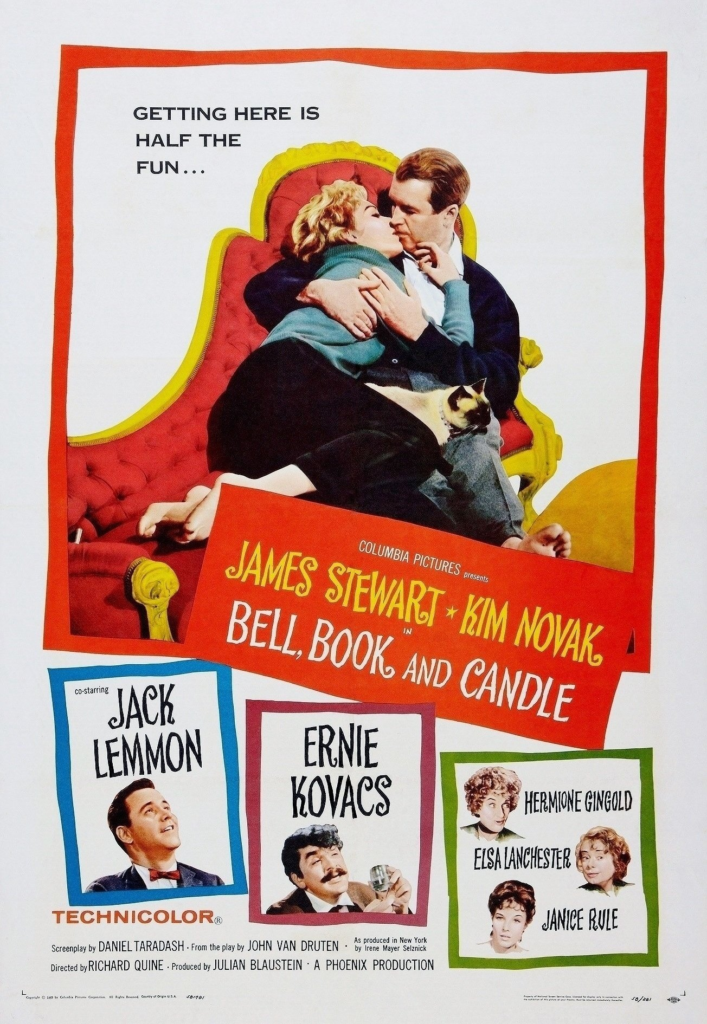
So, on Halloween night, Ben and I watched Bell, Book, and Candle (1958) which is a film largely about a perfect cat named Piwacket doing his little cat BEST when humans force magic on him, and also Jimmy Stewart mackin on Kim Novak the same year that Vertigo (1958) came out (in which they did not get to mack on each other). The Review Roulette wheel landed on Queer as our approach, which, as a reminder, can mean LGTBQ+ identities or can mean non-normative. In this case, we’re doing both.
Kim Novak is Gillian Holroyd, a Manhattan witch who owns and operates a gallery/apartment/shop of artifacts and art from Africa and Oceania in Greenwich Village. Shepherd Henderson (classic name; Stewart) lives in the apartment above Gillian’s gallery-apartment-shop and Gillian’s aunt, Queenie (Elsa Lanchester) who is also a witch and is annoying as hell, lives above Shep. Gillian and Shep have a moment together that prompts Gillian to wonder aloud if she even wants to be a witch. She asks Queenie if she ever thinks about what it would be like to be human with no powers, no excitement, and no bongos.
The bongos are oddly super important to this movie. In the underground witch headquarters nightclub in New York City, the Zodiac Club, witches and warlocks are free to be themselves as they chat, relax, and listen to the Zodiac’s house band featuring their bongos player Nicky Holroyd (Jack Lemmon), Gillian’s brother. Jack Lemmon is a lot in this movie, mostly for the bongos but also for his just general demeanor. But the bongos seem to be central to the whole vibe of the Zodiac and the beat of the bongos is how Shep and his fiancée eventually find their way to the underground hidden club. So, when Gillian says to Queenie, “Don’t you wish that you could spend Christmas Eve in a little church somewhere, listening to carols instead of bongo drums?” she’s really expressing a deep-seated feeling of loneliness, depression, and longing in the silliest way possible.
When Shep and his fiancée, Merle (Janice Rule), arrive at the club and join Gillian and Queenie for a drink, Gillian realizes that she went to college with this woman at Wellesley in Massachusetts, and she remembers that Merle sucked ass in college and reported her to the dean for being different (specifically for walking around barefoot, which, FAIR, but it’s a stand-in for her alternative lifestyle). Despite her iron clad rule that she will never toy with another woman’s man through magical means, Gillian decides to get revenge and charms Shep into being deeply infatuated with her.
And then they bang all night long. Just kidding, the film heavily implies that that’s what they did all night long with Lionel Richie singing outside Gillian’s window, but because it’s 1958, they feel compelled to say that they went out “dancing.” All night long. Until Shep goes and calls off his engagement with Gillian who, after seeing the way Gillian looked at Shep in the Zodiac, moved their wedding up from whenever it was supposed to be to the next day, Christmas morning, when they were originally meant to be announcing their engagement for the first time. Say what you will about Merle, but girl is perceptive. And also too late.
So, that’s the set-up for the film that ultimately plays out to be a rather thoughtful rom-com, complete with some kitschy foreshadowing about how witches lose their powers when they fall in love and how they can’t cry or blush. Very Practical Magic (1998) and The Holiday (2006).
I think an obvious reading of the witches in this film is that they represent the subculture, the Beats, in the late 1950s. Gillian is almost always barefoot in head-to-toe black with close cropped white-blonde hair and a phenomenal cat lurking around. She has an unconventional home in an exotic art gallery. Their club is literally underground and their heart beat is Jack Lemmon on bongos. They’re Beats. Bohemian hedonists obsessed with the human condition and liberation from the norms of society. In essence, this film is very much about the allure of the queering of society, the urge to break out of the confines of normalcy.
BUT, Gillian doesn’t want that, and I find that fascinating. Our heroes are the witches, the Beats, the counter-cultural weirdos who know how to live, and Gillian introduces Shep to a whole underworld he knew nothing about and, once initiated, cannot live without. But Gillian wants out herself. She doesn’t want to be a witch anymore. She wants to fall in love with a nice normal guy who looks and acts like Jimmy Stewart. She even says to Queenie, “it might be pleasant to be humdrum once in a while” when Queenie protests that Gillian wouldn’t like living as an ordinary human. So, we have this interesting duality between the allure of the alternative for a man and the allure of the ordinary for a woman.
But we also have Shep proposing to Gillian after two weeks because he can’t imagine not locking her down which introduces a flipped gender dynamic, though one quickly resolved. Gillian panics at the idea, believing it’s not possible for her to fall in love, and initially protests:
Gillian: Well, I hadn’t thought of marriage.
Shep: Darling, that’s the man’s remark usually. Gil, I-I’ve really got it bad. I’ve let everything slide. I have a pile of unopened manuscripts in my office this high. I can’t stay in my office for wanting to get to you. I’m going crazy. We can’t go on like this.
Gillian: Shep, that’s the woman’s remark usually.
Later in the conversation, she says, “I have always lived for and by the special, not the ordinary,” and she explains that agreeing to marry him would mean “giving up a whole way of thinking, behaving, a whole existence. I don’t know if I could.” The stakes for Gillian are much higher than she can explain at that moment to Shep, but the sentiment really strikes at the heart of the differences between his normative lifestyle and her alternative one, the differences between the normies and the Beats.
Quickly, though, Gillian talks herself into it and agrees to marry Shep. Ultimately, (spoiler I guess but it’s a rom-com) Gillian does fall in love with Shep, loses her powers, cries, blushes, the whole shebang and, tellingly, she changes the focus of her art gallery/shop to be bright florals as opposed to the indigenous art she curated before. So she comes closer to societal norms, even wearing a 1950s housewife-esque dress and they end in a hetero-normative couple with him not changing really in the slightest, but the film still spent most of it celebrating the alternative counter-culture of the witches/Beats.
This abrupt shift kind of feels like a cop-out, but when taken with Nicky’s story, almost feels like a betrayal. Nicky (again, Jack Lemmon) is an odd duckling, but he’s also LGBTQ+ coded. His storyline also has him bringing a human man into their underworld club and lifestyle, but his story is more about acceptance. Nicky cozies up to author Sidney Redlitch (Ernie Kovacs) who is writing a book on Magic in Manhattan. Nicky’s condition seems to be that he gets a financial cut of the book, but there is a real underlying tone of Nicky wanting to convey a specific message about their community and correct some derogatory and incorrect perceptions about witches and warlocks. Lemmon’s performance, while cuckoo bananas and bongo-mad, captures a pretty sweet expression of acceptance for a community largely still targeted by the Lavender Scare of the 1950s. Of course, the film does complicate this view a bit with his sister seeing it as a personal betrayal and with his financial motivations. Still, I think if we peel back some of those filmmaking choices, there’s a beautiful character in Nicky.
Bell, Book, and Candle is an odd but extremely fun film. It’s funny, it’s moving, the cat is phenomenal, should’ve won an Oscar for Best Supporting but the Academy is rigged and they gave it to Burl Ives for The Big Country instead (booooooo). It’s both a spooky Halloween movie with witches and Beats and a classic Christmas rom-com that ends in a heteronormative marriage-to-be. If you’re reading this before polls close on November 3rd, 2026, I promise it would be a fun way to pass the time and distract yourself from the real spooky scaries outside with a heartwarming story of lovers, acceptance, and kitty cats.
Leave a Reply