
A Reception Approach to 9 to 5 (1980)
9 to 5 (1980) – Reception
I have a confession: I don’t know Dolly Parton for her music. I know some songs like “I Will Always Love You,” “Island in the Stream,” and, of course, “Jolene,” but I know Dolly Parton more abstractly. I don’t think I even know many facts about her. I know she loved her privacy and her husband, and she was one of many children in an impoverished home. And I know she fashioned herself after the town trollop because she thought the woman was beautiful, and I know she was so comfortable with herself and knew who she was enough to live her private life and her public one as two halves of one person, an admirable quality in our increasingly public world. And I know she was a deeply good, loving person who funded education, science, and community developments and whose drive in life was to make other peoples’ lives better with food, books, music, laughter, and anything else she had at her disposal. I hadn’t even seen her in a film until this week. But I knew Dolly Parton in the same way I knew Mr. Rogers, by which I mean, I felt loved by them in as intimate a way a stranger you’ve never met or interacted with can, and I felt a connection to them beyond what words or reason can really explain. I felt my life touched just by knowing that these saintly figures (or as close to saints as I, a non-religious person, can imagine) existed at the same time I did, spreading love and using their influence for immense good. So, we’re gonna honor her.
This week, I watched 9 to 5 (1980) and the Review Roulette wheel landed on Reception as our approach. As a reminder, a reception approach asks us to think about how the film was received by audiences and/or critics at the time or at a later date.
I meant to write this review yesterday, but, as luck or irony would have it, I was too busy working. I don’t think I’ve mentioned yet here, but after two years on the job market, I have finally, finally, gotten a job. Two jobs actually – I’m adjuncting at UMass Boston and Massasoit Community College this semester, and I am so unbelievably excited to be back in a classroom after so many years. But, that means I’ve been prepping and reading and writing and prepping and researching and trying to finish other things that I thought I’d have more time for this fall since I had become so famously unemployed that I forgot there was the possibility I might actually be hired somewhere. And, even more funnily, I’m writing this after my first day on campus (for a professional development day – classes start next week!).
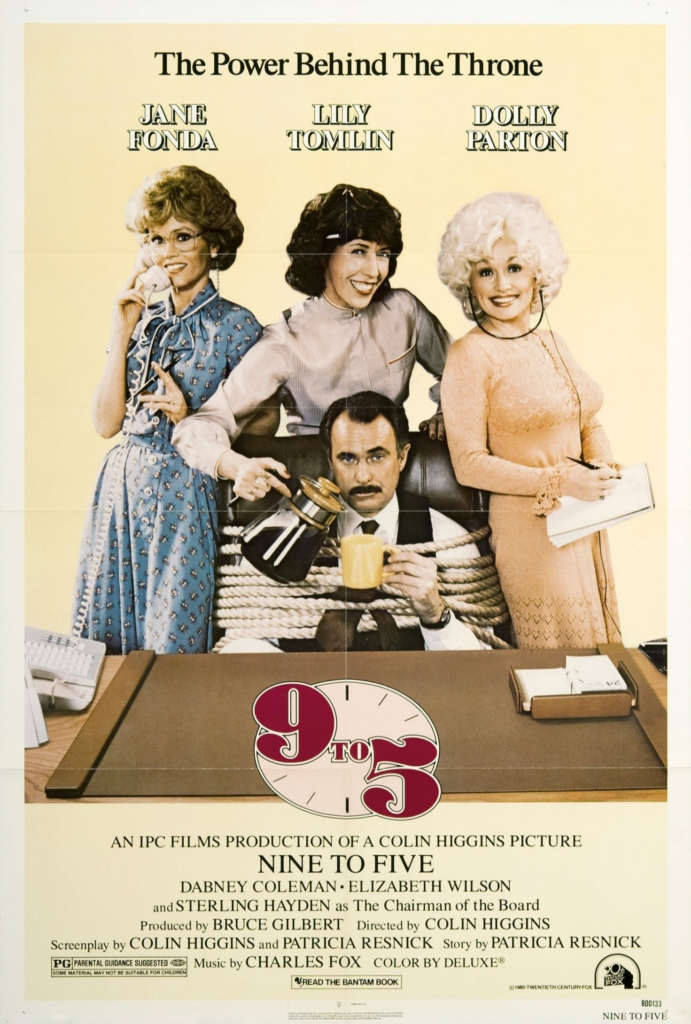
So, 9 to 5, what a delight. What a romp. What a silly little story that goes in wild, unexpected directions. And what a cast. Dolly Parton, Jane Fonda, and Lily Tomlin? If I had known that before, I would’ve watched it years ago. For those unfamiliar, 9 to 5 is about these three powerhouse women who work under a “sexist, egotistical, lying, hypocritical bigot” of a boss, Franklin Hart Jr. (Dabney Coleman), whom they unintentionally kidnap for six weeks while simultaneously faking his signature to implement tangible benefits for the workers in the office. Now, I did not know that was the plot of this film, and I was like waiting for a Norma Rae (1979) unionization scene because that’s what they’re setting up at the start (and maybe purposely as this was released just a year later) but then Lily Tomlin steals a corpse and you’re like “huh, guess that’s not what this one is about.” And then it really spirals.
So, reception. It’s clearly beloved. I knew that years ago (I knew this song, too!). But some critics seem to have been unimpressed with some aspects of the film, including the late, not great former Dirty Dem himself, Ronnie Reags. Reagan and Nancy apparently watched 9 to 5 on Valentine’s Day 1981 and he took issue with one scene in particular. You might think he understood the lessons about exploitation of workers or sexual harassment or how social programs improve morale, productivity, and quality of life or how we should support single mothers or how precarious life could be for divorced/widowed women in 1980 or how people who are exploited and overworked fantasize about harming their bosses and maybe he was rightfully disturbed by that as President and was like “wow, good golly, the Gipper should do something to right all of these problems that are clearly ubiquitous enough to be the cornerstone of a very popular comedy film with three huge leading ladies, I’ll get right on that.” But no, Ronnie was like “these ladies are STONED, stoned on POT, what a moral failing.”
I shit you not, Ronald Reagan wrote in his presidential diary, “Funny—but one scene made me mad. A truly funny scene if the 3 gals had played getting drunk but no they had to get stoned on pot. It was an endorsement of Pot smoking for any young person who sees the picture.” And, I don’t know, I feel like, what the fuck, man? And that reminds me that like Dolly Parton, Reagan was also always performing the role of Ronald Reagan, President, Failed Actor, Former Roosevelt Democrat. I don’t believe that was an honest assessment of the film he watched, but I do believe he felt he had to say that because of the War on Drugs he was soon to escalate, and I find that both sad and bad. Also, “stoned on pot”? Grow up, Ronald Reagan. Grow up.
One other review from the time stands out to me as an exemplary one. Roger Ebert gave the film 3 of 4 stars and wrote that it was “pleasant entertainment, and I liked it, despite its uneven qualities and a plot that’s almost too preposterous for the material.” I’m a big fan of just straight up enjoying films. As a film critic/analyst/historian, I frequently have conversations in which people want me to be really theoretical about films or really cynical and nit-picky about form, and they often assume I only watch “cinema”, whatever that actually means to them. But if you’re familiar with Review Roulette, you know that’s not my bag, and I really respect a film critic who knows when to say “this film was fun, and that’s all I asked of it.” I wrote a review like that for Spa Weekend (2026) last week. I wrote, “Was it The Godfather Part II? No. Was it The Manchurian Candidate? Absolutely not. Was it a fun time with funny people doing their thing and exactly what you’d expect it to be? 100%.” Because sometimes you just want a fun movie.
And fun movies do comment on serious things. 9 to 5 is all of those things Ronald Reagan summed up as “Funny” without any further interrogation of his literally brand new role with the power to influence change for some of the societal failings the film captured. Fun movies are, arguably, even more influential than serious cinema because more people are going to see fun movies and come away with the idea that social programs change lives and work doesn’t have to be soul-crushing. I made the same argument about Coyote vs. Acme (2026) – it’s important that Hollywood knows we like these types of fun films with strong social messages.
Anyway, 9 to 5 is just so delightful, and Dolly Parton is simply exceptional in it. All the ladies are, and Dabney Coleman is a real mensch for playing such an absurd role and also being game for the fantasy scenes in which each woman has a different way to torture and/or murder him. I don’t want the remake of 9 to 5 that’s reportedly in the works, but I would like to see more films with the playfulness, fun, and social heart that Dolly brought to all of her projects and that Lily Tomlin and Jane Fonda still do. How lucky we are to have them all.
Leave a Reply