
A Feminist Approach to Practical Magic (1998)
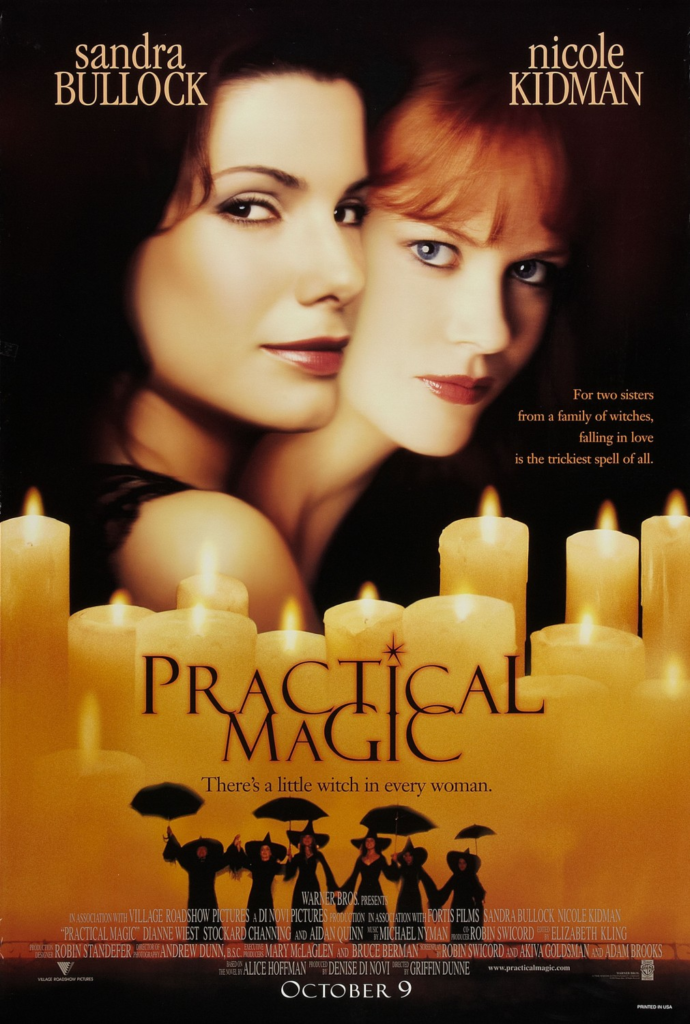
Practical Magic (1998) – Feminist
The season of the witch is almost upon us, but for me it’s been ramping up steadily for the past few weeks as I prepare to teach a class on witches and witch-hunts this fall. So, in anticipation of Spooky Season: Witch Edition and next month’s release of this film’s sequel, this week I watched Practical Magic (1998).
The Review Roulette wheel landed on Feminist as our approach, and I obviously groaned because, come on. That’s too on the nose for Practical Magic, but I think there are some things to say that aren’t just recounting the plot and pointing like Leonardo DiCaprio.
So, Practical Magic is a film about two sisters Sally and Gilly (Sandra Bullock and Nicole Kidman) who grow up with their aunts Frances and Jet (Stockard Channing and Dianne Wiest). All of the women in their family are witches, and all of the men who fall in love with the women in the family are cursed to die prematurely. The film is based on a novel of the same name by Alice Hoffman that I’m sure follows through with more of the themes of magic instead of vaguely waving a hand around and being like “you know, it’s magic or whatever” like the movie does, but that doesn’t make the film any less entertaining. Unless, of course, your whole thing is trying to trace the logic and conventions of an established supernatural element, then it’s bad, it’ll be bad for you.
Anyway, the sisters follow different paths in life. As a kid, Sally was terrified of falling in love and cast a true love spell that her true love would be a man with extremely unlikely attributes like one blue eye, one green eye, and the ability to flip a pancake. As an adult, Sally stays on the small fictional Massachusetts island with her aunts who cast their own love spell on her to make her fall in love with the produce delivery guy in town, Michael (Mark Feuerstein). (One might take exception with the fact that Sally has lived on the island her entire life and the entire town shuns her family because it’s public knowledge that they’re witches, and we can presume that Michael has also lived on the island for at least a while but before the aunts cast their spell, he’s already down bad for Sally despite the town’s immense hatred for her. But only if you’re a logistics person.) Sally and Michael have two daughters and a beautiful happy life before he is taken by the family curse.
Gilly, on the other hand, ran away to elope with a guy as a teen, then spent a decade traveling around the country and partying. Ultimately, she manages to call Sally for help while she’s in a dangerous situation with her abusive boyfriend Jimmy (Goran Visnjic) who believes he’s like a cowboy Dracula kind of immortal being or something. So Sally accidentally kills him right in the nick of time to save Gilly, and the two hatch an absolutely vacant idea to bring him back to life. After dabbling with some necromancy a sec, they decide to kill him a second time when he obviously attacks Gilly with demon strength now, and they bury him like they should have the first time. So he haunts them and they girlboss a way out of it while a handsome investigator (Aidan Quinn) goes way, way, way too far out of his jurisdiction to question Sally about Jimmy and flip pancakes for her daughters.
There are lots of feminist elements here that we can celebrate. The girls going in their own directions in life, the ride or die solidarity between the sisters to kill an abusive boyfriend and cover it up twice, the young sisterly bond growing between Sally’s daughters, etc. I want to focus on two things that, again, are obvious here, but worth talking about. The first is that this film might have two of the best casting choices in cinema history.
Stockard Channing and Dianne Wiest are everyone’s witchy aunts. Their wardrobes, Stockard’s cunty little parasol that’s smaller than her sun hat, Dianne’s sweet-but-deadly smirk/smile, their whole vibe is just perfect. And I think that’s just correct. As Ben said while watching, “this movie is 50% plot and 50% vibes,” and that’s almost entirely due to Stockard and Dianne hamming it up as what I can only assume is themselves. Didn’t even need a script, just showed up in Victorian-chic sipping sherry out of a bat-shaped flask. I loved Sabrina The Teenage Witch, and aunts Zelda and Hilda (Beth Broderick and Caroline Rhea) were perfectly cast sitcom aunt witches who take in their niece, like I believed this is good casting, they play this well, but Stockard and Dianne don’t feel like they were cast, they just are, you feel me?
They let the girls have chocolate cake for breakfast. Tell me Stockard Channing doesn’t let her own niece do that when she stays over. And they have Midnight Margarita parties just for the hell of it. Tell me Stockard Channing and Dianne Wiest were not just on set making margaritas when the director whispered “keep filming” to the DP. Tell me the first people you want to see after coming out of a harrowing dangerous situation aren’t Stockard Channing and Dianne Wiest with their chocolate cake breakfast. I won’t believe you. You’re simply lying.
And I think they’re cast so well because they’re such solid representation for single older women. They rock. They’re ostracized from their small town, but they still strut around like they own it because the other townspeople suck so bad. Until they don’t, which is the second thing.
There’s an excellent call back in this film to an earlier community ostracization moment that turns into a community building one, and suffice to say, it’s such a well-constructed call back that it made me audibly go “AW.” Women from around the town, who throughout the film have been throwing allegations and accusations at the witch family and bullying them with the all-time banger refrain “witch, witch, you’re a bitch” (clever), still show up when Sally tells them that Gilly’s ex-boyfriend must be exorcized from the house. It’s a really moving way to end this film with feminist solidarity against abusive men regardless of the circumstances between the women themselves. Through this experience, all the witches become more accepted in the town and are brought more fully into the community, and all the town (at least the women) get to embrace a bit of the magic that Aunt Frances says is in us all to some extent.
And I think that those two things together, Channing/Wiest and the solidarity moment are really key to the ideological twist this film prompts: what if, instead of following our ancestors’ lead in hunting, prosecuting, and/or ostracizing women we deem as “witches,” we embraced them instead? What if the “witches” were actually the women who, like Channing and Wiest, are just unapologetically themselves, and what if they are actually the key to solidarity among women? In so much of cultural history, witches are portrayed as a threat to their society, but what if their society needs threatening? This film says what if the real threat all along was strong women who could inspire other women to be strong while holding cunty little parasols? Maybe the practical magic that’s in all of us is just caring about the other people in your community.
It’s a super fun little movie with a banger witchy-girl soundtrack featuring the witchy-girl Queen herself Stevie Nicks not once but twice. I do think that a sequel will kind of render the whole romance aspect of this first one moot, like I don’t understand the logical follow through for what has been said about the sequel, but again, 50% plot, 50% vibes. Doesn’t really matter because Stockard Channing and Dianne Wiest are coming back for it with their chocolate cake and Midnight Margaritas and that’s all I really care about. That’s the vision of older womanhood that will keep me going well into my 80s, and that’s why Practical Magic is such a fun time while having no real allegiance to logic at all.
Leave a Reply