
A Contemporary History Approach to High Noon (1952)
High Noon (1952) – Contemporary History
Dear my lovely, loyal Review Roulette readers,
Thank you for the well-wishes you expressed last week for my vague request for good vibes to my family. It has been a difficult few weeks for us after the recent loss of my father-in-law, and so this week I want to dedicate a review of his favorite film to him. Of course, as a brilliant thinker, writer, and scholar himself, his favorite film just happens to be the multi-layered, complicated, and contentious High Noon (1952), just brimming with deeply American contradictions and philosophical intrigue that were too nuanced for John Wayne to handle. In my father-in-law’s honor, but not necessarily from his perspective, here is my review of Fred Zinnemann’s High Noon.
As for our lens, the Review Roulette wheel genuinely landed on Contemporary History this week; I swear I didn’t put a finger on it like Rick’s spinner in Casablanca (1942). I honestly would have rather had an easier approach to this complicated film, but we must abide by the wheel and so, let’s get into the absolute insanity that is the contemporary history of High Noon. To keep this a little orderly, I’m going to split the context for this review into sections based on people whose influences or perspectives were significant in the creation of or controversy around the film.
Firstly, however, we should set the scene. It’s 1952 Hollywood. Seven years after the end of WWII; five years after the House Committee on Un-American Activities (HUAC) comes into Hollywood to root out Communists in the industry and the industry responds with the blacklist; four years after the Paramount Decrees rock the financial stability of Hollywood when the Supreme Court forced studios to sell their cinemas. HUAC is conducting its second round of investigations in Hollywood, and the blacklist was nearing its height of influence by 1952 after lists of individuals’ names were published in places such as Red Channels the year before. The hunt for Communist sympathizers in the motion picture industry was actively ruining careers forever, sending people to prison for contempt of Congress, influencing the content of films produced, and operating with the force of fear and threat should anyone produce a subjective art piece that could be construed to support an ill-defined, vague suggestion of Communist ideology.
Fred Zinnemann – Director: Zinnemann was a Jewish man born in Austria-Hungary who began his studies in law but soon switched to film, moving from Vienna to Paris, then to Berlin and eventually Hollywood for work. After WWII, Zinnemann learned that his parents had been murdered in the Holocaust, driving Zinnemann to lean into anti-fascist messaging in his work, including the critically acclaimed The Search (1948) and The Men (1950).
Carl Foreman – Writer: Foreman was a Jewish screenwriter from Chicago who joined the Communist Party in 1938 during the Popular Front wave of membership (which only peaked at 66,000 members by 1939 amounting to approximately 0.07% of the adult US population). Foreman left the Party in 1942 (along with approximately 20,000 who withdrew their membership by 1943), but the red stain stayed with him into the post-war period when HUAC was operating in Hollywood. Almost a decade after Foreman ended his ties with the Communist Party and while his script for High Noon was in production, Foreman was summoned before HUAC in 1951, marked an “uncooperative witness” for not naming names of other Communists, and blacklisted, forced to move to England to continue working.
Stanley Kramer – Producer: Kramer was a Jewish film producer and director from New York City who is lauded still as a visionary filmmaker. Kramer worked as an independent primarily and focused on message movies that drew attention to significant social issues such as racism in Guess Who’s Coming to Dinner (1967) and fascism in Judgement at Nuremburg (1961). Kramer and Foreman were production partners up until Foreman’s HUAC testimony and subsequent blacklisting when Kramer broke their agreement, likely due to fear of guilt by association.
Gary Cooper – Star: Cooper was an actor from Montana who was raised with American Western traditions and British education, as his parents were recent immigrants from Britain. Cooper played quintessentially American roles including as a brooding cowboy hero in many Westerns and a populist folk hero in several Frank Capra films of the 1930s. As an icon of one particular type of Americana, Cooper was also a devout conservative who campaigned against Franklin D. Roosevelt in multiple elections and, in 1944, helped form the Motion Picture Alliance for the Preservation of American Ideals (MPAPAI, or sometimes MPA), the conservative intra-industry watchdog group that invited HUAC to Hollywood in the first place. Despite his background with the MPAPAI and HUAC, Cooper was the only person in the production of High Noon to defend Foreman when he was blacklisted.
John Wayne – Asshole: Wayne was an actor from Iowa and one of the biggest assholes in Hollywood history. Wayne was another conservative who helped form the MPAPAI and served as its president from 1949 to 1954, arguably the peak of the blacklisting era, though Wayne denied having been president during the blacklist in an infamous interview with Playboy in 1971. In this interview, Wayne recounts how proud he was to have helped run Foreman out of the country, taking credit for the act and saying it is something he would “never regret”. Despite his close friendship and political allegiance with Cooper, Wayne described High Noon as “the most un-American thing I’ve ever seen in my whole life” (even though when he accepted Cooper’s Best Actor Oscar on his behalf, Wayne said he was off to “find out why I didn’t get High Noon instead of Cooper”).
So, what is this “most un-American thing” John Wayne had ever seen in his whole life all about? A great many things, but primarily questions about the role of a community.
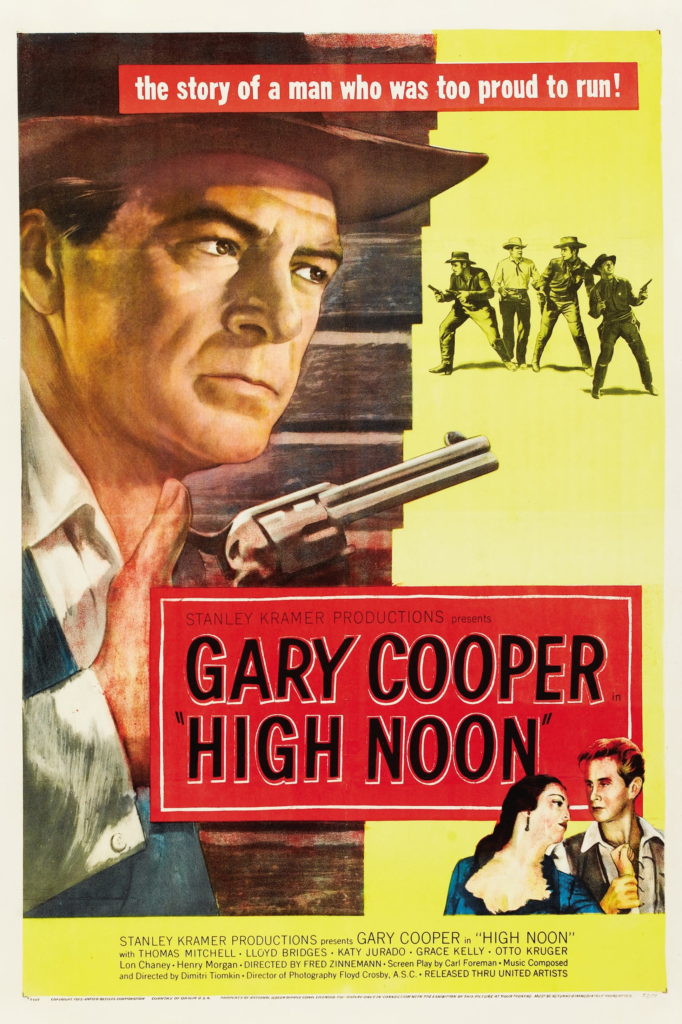
High Noon is an 85-minute film that plays roughly in real time starting at 10:40am and building in suspense to high noon. Throughout that first 80 or so minutes, newly married Will Kane (Cooper) faces a crisis of conscience as a train due in at noon carries a recently released murderer Kane had put away as marshal of the Western town of Hadleyville. Kane feels that it is right to stay in Hadleyville and face Miller and his gunslinger gang, confident that with a few specially appointed deputies, they will be able to subdue the gang and save the town from their violence. However, as the 80 minutes pass, Kane is repeatedly disappointed by the cowardice of the townspeople who largely refuse to stand with him or back out when they realize they alone volunteered.
The townspeople’s responses vary and culminate in a discussion had when Kane goes to the church to seek help. Among the viewpoints voiced are that the citizens pay taxes for a marshal and deputies, so it should be their problem to fix without asking more of the citizenry and that the town should be ashamed for not volunteering to help after Kane’s tenure as marshal has cleaned up the town and made it safe for women and children – though, it should be noted that those voicing this shame also do not volunteer to stand with him. Ultimately, the mayor of the town (another Capra alum, Thomas Mitchell) who has been presiding over the debate in the church requests that, since Miller’s problem is with Kane personally, Kane leave town and allow the new marshal to handle the issue when he arrives the following day. Of course, the mayor is misrepresenting the issue as personal when the matter is purely professional.
Additionally, Kane’s new wife, Amy (Grace Kelly) is a Quaker who wants Kane to give up his badge and run from the gang with her, fearing for his life as she had previously lost both her father and brother to gun violence and vowed to never be part of it again. Kane’s ex-romantic partner is a Mexican businesswoman named Helen Ramirez (Katy Jurado) who chides Amy for not wanting to stand with her man and tells her that if Kane was still hers, she would grab a gun and defend him herself.
So, what do we do with this film? This rapid film that has so many layers of Americana and speaks to different communities, religions, and histories all present in the American story? I think the contemporary influences are quite obvious when we think about the people working on it. Zinnemann saw the story as a broad warning against fascistic threats, with the looming arrival of Miller an imminent and inevitable darkness that demands of the citizens that they not be complacent. Foreman saw High Noon as a direct allegory for HUAC in Hollywood and the wider air of McCarthyism throughout the country. Ironically, or perhaps simply as inevitably as Zinnemann saw it, Foreman was himself living the nightmare of Will Kane during the production of the film.
And as we know, John Wayne saw it as “the most un-American thing” he had ever seen in his whole damn life. And I think that’s horseshit, to quote another part of his interview.
The Western is itself a vehicle for American mythology and self-aggrandizing with stories of exceptional individuals with exceptional honor and bravery. One of the foundational stories of this genre is The Virginian, a 1902 novel by Owen Wister that was adapted to film several times, including in 1929 starring the one and only Gary Cooper in a similar role to Will Kane of High Noon. It is absolutely true that High Noon challenges the conventions of the genre with story structure and cinematography, but that does not make it un-American.
Rather, I think the use of the Western to tell the extremely American story of the current contemporary events of the American government in the American motion picture industry is a brilliant touch to emphasize how true to our collective story that betrayal of American citizens’ trust really is. Subverting the American mythological genre to reflect an American reality exposes the contradictions inherent in our country and its history. Being American is not only the best of our story; if we are going to look at our history truthfully, we have to be able to reckon with the fact that the US government’s House Committee on Un-American Activities asked questions that violated the US Constitution, and that the individuals who refused to answer those questions and were subsequently held in contempt of the US Congress were exercising their legal rights, and that both of those things are American. We have to own both of them.
If we extrapolate from the specific examples the filmmakers may have been considering when making High Noon, I think one macro-contention is that between individualism and the community, something I have thought about a lot and written about in the postwar period in my dissertation. The increasing individualization of the postwar period as a result of the mounting fear mongering of McCarthyism, suburbs, and other influences of terror in the atomic age diminished the potential for communal support and a strong social contract. This turn inwards prized the individual’s comfort over the survival needs of the community, ultimately doing a disservice to every individual making up the abstract collective.
Watching this film now in 2025 only seems to heighten all of these contradictions and complications of our history. Self-proclaimed white supremacist and Western icon John Wayne said it’s un-American to show a US marshal who has no support from his own town because he made it too safe, clean, and habitable for strong women to thrive. Zinnemann wanted to warn us that it happened in his homeland, and it can happen here if average people won’t stand up to the looming threats of fascism. Foreman and Kramer showed us that that threat was not just looming but already present and actively attacking the very production. When Kane goes to the former marshal in Hadleyville for help and perspective on why people are reluctant to stand with him, the older marshal says, “It’s all happened too sudden. People got to talk themselves into law and order before they do anything about it. Maybe because down deep they don’t care. They just don’t care.”
Watching it today, all of those warnings are amplified and form an emergent call to action to help the Will Kanes who are willing to fight back against the clear and present fascistic threats of our current administration.
We are stronger together, and we cannot allow the inevitable inbound train to divide us, silence us, dissuade us from our principles, or intimidate us into compliance and appeasement. As our American forefather Benjamin Franklin said, “We must all hang together, or, most assuredly, we shall all hang separately.” Thankfully, High Noon offers slightly more optimism for the task at hand, but conveys that gravity of that deeply American sentiment no matter what John Wayne thinks.
Leave a Reply