
A Feminist Approach to Some Like it Hot (1959)
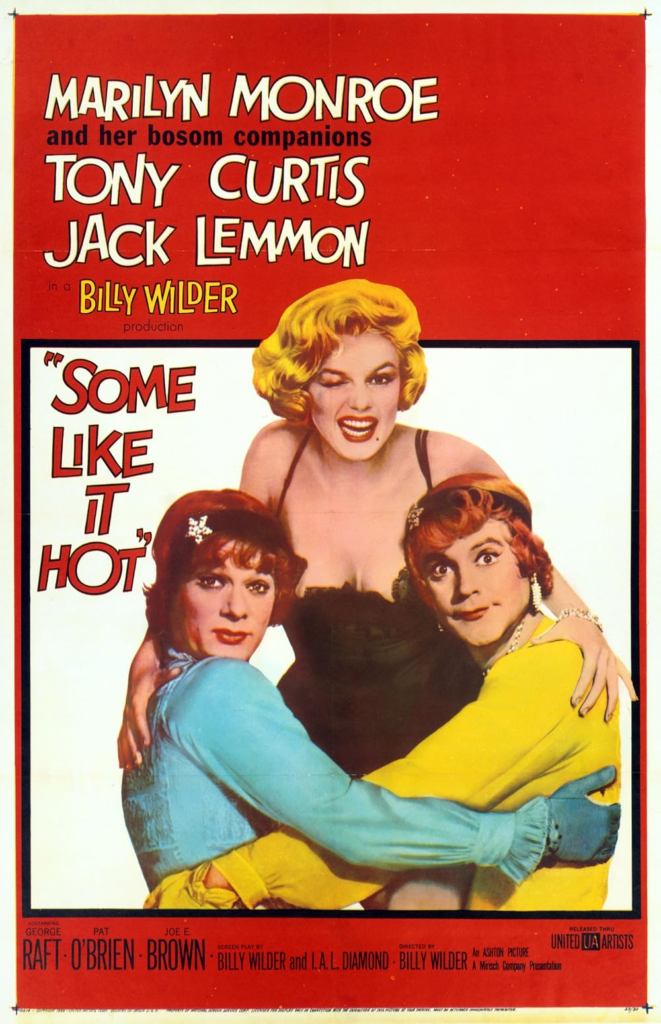
Some Like it Hot (1959) – Feminist
June 1st would have been Marilyn Monroe’s 100th birthday, a seemingly absurd number for someone who is etched in the public memory as the embodiment of youth. To mark the occasion, Ben wrote a week-long series on Monroe – starting with this post on her American origins – on his AmericanStudier blog, and, for Review Roulette, we watched Billy Wilder’s Some Like it Hot (1959).
Side bar: A little inside baseball/admission of guilt, the Review Roulette wheel is an app on my phone, and I usually spin the wheel before I watch a film to guide how I watch the film, but my phone was charging when we watched Some Like it Hot, so I’m writing about something I just wanted to write about from a Feminist approach.
You might be thinking “feminist? For Some Like it Hot? Real original take this is gonna be,” and you’d be right. It’s the obvious frame to view the film through, and I resisted it, but a Bluesky post I saw earlier in the day before watching the film was rattling around in my head. Marisa Kabas, independent journalist and creator of The Handbasket, posted “the vision for positive masculinity is feminism.” And that succinct fact is the moral cornerstone of Some Like it Hot, but, curiously, not the final beat of the main couple in the film.
For those who haven’t seen it, as I hadn’t before Tuesday, Some Like it Hot is a film about two musicians, Joe and Jerry (Tony Curtis and Jack Lemmon) who witness a St. Valentine’s Day massacre by gangsters in Prohibition-era Chicago and flee the city by dressing as women and joining a women-only band headed to Florida. As Josephine and Daphne, Joe and Jerry meet Sugar Kane (Monroe) for whom they both pine. Sugar is a somewhat sad woman who laments her poor taste in men and insatiable sex drive that keeps her coming back, especially to tenor saxes, which Joe/Josephine just happens to be. Once they arrive in Florida, Joe devises a plan to sleep with Sugar, despite her having opened up to him about her problems in life and love. In fact, he uses Sugar’s openness to learn what she is looking for in a man (a glasses-wearing, helpless millionaire) to create a character (Shell Oil Jr.) to seduce her. Like a jackass. Meanwhile, Jerry/Daphne is being pursued by an actual millionaire with a marriage problem, in that he just can’t stop marrying women who are just after his money and hopes to make Daphne his 7th or 8th wife.
So, again, feminist is the obvious approach here, right? It’s a classic gender-bending, “dress in drag and do the hula,” trick the nice lady into coerced intimacy that most definitely is deeply fucked up by today’s standards, buddies on the run comedy. It’s my best friend’s favorite film, White Chicks (2004), but with reversed criminal context and without the added layer of race.
As any gender-bent romantic comedy since the dawn of time, the idea is that men, privileged from the patriarchy, live as women for a brief, comedic time, and learn a little something about what it’s like to be a woman. Some Like it Hot does this very well up to a point, and then does not do it at all, so that’s what I want to talk about with that post from Kabas, “the vision for positive masculinity is feminism,” in mind.
So, this film is a real wild ride for genre expectations. As the comedic relief half of the duo, and as expected, Jerry/Daphne goes from one extreme to the other in terms of gender performance. When the two musicians hop the train and meet the band and Sugar, Jerry/Daphne is, and I cannot stress this enough, a cartoon wolf whose eyes are popping out amidst a traumatic cardiovascular incident in which his heart stretches out from his chest at an alarming distance while steam shoots from his ears and a primal “awoogah” blares from his puckered lips like a train whistle. He’s an absolute dog who likens the women to pastries he just can’t keep his hands off, and himself tries to liquor Sugar up to get her into bed. And the whole time, after every double entendre he makes or slight insinuation that he will assault Sugar once she’s drunk enough, he laughs like Jack Nicholson’s Joker in the most off-putting, Sahara desert-making way possible. The film even endorses this because every time we see Sugar on the train, she is introduced with a muted trumpet to underscore her sexiness, like awoogahs from the brass section.
Then, upon arrival at the hotel in Florida where the band is scheduled to perform, Daphne is immediately targeted by Osgood Fielding III (Joe E. Brown), a millionaire with a yacht and the same Jack Nicholson laugh, this time giggling about assaulting Daphne. Suddenly, Jerry isn’t too fond of absolute dogs. Jerry doesn’t like his ass being pinched and the insinuation that he is, in fact, the aforementioned sexualized pastry. Jerry seemingly immediately learns the lesson that he is a trash person, i.e. a bad man with piss poor masculinity, but then just as quickly forgets it when there is the chance to see Sugar in a bathing suit.
Likewise, when Jerry/Daphne is complaining about how Osgood treated her, Joe/Josephine responds with an air of superiority, saying, “now you know how the other half lives,” as though Joe has been aware the whole time that they are both, in fact, trash people. The awareness doesn’t seem to be the dawning realization that these stories often inspire, but the awareness is still the moral cornerstone of the film. Both Joe and Jerry know that women are hounded by cartoon wolf men all day, every day and only seem perturbed by it when they are the recipient, and that perturbation doesn’t translate to other people, as both men are still eager to hound Sugar.
The worse offender here is definitely Joe/Josephine, though, who encourages Jerry/Daphne to go on a date with Osgood so Joe can use his yacht to coerce Sugar into something she very much does not want to do. The scene on the yacht is deeply disturbing from a modern perspective. As a film historian of this exact period, I get why this was seen as a funny bit at the time, but good god is the manipulation extreme and psychotic. Joe is a real piece of shit, using his intimate conversations with Sugar when dressed as Josephine to manipulate her as Shell Oil Jr., only to come to the realization that he feels bad about it after coercing her into the exact situation she told him she was actively trying to avoid. He tells her in the end that no man is worth this trouble, and somehow that’s enough to forgive a deeply fucked up, borderline sociopathic betrayal of her vulnerability.
So, really, I don’t think either one really learns the lesson that is the bedrock of the film, which is a pretty fascinating way to make one of these films. “The vision for positive masculinity is feminism” is the guiding principle of the film and the trope, having men walk a day in a woman’s shoes. The film even has a joke about how hard it is to walk in women’s shoes to really hit that one over our heads and set us up for the expected character growth of our leading men. But in the end, they’re still pretty shitty trash people who don’t grow intrinsically, just simply gain more awareness of the awful behaviors they inflict on women. When Joe obviously gets Sugar in the end, he objects, throwing himself down as the exact type of man she doesn’t want, implying that he has not changed and will not change despite his apology, and Sugar defends her choice by reminding him that she’s not too bright.
Girl.
It’s a fascinating film that can successfully profess a moral message while failing to live up to it. And perhaps that’s why the final words of Some Like it Hot have become some of the most recognizable in Western film, “I’m a man,” “Well, nobody’s perfect.” It suggests that core philosophy summarized by Kabas, positive masculinity is equality across genders, but also admits that the film doesn’t really expect men to live up to that philosophical treatise. In a major film with major stars from 1959, this is almost a step in the right direction towards feminism by loudly acknowledging the inequality of men and women, particularly in public spaces and when it comes to men hounding every woman within awoogahing distance. But watching it today? Woof.
Because I’m Never Done When I Say I Am
Contextual History
It’s interesting that this film is set in 1929. Some Like it Hot is based on the 1935 French film Fanfare d’amour which is set in the Great Depression, with two men getting work in an all-female orchestra on the French Riviera. Wilder added the Chicago gangster context, and that’s just interesting. My take on that is definitely informed by the above, but I guess I would say that the added gangster elements offer us a third kind of much more extreme, violent, toxic masculinity that makes our leading men look less bad in comparison.
Leave a Reply