
An Actor’s Oeuvre Approach to Charade (1963)
[Contains light spoilers for The Bishop’s Wife, North by Northwest, and Charade]
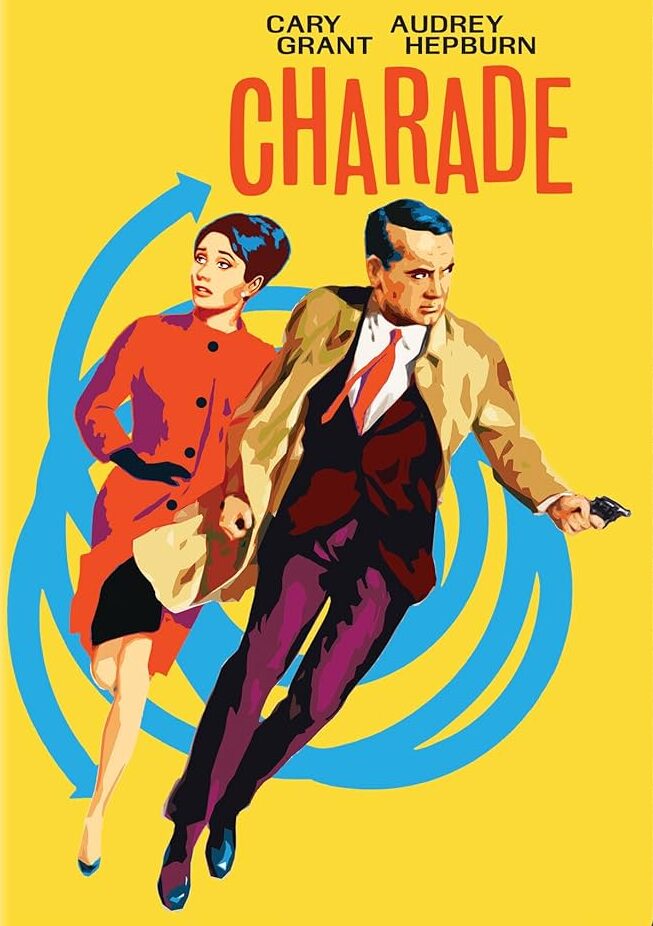
Charade (1963) – Actor’s Oeuvre
It’s been 20 years since last Thursday. Please take care of yourselves, your loved ones, and your neighbors, my darling readers. Practicing kindness has never been more important.
In that vein, I’m going to practice a kindness to myself this week. This week, I showed Ben one of my favorite films, Stanley Donen’s 1963 Charade starring Cary Grant and Audrey Hepburn (as well as a host of other excellent actors). As a favor to myself, I am going to keep this review brief because that’s what I need at the moment, and I hope you will find things, practical things, to do in the coming weeks and months that both serve you and your community in ways that benefit both. I love this newsletter, I hope you love reading it, and I need to keep it short tonight.
So, the Review Roulette wheel landed on Actor’s Oeuvre as our approach, for which I will choose Cary Grant and not write about every single one of his films, just a few.
I just so happened to review a Cary Grant film last week, An Affair to Remember (1957), in which I wrote about the absolutely absurd levels of charisma that happened in that film between Grant and Deborah Kerr. The two of them are so charismatic that there’s no wonder every single person is in unfathomable adoration of them even when they behave in ways that would normally give us the ick. It’s hard to watch a Cary Grant film and think, “he was fine” and not mean it in a way where you’re fanning yourself before you swoon so hard you get whiplash, and An Affair to Remember is one of the best examples of that very Cary Grant specific quality.
In Charade, this becomes a little challenging. For the uninitiated, I will spoil it a little, but I also won’t because you already know. You know before you watch the film. You know that whatever Cary Grant does on screen, you’ll be like, “I’m sure he had a good motive though” because of the Grantian physics of it all. So, the spoiler: he’s not the bad guy. SHOCK. AND. AWE. He’s not like the best guy, but he’s definitely not the bad guy. Even with all the twists and turns and double crosses and triple crosses and double double crosses that become quadruple crosses, you might think for a moment, “is this it? Am I going to have to justify a whole bunch of crimes because Cary Grant did them?” But, no, because it’s Cary Grant.
I don’t know if I’m making myself clear, but this is important. Cary Grant was incapable of being the bad guy, even when he was the bad guy. In one of the wilder Christmas films in my book (shameless, I know), The Bishop’s Wife (1947), Cary Grant plays a literal angel. Yes, makes sense, understood. But that angel is sent to help the titular Bishop reprioritize his situation, remember what truly matters in life. And do you know how Cary Grant angel does that? He seduces the Bishop’s Wife. That’s the film. Cary Grant just shows up and hits on that guy’s wife until he stops doing paperwork and pays attention to his hot wife. And that’s one of our most beloved classic American Christmas films. I’m not knocking it, I’m just illustrating a point.
In North by Northwest (1959), Cary Grant is a kind of unfortunate soul who is being corralled into a difficult wild goose chase to clear his name of false charges – “a deadly game of TAG and Cary Grant is ‘it’.” He’s an advertising executive (very Don Draper, as I write in that linked Reception review of it), but, because he’s Cary Grant, he’s also clever and charming enough to not only survive the chase but also foils the plot, traverses Mount Rushmore, and gets the girl, and never for a moment would you have questioned whether he could because he’s Cary Grant. You might not have been like, “I bet he climbs a president’s face” beforehand, but you’re not surprised he did afterward. It’s just another thing Cary Grant could do. Because of the Grantian physics.
I am aware this isn’t a review of Charade. I deeply love that movie, and I think that if you like mysteries and comedies and comedies that are mysteries, you should definitely watch it. It’s very fun and has the single most mid-century Hollywood marriage proposal I’ve ever heard in my life (after my own, of course). There’s just not much more to say about Cary Grant except that you are always rooting for him even when you’re not because the gravitational pull of that dense a star is inescapable. And opposite Audrey? Man. We never stood a chance.
Leave a Reply